Wildebeest Introduction
Wildebeest (scientific name: *Connochaetes *) are large herbivorous mammals that live on the African savanna, known for their herd migrations and distinctive appearance. As an important part of the African savanna ecosystem, wildebeest are not only typical representatives of herbivores but also important prey for many predators.
Classification and biological characteristics of wildebeest
Classification of wildebeest
Wildebeest belong to the Bovidae family, and their specific classification is as follows:
Kingdom : Animalia
Phylum : Chordata
Class : Mammalia
Order : Artiodactyla
Family : Bovidae
Genus : Connochaetes
Species : Common wildebeest ( Connochaetes taurinus ) and black wildebeest ( Connochaetes gnou )
physical characteristics
Body structure :
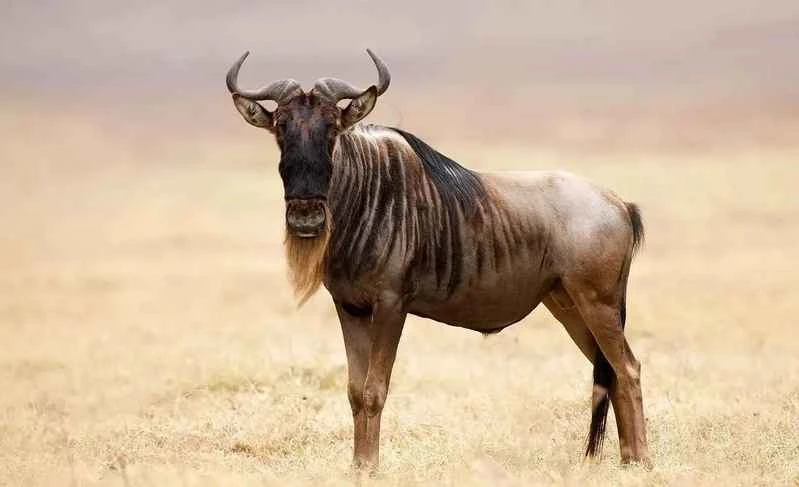
Adult wildebeest are about 2-2.4 meters long, 1.2-1.5 meters tall at the shoulder, and can weigh up to 250 kilograms.
With a strong body and thick forelegs, it is suitable for long-distance running.
fur color and horns :
Common wildebeest have a grayish-brown coat, while black wildebeest have a dark brown coat.
The curved horns serve as both a defensive weapon and a feature for gender identification.
Facial features :
It has distinct black stripes on its face and a wide nose, adapted to the foraging needs of the grasslands.
Behavioral characteristics
Wildebeest are highly social animals that often live in large groups. Their collective behavior not only improves their survival rate but also makes them one of the most spectacular sights on the African savanna.
Wildebeest habitat and distribution
main habitat
Wildebeests primarily inhabit the grasslands and savannas of East and South Africa. They prefer open plains and areas with abundant water sources.
Distribution area
Common wildebeest : Found in Kenya, Tanzania and South Africa.
Wildebeest : mainly distributed in the grasslands and hilly areas of South Africa.
Seasonal migration
Wildebeest are renowned for their massive migrations, especially across the East African plains, where over a million wildebeest cross the Serengeti and Masai Mara regions each year in search of water and pasture. This migration is one of the world's most spectacular natural phenomena.
Dietary habits of wildebeest
herbivores
Wildebeests primarily feed on grass and are typical herbivores. They choose fresh, tender grass as their main food source, but when food is scarce, they will also graze on shrubs or hay.
drinking water demand
Wildebeest are highly dependent on water and need to drink water every day, so their migration routes often revolve around water sources. During the dry season, wildebeest will concentrate in areas with water sources.
Foraging behavior
Wildebeest herds have a clear division of labor when foraging, with some guarding the front lines while others focus on feeding. This cooperative foraging behavior significantly reduces the threat from predators.
Wildebeest predators and survival threats
Main natural enemies
Wildebeest are important prey for many predators on the African savanna, including:
Lions : Lions will attack weak or lone wildebeest.
Cheetah : Cheetahs use their speed to catch young wildebeest.
Hyenas : Hyenas often gang up on wildebeests that are hunting alone.
Crocodiles : Crocodiles are the main threat to wildebeest when they migrate across rivers.
Defense strategy
Group protection : Wildebeest groups typically protect their members through numbers and cooperation.
Speed and endurance : Wildebeests can run at speeds of 60-70 kilometers per hour to quickly escape predators.
The impact of human activities
Habitat destruction : Agricultural development and urbanization have led to a reduction in grassland area.
Illegal hunting : Wildebeest leather and meat are over-hunted in some areas.
The migratory spectacle of wildebeest
The Great Migration of the Serengeti
The Great Migration in the Serengeti of East Africa is the most famous behavior of wildebeest, with more than 1.5 million wildebeest and 200,000 zebras crossing the Serengeti National Park and the Masai Mara National Reserve each year.
Time : Usually from June to March of the following year.
Route : From the Serengeti in Tanzania, they migrate north to the Maasai Mara in Kenya.
Significance : Migration is not only for finding fresh pasture and water, but also an important stage of reproduction.
Ecological impact
Wildebeest migration plays a vital role in the African savanna ecosystem:
Promoting grassland regeneration : The grazing behavior of wildebeests helps the natural restoration of grasslands.
A key element in the food chain : providing abundant prey for predators such as lions, hyenas, and crocodiles.
Wildebeest breeding and life cycle
Reproductive behavior
The wildebeest's annual breeding season typically occurs during the rainy season. Male wildebeest fight for mating rights.
cub growth
Gestation period : The gestation period for female wildebeest is 8 months, and they usually give birth to one calf per litter.
Newborn cubs : Cubs can stand within minutes of birth and begin to walk within hours.
Maternal protection : Mother wildebeest will protect their calves during the most vulnerable months.
life
The average lifespan of a wildebeest is 15-20 years.
The significance of wildebeest in African culture
Cultural symbol
In African culture, wildebeest are often seen as a symbol of resilience and vitality. In the myths of many tribes, wildebeest represent the balance and unity of nature.
Tourism value
The annual wildebeest migration attracts tourists from all over the world, bringing huge economic benefits to the local tourism industry.
The current state of wildebeest conservation
Protection level
According to the International Union for Conservation of Nature (IUCN), the wildebeest is listed as "Least Concern," but habitat loss and illegal hunting remain significant threats to its survival.
Protective measures
Establishing protected areas : Serengeti National Park and Masai Mara National Reserve provide important habitat for wildebeest.
Ecotourism : Raising funds through tourism for wildebeest conservation.
Relationship between wildebeest and other animals
Symbiosis with zebras
Wildebeest and zebras often forage and migrate together. Wildebeest graze on lower grasses, while zebras eat the higher grasses; this symbiotic relationship improves grassland utilization efficiency.
Dynamics of predators
The presence of wildebeest is crucial for maintaining the stability of grassland predator populations, and their numbers directly affect the survival of predators such as lions and hyenas.
Conclusion: The Ecological Value of Wildebeest
Wildebeest are an integral part of the African savanna ecosystem. Their spectacular migrations not only showcase the wonders of nature but also provide important insights for studying ecological balance. By protecting wildebeest and their habitats, we not only maintain the ecological integrity of the African savanna but also preserve a precious natural heritage for future generations.