Researchers including Deng Tao from the Institute of Vertebrate Paleontology and Paleoanthropology, Chinese Academy of Sciences, recently published in the international journal Zootaxa a new species of Evodia rutaecarpa discovered in the Late Miocene strata of the Linxia Basin in Gansu Province. The species dates back 8 million years and has been found to contain the world's first known Evodia rutaecarpa skull fossil.
In 1925, Austrian paleontologist Otto Zdansky established *Eostyloceros* and its two species based on Late Miocene material collected from Wuxiang County, Shanxi Province. Subsequently, several other species of this genus were reported in Asia and Europe. However, the establishment of these species was based entirely on antler material, and most of it was incomplete, with no skull attached to the antlers found, thus raising significant questions about their reliability.
The Linxia Basin in Gansu Province is renowned for its rich fossils of Late Cenozoic mammals. Recently, a muntjac skull with complete antlers was discovered during a field survey in Hezheng County within the basin. This new material discovered in the Linxia Basin is the world's first known fossil of an *Eostyloceros* sp. nov., from which a new species, *Eostyloceros hezhengensis* sp. nov., was established. This species is a large muntjac. The new species exhibits a well-developed longitudinal ridge on the lateral margin of the frontal bone that connects posteriorly to the antler peduncle; the antler peduncle is short, stout, and cylindrical, extending posteriorly from behind the eye socket; the main branch and brow limb of the antler arise from the antler ring at a 30° angle; the main branch is quite long, with a strongly backward-curving tip; the brow limb is straight and located anteromedially to the main branch; the main branch is laterally flattened, while the brow limb has a circular cross-section.
Paleontologists previously knew very little about the phylogenetic relationships of *Euonymus alatus*. Based on cladistic analysis of new materials, a detailed phylogenetic tree has been established for the first time, including various species within *Euonymus alatus* and other muntjac species in the genus. Morphological observation combined with cladistic and principal component analysis indicates that *Euonymus alatus* possesses primitive traits such as a shorter antler peduncle, lower bifurcation on the antler ring, more slender brow twigs, and a relatively small angle between the brow twig and the main branch, proving that this new species occupies a more basal position than any known species in the genus.
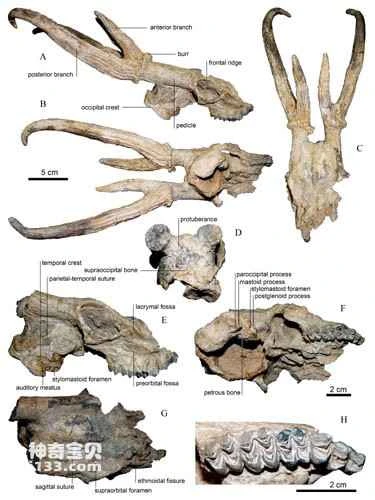
Figure 1. A fossilized skull of *Hezhengo* antler deer collected from the Linxia Basin, Gansu Province.
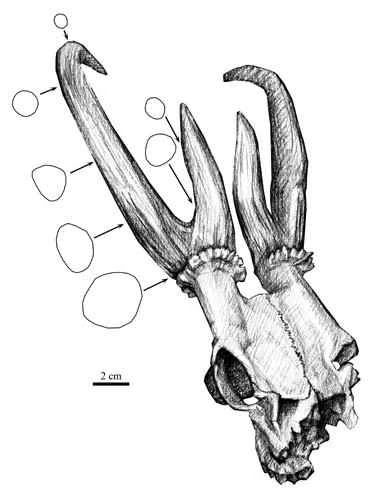
Figure 2. Sketch of the skull fossil of the Zhengshi deer and the cross-sectional changes of its antlers.