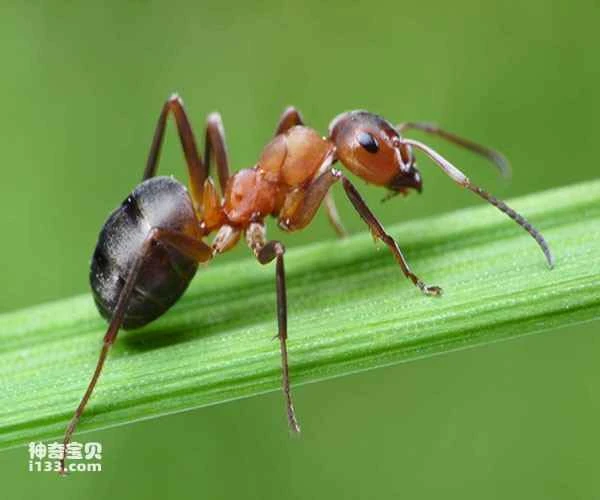
The sheer power of insect muscles often amazes us. For example, the Asian weaver ant can carry objects more than 100 times its own weight in its mouth; fleas can jump to heights more than 100 times their own height; and dung beetles can even push dung balls that are 1140 times their own weight!
Why are these insects so strong? Do they possess special muscles? To find out, scientists observed the fine structure of insect muscles (such as the flight muscles used for flight and the leg muscles used for crawling) and discovered that these muscles, like human skeletal muscles, are striated muscles. Their basic structural units (sarcomeres) and the striations within them are also very similar to those in humans. Without explanation, it's difficult to determine whether an electron microscope image is of human or insect striated muscle.
Are insect muscles merely similar in appearance to human muscles, with different compositions? To answer this question, scientists from Austria and Germany collaborated to examine the genes of these insects and discovered that they contain the same "core components" as human muscles, including myosin II, actin, myosin light chain (including "essential light chain" and "regulatory light chain"), tropomyosin, and calmodulin. This indicates that the core components of insect muscles are no different from those of humans.
The structure and composition of insect striated muscles are the same as those of humans. So, what would happen if we measured the strength of insect muscles (the tensile force generated per unit area) and compared it to the striated muscles of vertebrates? The results show that the striated muscles of vertebrates can generate approximately 25 Newtons (about 2.5 kg) of tensile force per square centimeter of cross-section. Insect muscles have similar strength, or slightly less. For example, when a cockroach flips over, it mainly uses its hind legs to push off; a single hind leg can generate 0.14 Newtons (about 14 grams) of force. The cross-section of a cockroach's hind leg muscle is approximately 0.6 square millimeters, which translates to a force of 2.3 kg per square centimeter.
Since insect muscles and human muscles are not fundamentally different, why does human relative strength seem so small? For example, the world record for the men's 62kg snatch was set by Shi Zhiyong of China in 2002, at 153kg, less than 2.5 times his own body weight. Why can't humans lift objects 100 times their own weight like insects? You can think about this question yourself first, and we'll discuss it at the end of the article. Now let's talk about topics related to muscles. It turns out that the contraction principle used by human and insect muscles existed long before animals appeared. This principle is not only used for muscle contraction but also for various power-requiring processes within cells.
Single-celled eukaryotes already have "muscles".
When we talk about muscles, it seems like we only think of animals. But even single-celled eukaryotes (like yeast and amoebas) already have the two most crucial components of vertebrate skeletal muscle: myosin and actin. Actin can aggregate to form filaments with "positive" and "negative" ends; while myosin uses the energy released from ATP hydrolysis as power to "walk" along the actin filaments towards the positive end. This is one of the "miniature power trains" inside the cell, capable of performing many functions.
Why do single-celled eukaryotes need such a "power train"? This is because eukaryotic cells (typically tens of micrometers in size) are thousands of times larger than prokaryotic cells (typically about 1 micrometer in size), and they also possess various organelles, such as mitochondria, lysosomes, the Golgi apparatus, the endoplasmic reticulum, and secretory vesicles. Small molecules (such as oxygen and glucose molecules) can diffuse to reach their desired locations within the cell, but organelles cannot move efficiently by diffusion alone; they require "carriers" to move them. Furthermore, cell movement (extending from the front and contracting from the back) and cell division (contraction of the middle of the cell and subsequent division into two) also require mechanical force.
Myosin possesses this ability. Myosin consists of three parts: a "head," a "neck," and a "tail," resembling the shape of a golf club. The "head" is enlarged and can bind to actin filaments. It has an ATP binding site. When an ATP molecule binds to the "head," the head deforms and detaches from the actin. The hydrolysis of ATP releases energy, causing the head to "deflect" from the "neck" and bind to a more distant position on the actin filament. The deflected "head," like a bent spring, tries to return to its original position, creating a pulling force on the actin filament. If the actin chain is fixed, the myosin "head" can move along the filament towards the positive end. If the myosin itself is fixed, it can pull the actin filament towards the negative end. This movement process continues indefinitely through the continuous binding and hydrolysis of ATP.
The exact time when this ingenious mechanism emerged is now impossible to determine, because actin and myosin are present in the cells of all eukaryotic organisms on Earth, so it must have developed sometime after the emergence of eukaryotic cells. Moreover, this mechanism for generating tension had already reached a very high level of perfection during the stage of single-celled eukaryotes, so much so that it has changed very little over the subsequent billions of years. Myosin in rabbit muscles can even bind to actin in amoebas; the "tracks" of actin in plants and animals are also very similar, such that the "head" of animal myosin slides at almost the same speed on a plant track as it does on an animal track.
This mechanism of generating tension is so valuable that, during evolution, organisms have continuously replicated and modified the genes of these two proteins to perform various tasks requiring tension without altering the mechanism and efficiency of tension generation. For example, yeast already has five myosin genes. The proteins they produce have similar "heads" but different "tails," allowing them to perform different functions. Humans, on the other hand, have more than 40 myosin genes.
Both type I and type V myosin have tails that can bind to biological membranes, allowing them to "carry" membrane-bound organelles (such as mitochondria, endoplasmic reticulum, Golgi apparatus, and secretory vesicles) along actin "tracks," thus playing a transport role. Type I myosin functions as a monomer, while type V myosin functions as a dimer.
In animal muscles, type II myosin first forms diploids, with the "tails" of two myosin proteins tightly wrapped together and the two "heads" at the same end of the diploid. Multiple such diploids then aggregate together, with one half facing the opposite direction to the other, forming a "double-headed mace" structure. Actin filaments are neatly "inserted" at their positive ends onto a disc, parallel to each other. Two such structures face each other, like the bristles of two electric toothbrushes facing each other, with a distance between them. The myosin "double-headed mace" inserts into the middle of these actin filaments, with the "head" binding to the filament. After ATP binds to the "head" of the myosin and is hydrolyzed, the "head" pulls the actin filament towards the negative end. Because the two ends of the myosin "double-headed mace" pull the actin filament in opposite directions, both "toothbrush heads" move towards the middle of the "mace" (i.e., the two "toothbrush heads" move closer to each other), and the muscle contracts.
As amoebas move forward, fine actin filaments form in their extended "pseudolegs," parallel to the direction of movement with the positive end facing outwards, forming a "track." The type I myosin "tail" attaches to the cell membrane, and the "head" slides along the actin "track," pulling the cell membrane forward. At the rear of the cell, a "contraction chain" composed of type II myosin and actin (similar to the contractile units in striated muscle) pulls the cell membrane away from the solid surface, allowing the rear of the cell to retract.
During yeast cell division, a "contraction loop" composed of type II myosin and actin forms in the center of the cell. This "contraction loop" tightens continuously, causing the cell to divide in two. Cells lacking type II myosin cannot divide and instead form giant cells containing many nuclei.
Therefore, even in single-celled eukaryotes, "muscle proteins" already play an important role. The muscles of multicellular organisms are simply developed on this basis.
Do plant cells also have "muscle proteins"?
Plants generally don't move and seem to need muscles. However, plant cells also contain actin and myosin, and more than one type. For example, types VIII, XI, and XIII myosin are unique to plants. They are involved in the transport of various "cargo" within plant cells; for instance, type XIII myosin can transport chloroplasts to the tips of newly formed tissues.
Another function of plant myosin is to induce "cytoplasmic streaming" in plant cells. Under a microscope, one can observe cytoplasm flowing around the central vacuole in green algae (Nitella). The flow is faster near the cell membrane and slower near the vacuole. Studies have shown that green algal cells form parallel actin "tracks" beneath the cell membrane. The "tail" of type XI myosin binds to plant organelles (such as chloroplasts), while the "head" slides along the actin "tracks," thus propelling the cytoplasm. In green algae, cytoplasmic streaming can reach speeds of up to 7 micrometers per second.
Therefore, at the cellular level, plants and animals have more similarities because they both need tension to perform certain activities, especially the transport of "cargo" within cells.
The "power trains" inside cells are not limited to actin-myosin.
Cellular transport has many tasks. For example, during cell division, the two sets of chromosomes need to be distributed between two cells, requiring a force to "pull" them together. A nerve cell's axon (the nerve fiber that transmits nerve signals) can be over a meter long, but nerve cell proteins are mainly synthesized in the cell body (including the swollen portion containing the nucleus). Neurotransmitters (molecules that transmit information between nerve cells), after synthesis, are encapsulated by membranes into secretory vesicles and then transported to the nerve endings. These transport tasks are no longer performed by actin and myosin, but by another type of "power train."
The "tracks" of this type of "powered train" are not made of actin filaments, but of hollow microtubules made of tubulin, and like actin filaments, they have positive and negative ends. Two proteins can carry the "cargo" along these "tracks." They both use the energy released during ATP hydrolysis as propulsion, but they move in different directions. Dynein moves towards the negative end of the microtubule, transporting the "cargo" from the distal end of the cell to the center. The other protein, kinesin, transports the "cargo" towards the positive end of the microtubule, that is, from the center of the cell to the distal end.
Besides "cargo transport," these proteins are also involved in chromosome separation during cell division. The two sets of replicated chromosomes are connected by "microtubules" and "centrioles" located at opposite poles of the cell, and then appear to be pulled into the two daughter cells by "dynein."
Like actin and myosin, tubulin, dynein, and kinesin already existed in single-celled eukaryotes (such as yeast), so this type of "power train" also has a long evolutionary history. This indicates that various cellular activities requiring pulling force already existed when eukaryotes appeared, and the actin-myosin system later developed into muscle.
Eukaryotes likely appeared 2.1 billion years ago. The fossilized Grypania at that time appears to have been multicellular organisms several centimeters in size. We owe our ability to have a heartbeat and breathe, to walk, cook, eat, exercise, drive, write, paint, embroider, dance, sing, play musical instruments, and so on, all thanks to the single-celled ancestors who invented the actin-myosin system.
The relatively "powerful" muscles of ants are actually due to simple geometric factors.
At this point, we can see that all eukaryotes, including ants and humans, can use the same myosin-actin interaction to generate the pulling force needed for animal locomotion, and this mechanism is quite sophisticated and highly efficient. The hydrolysis of each molecule of ATP into ADP and phosphate releases 38.5 kilojoules of energy, equivalent to 6.4 x 10⁻¹³ ergs of energy released per ATP molecule, enough to pull a distance of 16 nm with a force of 4 pN (micronewtons). Furthermore, the measured energy generated by the hydrolysis of a single ATP molecule by myosin can pull an actin filament 11 to 15 nm with a force of 3 to 4 pN! Since ants and humans use the same myosin-actin system, ants cannot possibly have any "magical muscles."
If that's the case, why can ants lift objects 100 times their own weight while humans can't? The answer is simply because ants are smaller. If you were to "enlarge" an ant to human size, with its muscle structure unchanged, it wouldn't be able to lift an object 100 times its own weight, or even lift its head (most ants have a much larger head-to-body ratio than humans). Conversely, if you were to shrink a human to the size of an ant, with its body structure unchanged, the human would become just as strong.
You might be a little confused about why this is. It's because when the size of an object changes, its length changes linearly, its area changes quadratically, and its volume changes cubically. For example, for objects of the same shape, if the length is reduced by a factor of 10, the area will decrease by a factor of 100, and the volume will decrease by a factor of 1000. For small animals, objects of the same proportion will be much lighter.
Assuming a human's height is 1.6 meters and an ant's length is 6.4 millimeters, the ant's length is 1/250th of a human's. Further assuming the ant's body structure is the same as a human's, then the cross-sectional area of the ant's leg muscles would be 1/62,500th of a human's (1/250 squared), and its weight would be 1/15,625,000th of a human's (1/250 cubed). If a human weighs 60 kilograms, then an ant would weigh 3.84 milligrams.
Since the cross-section of an ant's leg muscle is 1/62,500th of a human's, and muscle strength is roughly proportional to the cross-section, and a human can generally lift a weight equivalent to their own body weight, theoretically an ant could lift 1/62,500th of a human's weight, which is 960 milligrams, 250 times the ant's own weight! Therefore, an ant, with its relatively thin legs, can lift objects 100 times its own weight.
This explains why many insects, such as ants and mosquitoes, have relatively thin legs, while large animals like elephants need very thick legs. As an animal's size increases, its weight increases much faster. Without such thick legs, an elephant couldn't support its weight and wouldn't be able to move. The giant ape in the movie *Tarzan*, as tall as a multi-story building, moves with the agility of a real ape. In reality, this is impossible. If a gorilla were scaled up to 10 stories tall, it wouldn't be able to jump; it would probably have difficulty even walking.
The profound influence of simple geometric principles
In fact, this geometric principle has a profound impact not only on living things, but also on many other things.
Dust, for example, is a nuisance in our lives. Not only do we need to frequently "clean" and wipe away dust from tables, but PM2.5 can also penetrate deep into our lungs, affecting our health. These dust particles can float in the wind, seemingly "light," but in reality, each dust particle is much heavier than the same volume of air. For instance, the density of air at one atmosphere is approximately 1.21-1.25 kilograms per cubic meter, or 1.21-1.25 milligrams per cubic centimeter. The density of ordinary dust is generally 2 to 3 grams per cubic centimeter, and even cotton fibers shed from clothing weigh 1.5 grams per cubic centimeter—both more than 1000 times heavier than the same volume of air. The reason they can float in the air is because their small size results in a large surface area to volume ratio, so the friction generated by the airflow is enough to carry them into the air.
Objects small enough can "fly" in the air, but what if they become large enough? They would gradually become spherical, like the Earth (average radius 6364 km) and the Moon (average radius 1737 km). This spherical shape isn't something anyone "made"; it's a consequence of simple geometric relationships. Because when an object becomes large enough, the ratio of volume (proportional to weight) to surface area becomes extremely large, and the gravitational force per unit surface area becomes incredibly strong. Since the strength of rock doesn't change, any excessively high protrusion will collapse. For example, on Earth, there can only be mountains a few thousand meters high, not protrusions tens of kilometers high. For smaller planets, protrusions tens of kilometers high are possible. For example, the asteroid Eros, although weighing 7 trillion tons, is still irregularly shaped (13 x 13 x 33 km). Ceres, the largest known asteroid in the solar system, with an average radius of 471 km and a weight of 9 trillion trillion tons, is already very close to a sphere.
summary
The large size of eukaryotic cells compared to prokaryotic cells and the formation of various organelles necessitate an internal "power system" to perform transport tasks and other mechanically demanding work. The actin-myosin system developed in the single-celled stage of eukaryotic organisms, and its basic principles and components are still in use today, explaining the high similarity between the muscles of insects and mammals. Because the length, area, and volume of an object change at different rates when its size changes, proportionally enlarging or shrinking an object results in different physical properties. With constant muscle strength, reducing the size of an organism can make an ant incredibly strong. With constant density and strength, a rock can become dust that "flies" in the air (when very small) or "automatically" transform into a sphere (when extremely large). Therefore, a simple geometric principle can have a profound impact on the "behavioral performance" of objects.