Anyone who's seen the movie *Rio* will surely remember the monkey thief gang: the monkeys using stolen gold watches as belts to appear wealthy. This scene vividly illustrates the size of marmosets. Marmosets originate in the forests of northeastern Brazil, but due to human domestication and other reasons, they have been introduced to southeastern Brazil, including cities like Rio de Janeiro, becoming an invasive species. Thus, in the movie, they are depicted as thieves committing misdeeds.
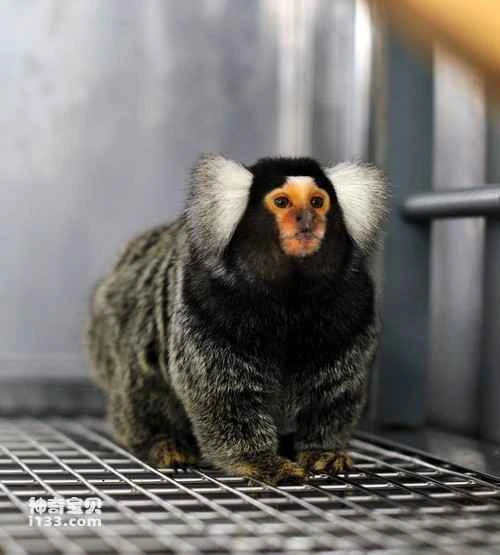
The most striking feature of these little monkeys is the tuft of cotton-like white hair on each of their ears, hence their name, the cotton-eared marmoset. Biologically, there are dozens of species of marmosets, with the cotton-eared marmoset being the most common, also known as the common marmoset. Even as adults, they are only about 20 centimeters long and weigh 300-400 grams, less than the weight of a bottle of ordinary mineral water. Newborn marmosets haven't yet grown their distinctive white ear hairs; they are about the length of an adult's finger and weigh only about 30 grams, easily able to hold a person's finger in their palm.
Forest elves
To adapt to life in the tropical rainforest, marmosets have evolved a host of advantages: powerful hind limbs ensure strong jumping ability, sharp claw-like nails allow them to firmly cling to branches, and a tail almost as long as their body helps control their balance during jumps. Like humans, marmosets are omnivorous. They enjoy eating forest flowers, fruits, sap, and insects, and sometimes they will steal bird eggs and prey on small vertebrates and reptiles.
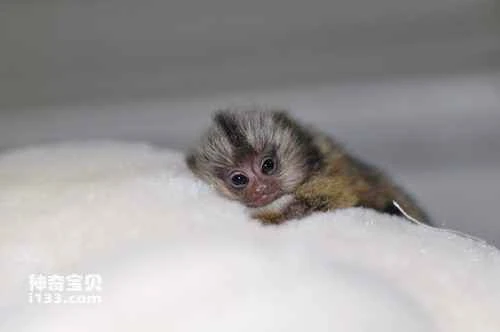
Marmosets have enviable large, double-lidded eyes. Scientists have discovered that marmosets have extremely sharp vision and, like humans, can accurately judge the distance of objects using both eyes simultaneously, allowing them to leap and dart freely through the jungle. However, marmosets are not as adept at color recognition as humans; all male marmosets are red-green colorblind. Interestingly, only a portion of female marmosets are red-green colorblind, while the rest have normal color vision like humans.
Marmosets have a very rich vocal range, similar to that of birds. They are also masters of high-pitched vocalizations, with some calls even exceeding the range of human hearing. Their hearing is also remarkably evolved. In the forest, marmosets are small but have a large range, and with the cover of foliage, vocal communication is arguably their most important means of communication.
Marmosets also have a keen sense of smell, which they can use to locate food and determine its ripeness, as well as to warn of potential intruders and predators. More importantly, marmosets also use scent for marking and communication, such as using urine to mark their territory or leaving identifiable scent information for other marmosets.
A loving little family
Marmosets have family structures very similar to human families. In the wild, a marmoset family consists of 3 to 15 members: a father marmoset, a mother marmoset, and their two offspring. Marmosets are able to leave their parents and form their own families at about 18 months old.
Marmoset family members have a clear division of labor. The father is the absolute workhorse, shouldering the heavy responsibility of defending the homeland against external enemies, while also being responsible for finding food. The mother is responsible for childbirth and breastfeeding, but the task of caring for the baby is still mainly the responsibility of the marmoset father. The older siblings of the baby marmoset also participate in caring for the baby, especially the eldest son, who can help share the workload with his parents and also gain experience for himself when he goes out to form a new family. Newborn marmoset babies will cling tightly to the backs of their parents or older siblings; between the 3rd and 5th week after birth, the baby's various motor skills begin to develop, and he can walk around on his own. By the 8th week after birth, the marmoset baby's motor skills are basically fully developed.

A helpful tool for scientific research
Both marmosets and macaques belong to the primate class, just like humans, and have long been used in human biomedical research, particularly in neuroscience. In China, because macaques are more numerous, most laboratories currently choose them as research subjects. Compared to macaques, marmosets have advantages such as smaller size, faster reproduction, and smaller enclosure requirements. Furthermore, marmosets are more similar to humans in some aspects; for example, their family structure is closer to that of humans, making them suitable for studying human social behavior; and they possess richer vocal communication, making them more suitable for studying human language than macaques.
In 2009, Japanese scientists bred a transgenic marmoset. These marmosets have an extra green fluorescent protein in their cells, causing them to turn green under specific fluorescent light. Even more remarkably, their offspring also carry this green fluorescent protein. This was the first time scientists had successfully propagated a transgenic monkey! Currently, laboratories around the world are attempting to breed more transgenic marmosets, which will provide crucial assistance in understanding the mysteries of the human brain.
Now, marmosets have also arrived at laboratories in China. Soon, these little creatures will surely help Chinese scientists make important scientific discoveries.