my country is one of the earliest countries in the world to utilize fish, relying on them for food and making them an essential food source for survival. Since ancient times, people have had an inseparable bond with fish; the painted pottery art of the Neolithic Age already revealed the worship of totem fish. The term "totem," originating from Native Americans and other primitive peoples, refers to a natural object, especially an animal, that is considered closely related to their family. This article introduces the long history and rich connotations of totem fish in my country from three aspects: totem fish in the Neolithic Age, totem fish in ancient Chinese texts, and totem fish in ethnic groups and folk customs.
I. Totem Fish of the Neolithic Age
Among the Neolithic painted pottery art excavated in my country, more than 20 sites feature totem fish. The most abundant examples are found in the Banpo-type Yangshao culture, where fish patterns and variations thereof are predominantly fish motifs. Painted pottery decorations served as symbols of specific communities, existing in most cases as clan totems or other symbols of worship. The "human-faced fish pattern" painted pottery found at sites such as Banpo in Xi'an, Jiangzhai in Lintong, Beishouling in Baoji, and Nanzheng on the Han River exhibits a distinct totemistic nature, thus reflecting the worship of fish.
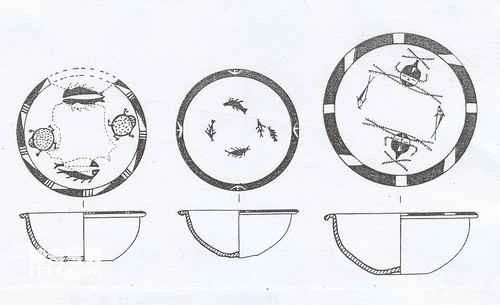
Figure 1 shows several totem fish symbols in the Jiangzhai primitive settlement (from: Gao Qiang, 1984, "Prehistoric Research").
Taking several totem fish symbols from the primitive settlement of Jiangzhai in Lintong, Shaanxi (Figure 1, cited from Gao Qiang's 1984 "Prehistoric Research") as examples, Figure 1. On the left is an unearthed pottery basin with a fish and frog pattern. The fish patterns are all black, in a compound shape, and combined with frogs in a symmetrical arrangement. Figure 1. In the middle is a burial pottery basin with a five-fish pattern, depicting five fish swimming with their mouths open, lifelike. Two of the fish are symmetrical, with black backs and white bellies, while the rest are black. Figure 1. On the right are two unearthed pottery basins with human face patterns. The human face pattern is combined with the fish pattern, painted in pairs on the inner wall of the basin. The fish patterns are all black, with black backs and white bellies. The human face pattern is quite special. The human face is round or oval, with basic facial features such as eyes, nose, and mouth, resembling a real human face. The head is also decorated, and the hair is tied on top of the head. Two long, intersecting lines are drawn at each corner of the mouth, adorned with small dots or spikes; this is an abstract representation of the fish's body. The following pottery artifacts unearthed in archaeological excavations illustrate the prehistoric people's understanding of human origins, believing themselves to be descendants of humans and fish that intermarried.
II. Totem Fish in Ancient Chinese Books
The *Classic of Mountains and Seas* is traditionally attributed to Yu the Great (reigned 2205-2198 BC) and others. It is my country's earliest geographical book and a record of human geography, as well as a unique ancient text compiling local myths. The book contains numerous records of totem fish; a few examples are given below: The *Classic of the Great Wilderness, Western Section* states, "There is a country called Hu (氏), where the grandson of Emperor Yan is named Ling. Ling gave birth to the people of Hu (氏), who can ascend and descend to heaven." The *Classic of the Seas Within, Southern Section* states, "The country of the Shi people is west of Jianmu. Their people have human faces and fish bodies, and no feet." (Note: The Shi people are depicted with human faces and fish bodies, able to ride the clouds and rain to ascend and descend to heaven; they are totem gods combining human and fish forms. This indicates that the fish totem is one of Emperor Yan's totems.)
The Classic of the Great Wilderness, West: "There is a fish that protects others, named Fish Woman. When Zhuanxu died, she was resurrected. A wind came from the north, and Yao became a great spring of water. The snake transformed into a fish, which is Fish Woman. When Zhuanxu died, she was resurrected" (Note: According to legend, Zhuanxu was the name of an ancient emperor).
The *Classic of Poetry* (Shijing), dating from the 25th century BC to no later than the 6th century BC, is an ancient collection of folk songs, author unknown. It was compiled by Confucius (552-469 BC) during the Spring and Autumn Period, who selected 305 poems from over 3000 collected ancient poems, including 21 poems about fish. For example, in the poem "No Sheep" from the *Minor Odes*, the shepherd dreams: "Many fish! Banners! The elder interprets it: 'Many fish! This signifies a bountiful year. Banners! The family will prosper.'" (Note: The dream of many fish symbolizes a plentiful harvest, and the dream of banners depicting turtles, snakes, and birds foretells a large and prosperous family.) The dream imagery in the poem is related to childbirth, a large family, and a bountiful harvest. The fish and banners here are manifestations of primitive totems in the dream.
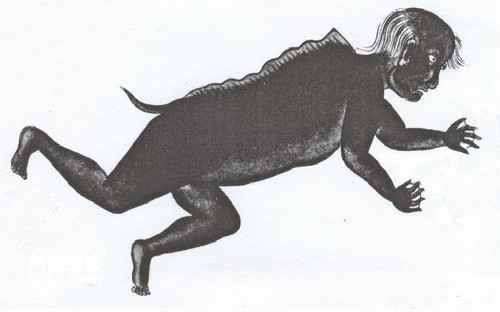
The image shows two mermaids (from: Nie Huang, ed., "Illustrated Compendium of Marine Creatures in the Qing Dynasty").
The *Illustrated Compendium of Marine Creatures* (Qing Palace Hai Cuo Tu) was compiled by Nie Huang in the year 1698 (Kangxi reign). It includes 233 marine species, 98 of which are fish (Zhang Shiyi and Shang Xiuqing, *Bulletin of Biology*, 2012). Regarding the "mermaid," it states: "The mermaid is as long as a human, with black flesh and yellow hair. It has hands, feet, eyebrows, eyes, mouth, and nose, and its genitals are the same as those of men and women. However, it has red wings on its back, a short tail, and calloused fingers, making it slightly different from a human." A Cantonese man named Liu once drew a picture for me, but I did not believe it. However, after consulting the *Zhi Fang Wai Ji*, it is called a "sea person," and the *Zheng Zi Tong* calls it a "fish person," saying it is the same as the fish described in the picture. Therefore, I believe it and record it. This fish is mostly found in Dayu Mountain and Lao Wan Mountain in Guangdong. When people from the sea obtain it, they can wear clothes and eat, but they cannot speak, only laugh. They take it to Dayu Mountain, where it disappears into the water. Guo Pu wrote *Ode to the Mermaid*. The *Guangdong New Tales* states that during strong winds and rain at sea, mermaids ride large fish, drifting with the waves, astonishing those who witness it. The Fire God prays, "Never encounter a sea maiden, never see a mermaid." The *Ode to the Mermaid* describes a fish named after a human, complete with hands and feet. It has a short tail, black skin, and a mane with calluses.
III. Totem Fish in Ethnic Groups and Folk Customs
There are many examples of fish being used as totems in Chinese folk customs; here are a few.
In ancient times, some Bai people used fish as a totem and adopted "fish" as their surname (called "Wu Ci" in the Bai language). Later, with frequent interactions with the Han people, they adopted Han surnames such as Zhang, Wang, Li, and Zhao, and changed their surname "Yu" to "Yu". In modern times, the Bai people still retain many fish totem worship customs. For example, in many villages around Erhai Lake in Yunnan, Bai women commonly wear fish-tail hats as headdresses, made of black or golden cloth in the shape of a fish. The fish head is in front, and the fish tail is behind, adorned with white silver beads or white pearls to represent fish scales. After death, there is a custom of burying fish and conch shells with the deceased.
Legend has it that fish were the ancestors of some Buyi people. One of them had a man who married a girl who was a fish in disguise, thus giving rise to their tribe's mythology. Even today, the custom of fish totem worship persists. After a person dies and is buried, their tombstone is engraved with a double fish and gourd pattern. During weddings, the bride's sedan chair is decorated with a double fish and full moon image on the back, symbolizing good fortune.
Many Manchu surnames are names of totems, such as Nimaha, which means fish. This is similar to the clans of Native Americans, where the so-called fish clan originally used fish as a totem, and the clan name gradually evolved into a surname (He Xingliang, 1996, "Central Plains Cultural Relics").
The Shui people are a minority ethnic group in southern my country with a long history, mainly residing in southeastern Guizhou Province. Fish are the most important objects of worship for the Shui people, and are seen as a reflection of their ancestors. From the Shui people's customs of ancestor worship, mourning, and marriage, it is evident that the Shui people and fish have a close relationship (Pan Chaolin, "Studies on Ethnic Groups in Guangxi," 2001).
In my country, fish or fish-patterned fish symbolize fertility, abundance, and wealth. Furthermore, homophones (鱼, yú) play a significant role, as seen in auspicious phrases like "auspicious abundance" (吉庆有余, jí qìng yǒu yú) and "abundance year after year" (年年有余, nián nián yǒu yú, jī yú, nián nián yǒu, jī yú ...