On July 24, Xu Xing's team from the Institute of Vertebrate Paleontology and Paleoanthropology, Chinese Academy of Sciences, published their latest findings on sauropod dinosaur evolution in the British journal Nature Communications. They reported a new genus and species of Diplodocus from the Early Middle Jurassic (174 million years ago) in China, Lingwulong shenqi. This discovery challenges traditional views on the origin and dispersal of Diplodocus dinosaurs and other new sauropod dinosaurs.
Sauropods are a group of herbivorous dinosaurs, including some of the largest land animals in Earth's history. It has long been believed that Neosauropods—a late evolutionary branch of sauropods—diverged during the breakup of Pangaea, a process that profoundly impacted their evolution. East Asia is thought to have been isolated from other continents approximately 164-158 million years ago. Traditionally, it was assumed that some animal groups, including Diplodocus, had not yet spread to East Asia before this isolation, leading to the formation of a distinct dinosaur fauna in the Middle-Late Jurassic of East Asia—a hypothesis known as the East Asian isolation hypothesis. New discoveries suggest that Diplodocus dinosaurs were once widely distributed across Pangaea, including East Asia, and that the East Asian fauna of the Middle-Late Jurassic may not have been as unique as previously thought. Past understanding may have been influenced by fossil sampling (i.e., discrepancies between the biota inferred from collected fossils and the actual biota during geological history due to geological and human factors), highlighting the importance of further fieldwork.
Through evolutionary and biogeographical analysis of the *Lingwuosaurus*, researchers believe that by the Middle Jurassic (approximately 174 to 164 million years ago), neosauropod dinosaurs had already diversified and were widely distributed. This challenges the traditional view of sauropod evolution, which posits that neosauropods appeared and rapidly diversified within a short period from the Late Middle Jurassic to the Early Late Jurassic, ultimately dominating Earth's terrestrial ecosystems. The new findings suggest that major sauropod subgroups may have originated in the Early Jurassic and had a long evolutionary history before becoming the dominant group in Earth's terrestrial ecosystems.
The remarkable Lingwu dinosaur fossils were first discovered in 2004 by a villager named Ma Yun in Ciyaopu, Lingwu City, Ningxia, while herding sheep. He then handed them over to the local cultural relics management department. In 2005, Yang Guozhu and Liu Hongan from the Lingwu City Cultural Bureau took the fossils to the Institute of Vertebrate Paleontology and Paleoanthropology, Chinese Academy of Sciences. Xu Xing identified them as dinosaur skeletal fossils. Subsequently, Xu Xing organized several field excavations in the area, and under the leadership of Wang Haijun and others, at least 8-10 individuals of different sizes, representing different age stages, were discovered.
This research was supported by the National Natural Science Foundation of China.
Original link: https://www.nature.com/articles/s41467-018-05128-1
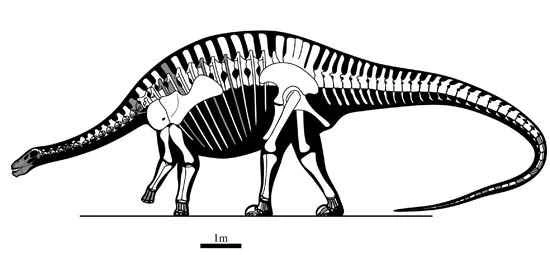
Figure 1. Outline of the skeleton of the magical Lingwu Dragon, with the gray area indicating the preserved bones (illustrated by Shi Aijuan).
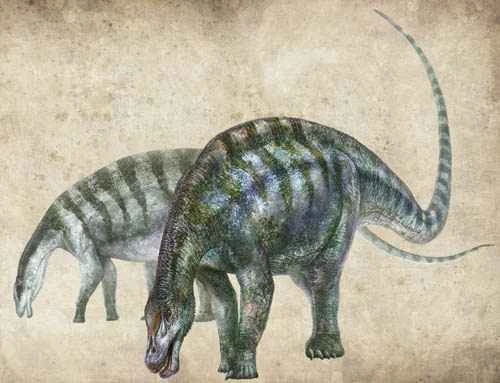
Figure 2. Reconstruction of the Mysterious Spirit Dragon (drawn by Zhang Zongda)
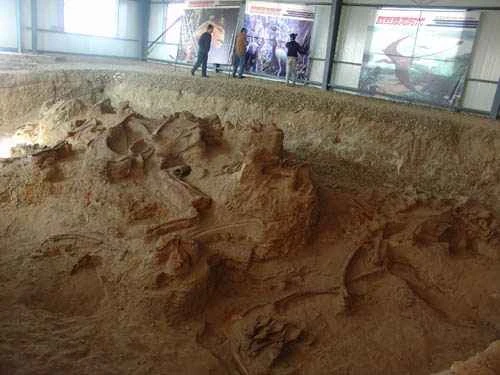
Figure 3. The excavation pit of the amazing Lingwu Dragon fossil (Photo provided by Xu Xing)
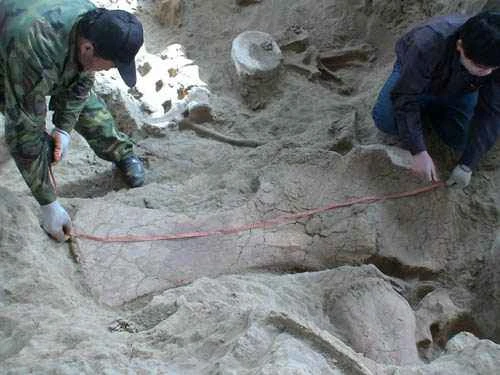
Figure 4. A large scapula preserved in situ by the miraculous Lingwu Dragon (Photo provided by Xu Xing)