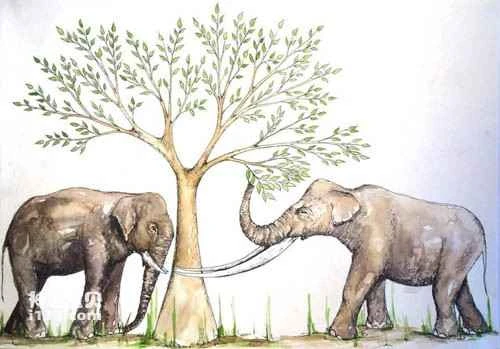
Both sexes of the large-lipped rhinoceros (Chilotherium) are hornless. Its lower jaw and snout extend strongly laterally, and it possesses two large tusks with sharp, blade-like tips. Its upper incisors are completely reduced and absent. It flourished across Eurasia during the Late Miocene. Since Linston (1924) established the new genus *Chilotherium*, 13 new species have been described, and 19 other genera and species have been revised and incorporated into this genus. However, through continued research, only 10 valid species within this genus have been identified. Recently, Professor Deng Tao's research group at the Institute of Vertebrate Paleontology and Paleoanthropology, Chinese Academy of Sciences, established a new species of the genus *Chilotherium*, *Chilotherium licenti* sp. nov., based on an adult skull and an adult mandible associated with the atlas from Qingyang, Gansu. They also systematically discussed the classification and evolution of *Chilotherium licenti* fossils. The relevant research results, with doctoral student Sun Danhui as the first author and Professor Deng Tao as the corresponding author, were published in the latest issue of *Vertebrata PalAsiatica*.
The specimen of *Rhinoceros sanguinis* is now preserved in the Beijiang Museum in Tianjin. It was collected in Qingyang, Gansu Province in 1920 by the French Jesuit priest, Father Jean-Pierre de Sang, and is detailed in his diary. The species name is given in gratitude to Mr. Sang and as a memorial. Besides the typical characteristics of the *Rhinoceros* genus, such as a strongly extended mandibular symphysis, a large i2 ridge with an upturned inner edge, a strongly contracted protocuscicle, well-developed anterior and ulnar spines, and weak anterior cusp folds and anterior cusp ribs, *Rhinoceros sanguinis* also exhibits well-developed anterior and ulnar spines that connect to form a central concave region (P2–M2), and degeneration of the internal and external dental bands. These advanced features indicate that it belongs to a highly specialized group within the *Rhinoceros* genus, dating to the Baudelaire period, corresponding to MN12–13 in Europe. Based on morphological comparisons and phylogenetic analysis, *Rhinoceros sanguinis*, from the Late Miocene, is inferred to be the most advanced species within the *Rhinoceros* genus.
The ancestral types of large-lipped rhinoceroses likely lived in the Siwalik region of South Asia during the Middle Miocene, before migrating to China, the Middle East, and Europe. In the early Late Miocene, the genus *Large-lipped Rhinoceros* of the tribe *Hornless Rhinoceros* began to appear, subsequently experiencing a dramatic increase in population, becoming the dominant group in the fauna at that time. In China, they were widely distributed not only in the northwest but also found on the Tibetan Plateau. The late Late Miocene marked the largest period of adaptive radiation for rhinoceroses in Chinese geological history. The tribe *Hornless Rhinoceros* remained dominant, with at least three species of large-lipped rhinoceroses being common in the fauna of mainland China, and they also had a vast distribution range throughout Eurasia. With the end of the Miocene, rhinoceroses in China declined from their peak.
This research was supported by the National Natural Science Foundation of China, the Strategic Priority Research Program of the Chinese Academy of Sciences, and the Key Research Program of Frontier Sciences of the Chinese Academy of Sciences.
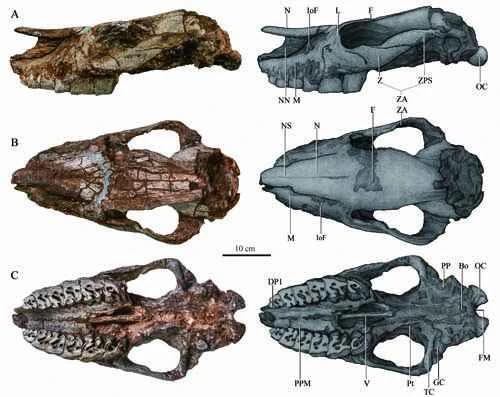
Figure 1. Skull of *Chilotherium licentisp. nov.* (TNP 03978), a new species of *Chilotherium licentisp.* from Qingyang, Gansu Province. Homotypographic specimen. A. Lateral view; B. Dorsal view; C. Ventral view (Photo provided by Sun Danhui)
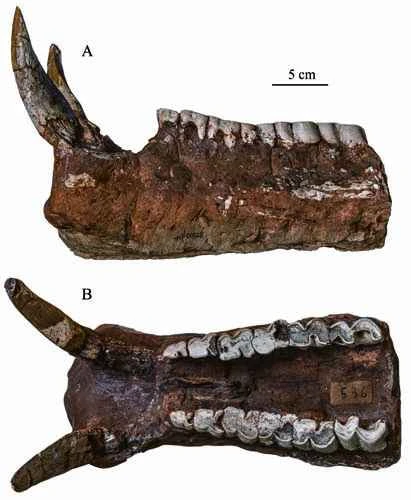
Figure 2. Mandible of a new species of large-lipped rhinoceros, *Chilotherium licentisp. nov.* (TNP 00328), Qingyang, Gansu Province. A. Lateral view; B. Occlusal view (Photo provided by Sun Danhui)
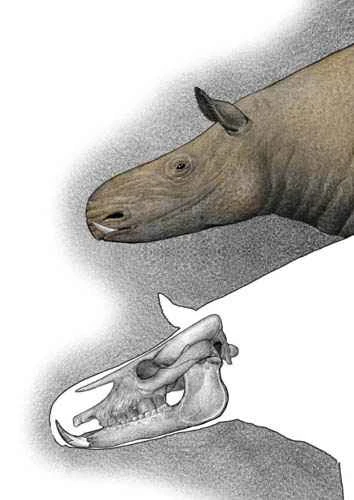
Figure 3. Reconstruction of a new species of large-lipped rhinoceros, *Chilotherium licentisp. nov.*, from Qingyang, Gansu (Illustration by Chen Yu).
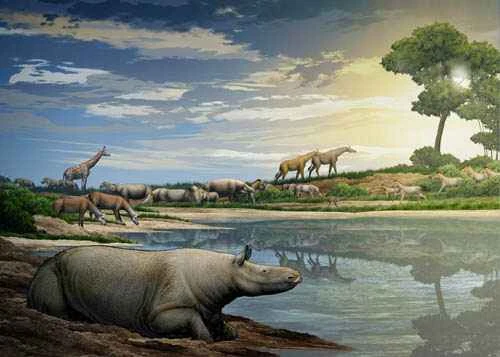
Figure 4. Ecological reconstruction of the large-lipped rhinoceros of Sang's (illustrated by Chen Yu)