On May 26, Zhou Zhonghe's research group at the Institute of Vertebrate Paleontology and Paleoanthropology reported in *Scientific Reports* a new pheasant fossil with nearly complete skeletal remains. The specimen, discovered in the Hezheng area of the Linxia Basin, adjacent to the Tibetan Plateau, dates back 7-11 million years. It preserves the earliest known fossil of a bird's specialized, elongated trachea, and consequently, the oldest evidence of changes in vocalizations (singing or calling).
Few fossils can directly indicate how extinct birds called, but this new skeletal specimen provides new clues through the morphological preservation of the tracheal cartilage. In the Late Miocene Linxia Basin, the widespread fine-grained clay, coupled with rapid, debris-flow-like deposition, created a highly favorable sedimentary environment for fossil formation, further protected by abundant clay surrounding rocks. This made the region an important site for Cenozoic mammal and bird fossils. The bird fossils and the three-toed horse fauna here both originate from the Late Miocene Liushu Formation.
Based on its distinctive feature of encircling the trachea, the research team named this extinct bird *Panraogallus hezhengensis*. Measurements showed that the trachea of *Panraogallus hezhengensis* was even longer than the bird's body length, with the coiled portion of the trachea distributed in the subcutaneous tissue outside the thoracic cavity. To date, over 60 modern bird species have been documented with different types of elongated tracheas. For example, in the extant Galliformes order, elongated tracheas are found in the South American crested pheasant, the African guinea fowl, and the ptarmigan of the grouse family. This newly discovered *Panraogallus hezhengensis* is the earliest record of this feature in pheasant fossils and the first such discovery in pheasant fossils at all.
It is estimated that the circumambulatory pheasant weighs around 2.5 kg. Body size usually directly affects the size of the larynx in mammals, which in turn affects the frequency of the vocalizations produced by mammals. Birds produce sounds from the syrinx (the part of the bronchus), and the trachea above the syrinx is the vocal tract. Therefore, it is likely that the bird evolved this super-elongated trachea to produce a louder and deeper sound, thus sounding like a larger bird.
This "deceptive signal" serves to intimidate predators and competitors, and to better attract mates, similar to the evolution of longer tracheas in many mammals. This "body size exaggeration theory" has been further validated in new fossils and comparative systematic analyses. Furthermore, research shows that in terrestrial mammal species where males are larger than females, males produce vocal signals that further exaggerate their size (e.g., by using the descent of the larynx to extend the length of the oropharynx in order to lower the sound frequency).
Like modern birds, this relatively long trachea is mostly found only in males. This specimen also preserves another distinct male characteristic: the tarsometatarsus (shinbone) retains a ridge similar to that of the spur in modern male pheasants.
Currently, the Hezheng area, adjacent to the mountain range created by the uplift of the Qinghai-Tibet Plateau, has risen to over 2,000 meters. However, this area was once a subtropical grassland, inhabited by pheasants, many other birds, and three-toed horses. This study provides further evidence for understanding the ecological diversity of pheasants.
The area where the pheasant once lived was once filled with the deep calls of rhinoceroses, horses, ostriches, kestrels, and pheasants; now, however, they have all disappeared from this land.
This research was supported by the Strategic Priority Research Program of the Chinese Academy of Sciences and the General Program of the National Natural Science Foundation of China, as well as the Hezheng Paleontological Fossil Museum.
Paper link: www.nature.com/articles/s41598-018-26178-x?from=timeline&isappinstalled=0
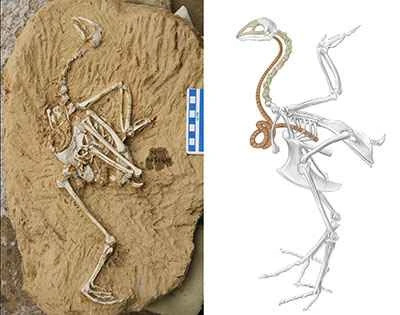
Photographs of a holotype specimen of a coiled pheasant (provided by Li Zhiheng) and its skeletal reconstruction (by Guo Xiaocong).