China has extensive exposure of Neogene terrestrial strata. For example, the Linxia Basin in Gansu Province has continuous strata from the Oligocene to the Pleistocene, covering the entire Neogene period and rich in mammalian fossils. Rapidly evolving mammals are an effective means of dividing and correlating Neogene terrestrial strata. Therefore, a unified Neogene mammalian biostratigraphic framework was established in China very early on, and mammalian stages were named. Due to the correspondence between geological time "stages" and chronostratigraphic units "steps," the Neogene system in China has seven consecutive steps, from bottom to top: the Xiejia Stage, Shanwang Stage, Tungur Stage, Bahe Stage, and Baode Stage of the Miocene, and the Gaozhuang Stage and Mazegou Stage of the Pliocene.
In recent years, Professor Deng Tao's research group at the Institute of Vertebrate Paleontology and Paleoanthropology, Chinese Academy of Sciences, has established and improved a geologically age-calibrated chronostratigraphic sequence of the Neogene in China by combining detailed biostratigraphy with paleomagnetism and isotopic chronology on continuous sections. The relevant research results were recently published in *Science China: Earth Sciences*. Candidate sections for the bottom boundary stratitype of each stage of the Neogene in China were proposed according to the principles and rules of modern stratigraphy, and a comprehensive comparison of Neogene strata in major regions was conducted based on this.
It is said that China has better conditions than Europe in establishing a precise Neogene biostratigraphic sequence in Eurasia because the Neogene terrestrial basin sediments in Europe are not as well developed, and many famous mammalian groups have been found in fissure deposits.
The extensive application of paleomagnetic dating in Neogene strata in China has effectively overcome the limitation of limited isotopic dating. Except for the Tungurian stage's base boundary, which aligns with the European terrestrial mammalian chronology, the latest research and refinement of the base boundary ages of the remaining Neogene stages in China are consistent with the marine stages in the International Stratigraphic Tables. In terms of biomarkers, the Neogene stages in China strive to use the first appearance of a single mammal species as a reference, some representing local species replacement, and others representing intercontinental animal migration and dispersal events. For example, the base boundaries of the two Upper Miocene stages, the Baheian and Baodeian, are marked by the first appearance of *Hipparion dongxiangense* and *H. forstenae*, respectively, with base boundary ages corresponding to the marine Tortonian (11.63 Ma) and Messinian (7.25 Ma) stages, respectively.
This research was funded by the National Natural Science Foundation of China, the Chinese Academy of Sciences, the Ministry of Science and Technology, and the National Stratigraphic Commission.
Original links: http://engine.scichina.com/doi/10.1007/s11430-017-9155-4, http://engine.scichina.com/doi/10.1360/N072017-00221

Figure 1. Outcrops of Neogene strata in the Linxia Basin, Gansu Province (Photo provided by Deng Tao)
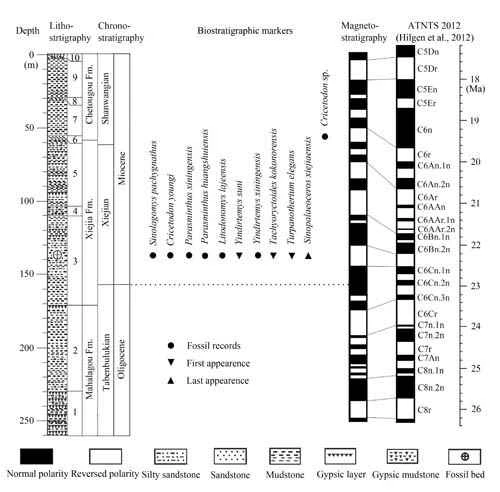
Figure 2. Comprehensive stratigraphic profile of the Xiejia site in the Xining Basin, Qinghai Province (Photo provided by Deng Tao)
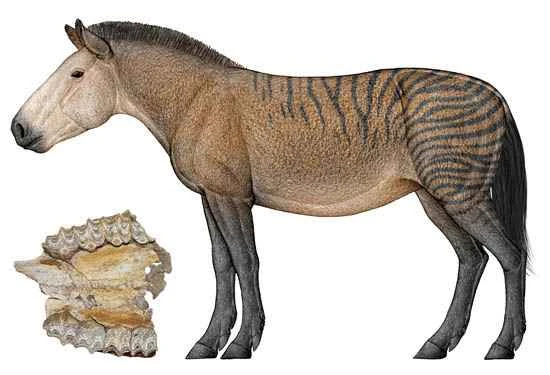
Figure 3. Fossilized and reconstructed mandible of the three-toed horse of Foucault (illustrated by Chen Yu)
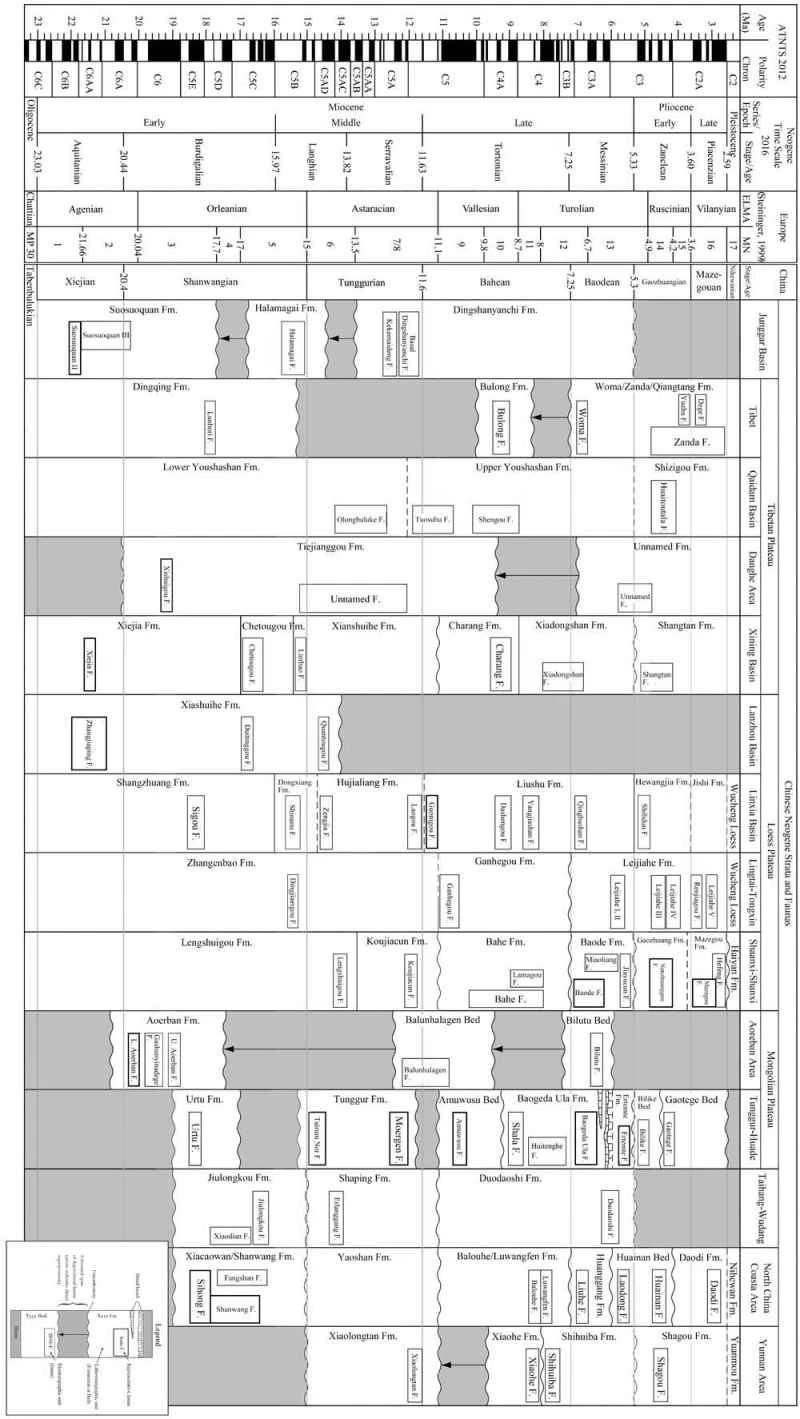
Figure 4. Distribution and correlation of Neogene strata and mammalian assemblages in the terrestrial region of China (Image provided by Deng Tao)