The white-crested coot, also known as the white-crested waterhen, is a very common waterbird that mainly lives in lakes, ponds, and wetlands. From a distance, it appears entirely black, except for a distinct white frontal shield, resembling a "white helmet," hence its name.
Many people have probably seen it swimming in the park's lakes. But did you know that the Common Moorhen is actually a fiercely independent and incredibly adaptable bird, with a very interesting lifestyle? Today, let's talk about everything about the Common Moorhen, from its appearance and habits to the challenges it faces, and what we can do for it.
1. The Coot's "ID Card"—Scientific Classification
To understand an animal, first look at its scientific classification:
Kingdom: Animalia
Phylum: Chordata
Class: Aves
Order: Gruiformes
Family: Rallidae
Genus: Fulica
Species: Coot (Fulica atra)
The common coot and the common moorhen (Gallinula chloropus) are closely related, but the common moorhen has a red frontal shield, while the common coot has a white one, making them easy to distinguish.
2. What does it look like? Physical characteristics of the Common Moorhen.
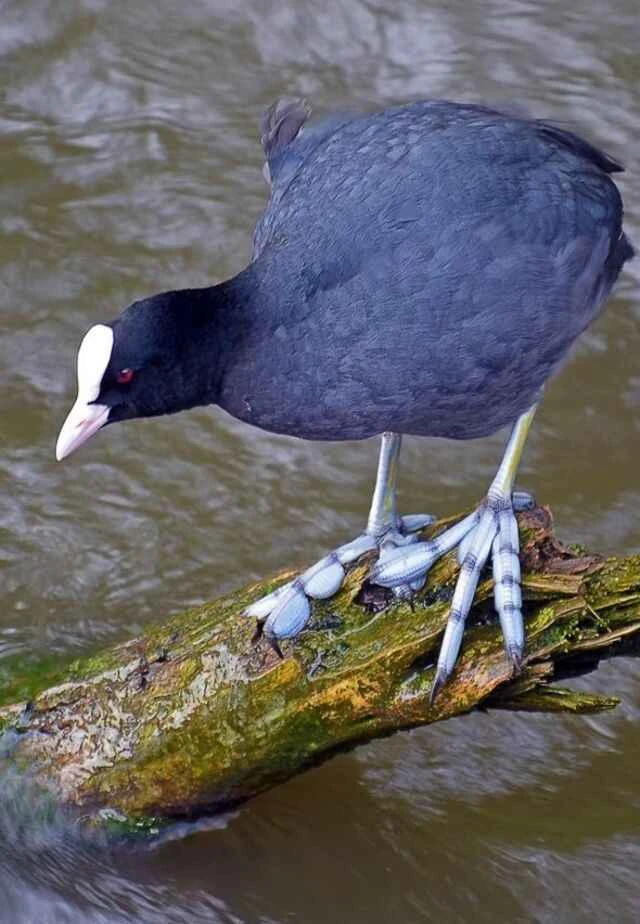
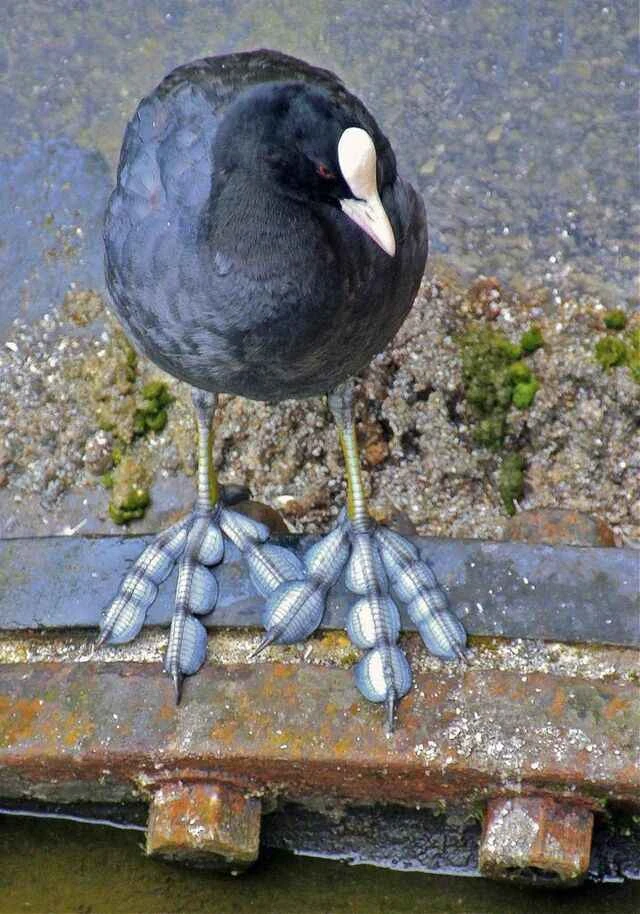
The first impression of the coot is its "black and white" color scheme. Its body is blackish-gray, with a distinct white frontal shield and a creamy-white beak, making it look very unique.
(1) Body size data
Body length approximately 36-42 cm
Wingspan can reach 70-80 cm
Their weight is around 600-900 grams, with some individuals reaching 1.2 kilograms.
(2) Unique little details
Webbed toes: Unlike ducks, whose webs are complete, ducks have "segmented" webbed toes, which are suitable for swimming in water and walking in mud.
Red eyes: Up close, the coot's eyes are red, making it look very energetic.
The young birds look different: newly hatched coots are covered with yellow, red and black downy feathers, and their heads are bright red. They only turn into all-black feathers as they grow up.
3. Where do they live? Distribution and habitat of the Common Moorhen
Coots are highly adaptable and have a wide distribution, ranging from Europe, Asia, and North Africa to Australia; they can be found almost anywhere there is water.
(1) Their favorite place
Lakes, ponds, and wetlands: especially those with open water surfaces and aquatic plants along the banks.
Slow-flowing rivers: If the river is relatively calm, it can also become their habitat.
Water features in city parks: They can also be seen swimming leisurely in some city lakes and park ponds.
4. Migration or Staying? The Seasonal Activity of the Coot
The migratory behavior of coots depends on their location:
Northern populations (such as those in northern Europe and northeastern China): migrate south during the winter, for example, flying to warmer regions such as southern China, India, and the Middle East to spend the winter.
Temperate and tropical populations (such as those in southern China and India): are generally resident birds that live in the same body of water year-round.
Some individuals are "semi-migratory": Some coots do not fly too far in winter, but simply move to a slightly warmer place, such as from a mountain lake to a lower altitude area.
5. Fiery temper? Social behavior of coots
Don't let their small size fool you; coots have quite the temper, especially during the breeding season—they're practically a "fighting nation."
Strong territorial instincts: Coots will engage in fierce battles to compete for territory, even kicking each other, making for a very intense scene.
Collective activities: Although they like to fight for territory, in winter they gather together to form large flocks, with hundreds or thousands of coots overwintering together.
Swimming experts: Coots can swim quickly on the surface of the water and can even dive for short periods of time to find food underwater.
6. What do they eat? The diet and foraging methods of the coot.
Coots are omnivorous and will eat almost anything, including:
Plants: Leaves, buds, fruits, and seeds of aquatic plants
Animals: Small crustaceans (such as water fleas), insects, and aquatic mollusks (such as snails and clams).
Artificial food: Visitors in the park often feed them bread, rice, etc., but these foods are not suitable for them and can easily lead to malnutrition if eaten in the long term.
Their foraging methods are also very flexible:
pecking at phytoplankton on the water surface
They stretched their necks directly underwater to scoop up food.
It can even dive for a period of time to catch small aquatic animals.
7. How to breed? Brooding habits of the Common Moorhen.
Breeding season: generally from April to July in the Northern Hemisphere, and from September to December in the Southern Hemisphere.
Nest building method: They will build a floating nest on the water surface using aquatic plants, which looks like a "small nest on the water".
Each clutch contains 6-10 eggs, and the incubation period is approximately 21-24 days. Both male and female participate in incubation.
Young coots learn to live independently after being born by following their parents, and it takes them about 8 weeks to become independent.
8. Threats and Current Status of Protection
(1) Protection level
Internationally: Listed as "Least Concern" (LC) by the IUCN, indicating that the global population is relatively stable.
China: Listed in the "National List of Terrestrial Wild Animals with Important Ecological, Scientific and Social Value".
(2) Main threats
Habitat destruction: Wetlands are being filled in and pollution is intensifying, leading to a reduction in their living space.
Human interference: Overfeeding and too many tourists can disrupt their normal lives.
Climate change: Global warming may affect their reproduction and migration patterns.
9. What can we do to protect the coot?
Protect wetlands and reduce pollution
Do not feed artificial food indiscriminately.
Respect their habitat and do not disturb them.
10. Ecological value
As an important member of the wetland ecosystem, the Common Moorhen has the following ecological value:
Maintaining the food chain : controlling insect and mollusc populations
Facilitating the dispersal of aquatic plants : Aquatic plant seeds are dispersed through foraging and excretion.
Biodiversity indicators : changes in their population size can reflect the health status of wetlands.
11. Relevant Cultural and Economic Value
In some parts of southern China, the coot was once considered an auspicious bird, symbolizing abundant water resources and ecological prosperity.
In the past, some regions had the custom of eating it, but with increased awareness of its protection in modern times, hunting behavior has decreased.
In the development of ecotourism, coots are commonly found in wetland parks, making them an important target for birdwatching enthusiasts.
12. Closely Related Varieties (Comparison Table)
| Species name | scientific name | Main differences |
|---|---|---|
| Black-necked stilts | Gallinula chloropus | Small in size, with red frontal armor |
| American coot | Fulica americana | Distributed in the Americas, and slightly larger in size. |
| Giant Coot | Fulica gigantea | Primarily distributed in South America, and larger in size. |
Conclusion: The Wetland's "Little Warriors"
Coots are not only important members of wetland ecosystems but also reflect the health of water bodies. Although their numbers are currently relatively stable, we still need to focus on wetland conservation so that these little warriors can continue to swim freely on the water. Next time you see them in the park, take a moment to quietly appreciate their wonderful lives!