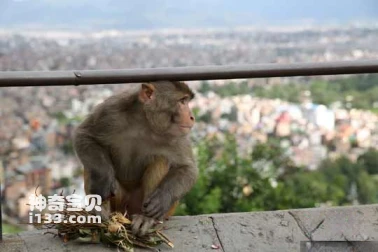
The Monkey Temple in Nepal is located on a small hill in the western part of Kathmandu, the capital city. The temple is named for the large number of monkeys that inhabit it. The picture shows a monkey sitting on the hilltop with an aerial view of Kathmandu in the background.
Perched atop a small hill in the western part of Kathmandu, the capital of Nepal, stands a striking golden stupa—the Swambhu Stupa, with a history spanning over 2,000 years. The temple itself is famous as the "Monkey Temple" due to its large monkey population.
Ascending the stone steps from the foot of the mountain, you can see groups of monkeys leisurely foraging, strolling, and sitting, sometimes suddenly leaping onto the heads of Buddha statues, giving visitors a glimpse into their lives. Not far from both sides of the mountain path are lush forests, the monkeys' natural habitat.
As a Buddhist holy site, the Monkey Temple is most famous for its Suvayanbhunath Stupa. According to Buddhist legend, the Kathmandu Valley was originally a lake, and one day a lotus flower rose from its surface. Suvayanbhunath means "the lotus flower radiating its own light" and is considered the source of power for the Kathmandu Valley.
As for the hordes of monkeys, there is a local legend: it is said that Manjushri Bodhisattva shaved his head here, his hair turning into trees, and the lice on his head transforming into monkeys. Therefore, the monkeys here are regarded as "sacred monkeys" and are respected and protected by the monks and residents of the temple.
Many people believe that the monkeys here live in the temple and grow up listening to Buddhist music, and their expressions and behavior really do have a kind of self-cultivation. "Monkeys also practice cultivation" has become a popular saying among tourists when talking about the monkey temple.
Mr. Buthachan, 27, runs a handicraft business in a corner of the temple. He told a reporter from China News Service, "My home is right behind the temple. I grew up here and I think the monkeys here are really different from those in the zoo."
Buthachan said that the monkeys at the Monkey Temple are generally mild-mannered and rarely exhibit "wild" or aggressive behavior. However, he also admitted that in recent years, with the increase in tourists, the phenomenon of feeding the monkeys indiscriminately has become more and more common, and the monkeys have become spoiled, drinking cola and eating biscuits, leading a very comfortable life.
The Monkey Temple currently has about 150 monks, but the number of monkeys is unknown. A fortune teller at the temple, who makes a living by reading palms, claims there are about 1,500 monkeys, but several monks denied this number to reporters, saying only that it was "difficult to count."
Actually, monkeys are not the only animals in the "Monkey Temple". Around the Suvayanbhunath Stupa, leisurely dogs lie around, and flocks of pigeons fly up and down to forage for food, presenting a unique temple scene.
The local guide said that the best time to visit the Monkey Temple is in the afternoon or evening. Standing on the hilltop, you can enjoy a panoramic view of Kathmandu. The light at dusk also makes the central stupa of the Monkey Temple look even more magnificent.