At the end of the Devonian period, a type of lobe-finned fish ventured out of the water and onto land, becoming the earliest amphibians. From then on, vertebrates entered a new world completely different from the environment in which they had lived for hundreds of millions of years.
The first major problem faced by early amphibians was breathing. However, this had already been solved by their lobe-finned fish ancestors. Lobe-finned fish had well-developed lungs that were likely used frequently. The main difference between amphibians and their lobe-finned fish ancestors in this respect is that while most lunged fish still primarily breathe through gills, with lungs usually serving as a secondary respiratory organ, amphibians essentially breathe through their lungs in the air, only using gills in the water during their juvenile stages.
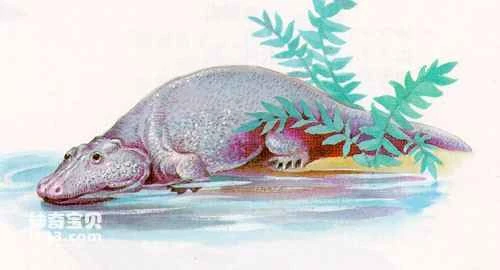
Labyrinthine salamander—a type of labyrinthine amphibian
The second major problem faced by early amphibians was dehydration. Fish, always immersed in water, did not have this problem, but when the earliest amphibians stopped being submerged, they faced the challenge of preventing their body fluids from evaporating. Therefore, on the one hand, early amphibians, like most modern amphibians, had to stay close to water and frequently return to streams or lakes; on the other hand, they evolved body coverings or garments to resist the drying effects of air. There is evidence that some of the earliest amphibians retained scales similar to their fish ancestors; however, with evolution, amphibians from the Permian onward developed strong skin, usually lining the underside of small bony plates or scales. As the amphibian skin's ability to prevent body fluid evaporation gradually increased and became a robust protective layer, amphibians became less dependent on water and could spend more time on land. This is an important aspect of amphibian evolution, and even more important for the more advanced vertebrates that evolved from amphibians, such as reptiles.
Gravity has a minimal effect on fish because of buoyancy. However, for terrestrial vertebrates, gravity is a powerful factor that significantly impacts their structure and lifestyle. Early amphibians, after leaving the water, struggled against increased gravity, resulting in the development of strong vertebrae and powerful appendages. The simpler "discs" or "rings" of the vertebrae that make up the vertebrae of lobe-finned fish evolved into interlocking structures, forming a powerful, horizontal vertebral column that supports the body. This column is supported at two points: the anterior pectoral girdle and the posterior pelvic girdle, which are in turn supported by the forelimbs and hindlimbs, respectively.
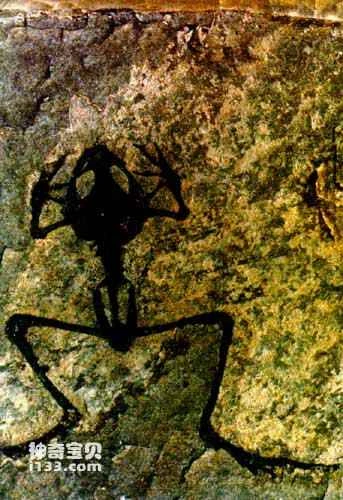
Basalt frog—a fossilized gliding amphibian
Early terrestrial vertebrates also developed a new mode of locomotion in which limbs played the most important role. They not only overcame gravity, lifting their bodies off the ground, but also propelled themselves across the land. In this respect, we see an inversion of locomotion functions between fish and amphibians: fish use their body and tail for locomotion, with paired fins providing balance; early terrestrial vertebrates, however, gradually tapered from front to back, becoming to some extent a balancer, while their paired appendages became the primary organs of locomotion. This mode of locomotion pioneered by early amphibians continued in various forms throughout the evolution of terrestrial vertebrates.
Early terrestrial vertebrates also faced reproductive challenges. Fish typically lay unprotected eggs in the water, where they hatch naturally. Terrestrial vertebrates either returned to aquatic reproduction or had to develop methods to protect their eggs on land. Amphibians failed to solve the problem of protecting their eggs on land; throughout history, they had always had to return to water to lay their eggs, with some specialized types having to go to damp places to lay them. Therefore, amphibians can only be considered pioneers of vertebrate terrestrial colonies, far from being true conquerors of the land.
Starting with ichthyostega-like ancestors, amphibians (class) differentiated into three subclasses in the process of adapting to terrestrial environments: Labyrinthodontia, Schizothodontia, and Lithostomata.