Traces of ancient organisms' activities and their remains preserved in rock strata are called trace fossils. Among them, the remains of ancient organisms can be called artifact fossils.

Dinosaur footprints
Trace fossils are rarely preserved alongside the fossilized remains of the ancient organisms that left the traces, making it difficult to determine the correspondence between the two. Trace fossils can fully illustrate the existence and lifestyles of certain organisms during geological history, enriching the records left by paleontologists and providing us with more comprehensive clues to our understanding of ancient life.
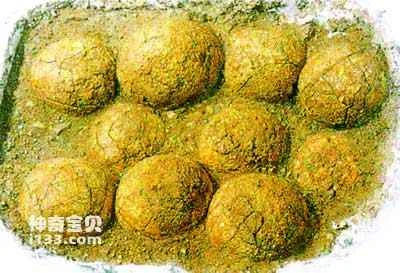
Dinosaur egg fossils
The most fascinating trace fossils are undoubtedly vertebrate footprints. Based on the size, depth, and arrangement of the footprints, scientists can infer whether the ancient animals that left them were heavy or light, and whether their gait was leisurely, running, or hopping. Whether the footprints contain claw marks or hoof prints, scientists can deduce whether these animals were carnivores or herbivores. The Paleozoological Museum of China, located near the Beijing Zoo, houses many dinosaur footprints of various sizes. Through these trace fossils, you can imagine dinosaurs strolling or running across the ancient earth 100 million years ago.

Paleolithic
In addition, common trace fossils include crawling tracks of worms, crawling marks of arthropods, burrows left by lingula and worms drilling on the seabed, and foraging traces of certain animals.
The fossil remains mainly consist of animal excrement (fossilized cod) or eggs (fossilized eggs). Fossilized fish cod (pictured), fossilized hyena cod (pictured), various kinds of dinosaur egg fossils, and fossilized ostrich eggs can all be seen in the Paleozoological Museum of China.
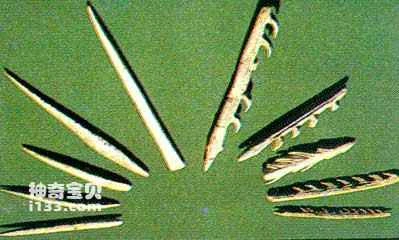
Bone Instruments
Since the emergence of early humans, the tools and other cultural relics they created and used in various stages of development are all considered fossils. If you visit the Paleozoological Museum of China, you can admire hundreds of precious Paleolithic tools, bone tools, and other fossils that embody the wisdom of ancient humans in the "Shuhua Paleoanthropology Museum." The museum's curator, Long Zi, once saw a short sword made from mammoth bone by an ancient human more than 10,000 years ago in the hands of a farmer. It was exquisitely crafted, almost like a modern soldier's dagger, and the blood groove still contained the oily black residue formed from the decomposed blood of the hunted animals. Through this short sword, I seemed to see the primitive life of our ancestors more than 10,000 years ago, eating raw meat and drinking blood. But I felt even more strongly the indomitable spirit of our ancestors who used their wisdom to fight relentlessly in a harsh environment of survival competition. It is through this spirit and wisdom that we humans have finally evolved step by step to become the masters of the earth today.