Paleontologists call the imprints and replicas of ancient biological remains left in rock strata or surrounding rocks mold fossils. They can be classified into five types according to their relationship with the surrounding rock: imprint fossils, mold fossils, mold core fossils, casting fossils, and composite mold fossils.
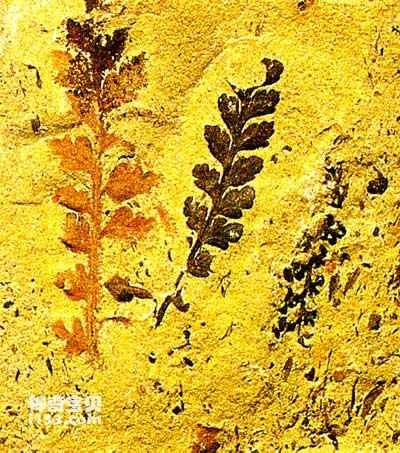
Leaf fossils
Imprint fossils are the marks left by the remains of organisms (mainly soft parts) when they become trapped in fine clastic or chemical sediments. Although erosion and diagenesis destroy the remains themselves, the imprints are preserved, and these imprints often reflect the main characteristics of the organism. Examples of imprint fossils include jellyfish imprints of coelenterates, imprints of worms, and imprints of plant leaves.
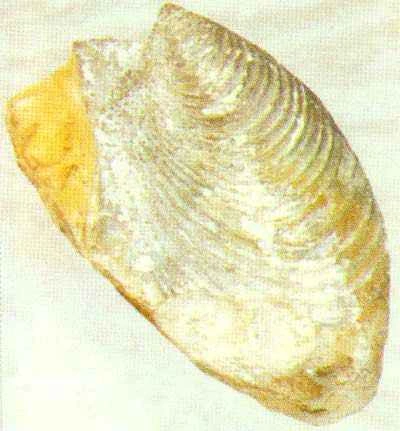
Shellfish—a type of bivalve
Mold fossils include two types: external molds and internal molds. An external mold is the imprint of the outer surface of the hard part of an ancient organism (such as a shell) onto the surrounding rock, reflecting the original morphology and structural features of the organism. An internal mold is the imprint left by the outline of the inner surface of the shell, reflecting the internal morphology and structural features of the organism's body. For example, the two lobes of bivalves are often preserved separately. When they are buried by sediment, the sediment solidifies into rock through diagenesis, and the shell is sometimes dissolved by water. However, an external mold is imprinted on the contact surface between the surrounding rock and the outer surface of the shell, while an internal mold is imprinted on the contact surface between the surrounding rock and the inner surface of the shell.
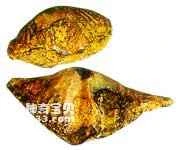
Stone swallows—a type of brachiopod
Mosaic fossils are divided into two types: the inner core and the outer core. When brachiopods and some bivalves die, their shells are often buried intact in both halves, and their internal cavities are filled with sediment. After consolidation and dissolution of the shell, a solid entity remains inside, which is called the inner core. If the shell is not filled with sediment, when the shell dissolves, it will leave a space in the surrounding rock that is the same size and shape as the shell. If this space is filled again, it will form a solid entity that is the same size and shape as the original shell but with a homogeneous composition. This entity is called the outer core.
When a shell is buried by sediment and has formed an outer mold and a nucleus, the shell material sometimes dissolves completely and is then filled with another mineral. This filler material retains the original shape and size of the shell, just like a cast mold, thus forming a cast fossil.
A composite mold fossil is a type of casting fossil in which the inner and outer molds overlap. When a shell is buried in sediment and forms an inner and outer mold, if the shell is subsequently dissolved, leaving a void in the surrounding rock, and then the outer mold overlaps with the inner mold due to the compaction of the rock strata, a composite mold fossil is formed.