Chinese name: Tail Feather Dragon
Latin name: Caudipteryx
Era: Early Cretaceous
Fossil origin: Liaoning, China
Physical characteristics: 70-90 cm in length
Diet: Carnivorous
Type: Theropod
Definition: A bird with feathered tail
The discovery of feather-like skin derivatives preserved by Caudata, a species belonging to the Oviraptorosauria suborder, and Protoceratops, a dromaeosaurid-like dinosaur, provides important information for the first time in the world on the long-standing question of the origin of bird feathers, and allows our research on the origin and early evolution of feathers to be based on fossil evidence for the first time.
These findings suggest that the original function of feathers was not flight, but rather warmth or attracting mates; feathers can no longer be used as a characteristic for identifying birds, and feathers existed before birds appeared.
Caudysaur is a very important discovery. It is similar in size to the primitive Archaeopteryx, and even the fossilized posture is very similar, but they represent two very different types of animals.
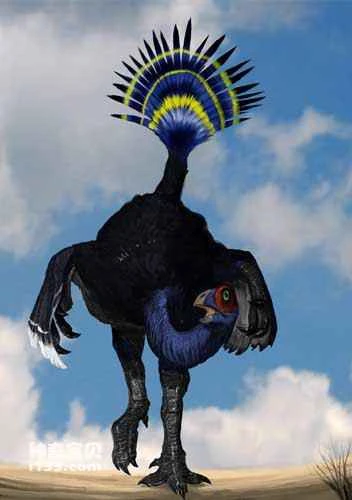
Caudatanosaurus had a short, tall head, and its mouth was almost entirely devoid of teeth, except for a few oddly shaped, forward-pointing teeth at the very tip of its snout. Its forelimbs were very small, and its tail was also short, but its neck was quite long. In its stomach, it retained a cluster of small stones, similar to gastroliths found in the stomachs of modern birds, used for grinding and digesting food. Gastroliths are common in birds and other types of dinosaurs, but are extremely rare in theropod dinosaurs.
Most excitingly, Caudulosaurus possessed a fan-shaped tuft of tail feathers at the tip of its tail, and a row of feathers on its forelimbs. These feathers had distinct shafts and developed vanes, and their overall morphology was very similar to that of modern bird feathers; the only difference was that its vanes were symmetrically distributed, while the feathers of birds, including Archaeopteryx, had asymmetrically distributed vanes. It is generally believed that asymmetrical feathers were for flight. The symmetrical feathers of Caudulosaurus may represent a relatively primitive stage in feather evolution.
In fact, the skeletal morphology of Caudata is more primitive than that of Archaeopteryx. Its postcranial skeletal structure indicates that it was a running animal and could not fly. Recent research shows that Caudata is very similar to oviraptorosaurs, possibly representing a primitive type of oviraptorosaur. Oviraptorosaurs were common in Asia and North America during the Cretaceous period and are a very famous group of dinosaurs in history. Paleontologists initially mistakenly believed that these dinosaurs stole other dinosaur eggs, hence the name "oviraptorosaur." Later discoveries showed that these dinosaurs actually incubated their own eggs, not stolen them. This discovery indicates that oviraptorosaurs exhibited bird-like incubation behavior, providing ethological evidence of the close relationship between small theropod dinosaurs and birds. The discovery of Caudata reminds us that oviraptorosaurs developed true feathers. Recently, paleontologists discovered oviraptorosaurs with a pygostyle in Mongolia. The main function of the pygostyle is to attach tail feathers, suggesting that all oviraptorosaurs possessed tail feathers.
The discovery of Archaeopteryx and Caudulosaurus marked the first time in biological history that the distribution of feathers was expanded beyond birds, indicating that feathers existed before birds and can no longer be used as a distinguishing feature. In the future, if we discover fossils of feathered animals, we must carefully examine their skeletal morphology to determine whether they belong to birds or carnivorous dinosaurs, because a feathered animal is not necessarily a bird; it could be a feathered, terrestrial carnivorous dinosaur!