Chinese name: Oviraptor
Latin name: Oviraptor
Age of existence: Late Cretaceous
Fossil origin: Mongolia
Physical characteristics: 1.8~2.5 meters in length
Diet: Carnivorous
Type: Theropod
Meaning: Egg thief
In 1920, the Third Central Asia Expedition, led by the American Museum of Natural History in New York, shocked the world with its successful excavations in Inner Mongolia, China, and the Gobi Desert in southern Mongolia.
The expedition discovered the first dinosaur eggs ever found, along with numerous new dinosaur species. While cleaning the egg fossils, the expedition's technician, Olsen, discovered scattered rib fragments and some white bones nearby—parts of formed joints, limbs, and leg bones. The expedition continued digging deeper into the red rock, gradually revealing larger skeletons, and even a broken skull. This skeleton was very strange; it belonged to a dinosaur previously unknown to humans, resembling a bird. During the study, Osborn, then head of the Vertebrate Paleontology Department at the American Museum of Natural History and a renowned paleontologist, believed it had clearly died in a daring theft. One can imagine that when the Protoceratops returned to its nest, it found the Oviraptor trying to steal its eggs. In anger, the Protoceratops crushed the thief's skull. Thus, as if by a curse, the fossil was named "Oviraptor," Latin for "egg thief."
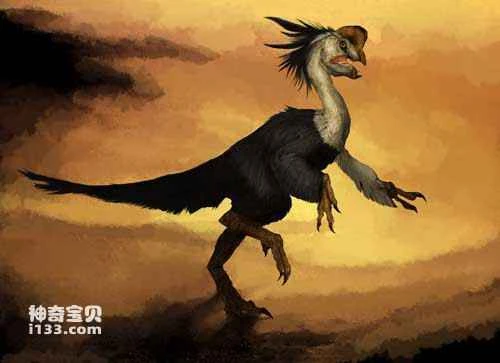
Oviraptor was 1.8–2.5 meters long and weighed 25–35 kilograms. Each hand had three fingers, each with a sharp, curved claw. The first finger was much shorter than the other two, resembling a thumb, and could curve towards the other two fingers to grip prey tightly. Oviraptor could run at high speeds thanks to its two long hind legs and three powerful claws. It had no teeth, but its beak was strong and capable of crushing bones. Its body resembled that of a turkey, and it possessed a long tail.
In most pictures and books about dinosaurs, Oviraptor is often depicted as someone who uses its beak to crack open eggshells, steal the eggs, and suck them up. However, in 1993, more Oviraptor fossils were discovered at the same site, along with similar eggs. One of these eggs even contained the tiny bones of an Oviraptor embryo. Dr. Mark Lowell of the American Museum of Natural History concluded that the Oviraptor was not killed for stealing eggs, but rather protected its own eggs, shielding the young with its long claws when danger approached. He also believed that the Oviraptor's diet consisted mainly of freshwater clams and mussels, as more Oviraptor species have been found in lacustrine sediments. Thus, a 70-year-old injustice was finally redressed. However, according to naming conventions, the curse of its name will continue, but from now on, the image of the Oviraptor in our minds will change; it will no longer be a "thief of eggs," but a dutiful parent.