Chinese name: Troodon
Latin name: Troodon
Age of existence: Late Cretaceous
Fossil sites: Canada, the United States, China
Physical characteristics: 2 to 3.5 meters in length
Diet: Carnivorous
Type: Theropod
Definition: Gnawing teeth
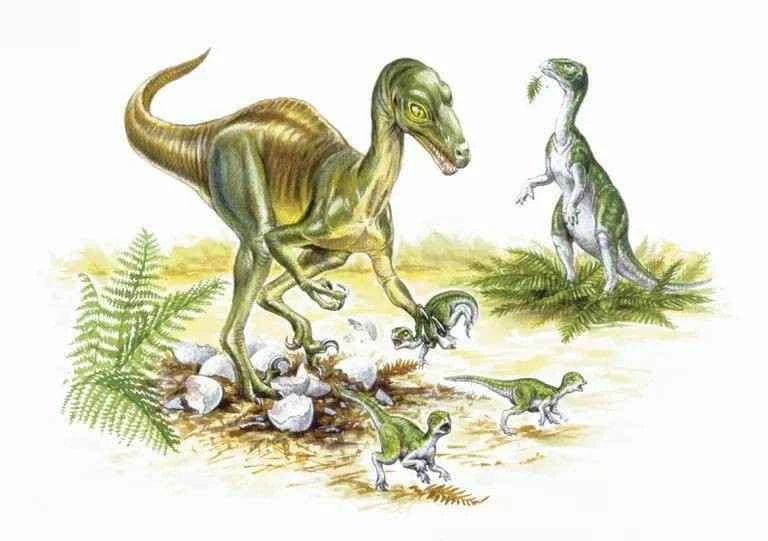
Troodon was a small theropod dinosaur that resembled the well-known Velociraptor, living in North America during the Late Cretaceous period. Its initial discovery caused considerable confusion in the paleontological community. Many paleontologists initially classified it as an ornithischian dinosaur, which would have made it the only carnivorous member of the ornithischian family. However, after a period of research, paleontologists determined that it actually belonged to the saurischia, a theropod dinosaur.
Troodon is generally believed to have primarily preyed on mammals. Their sharp claws were highly lethal, and when hunting in packs, they could kill medium-sized herbivorous dinosaurs. Compared to other carnivorous dinosaurs, Troodon had much larger eyes, indicating excellent eyesight and an ability to adapt to dark environments, which undoubtedly increased their living space.
Paleontologists and dinosaur enthusiasts alike consider Troodon to be the most intelligent dinosaur. Some even claim it slowed mammalian evolution by millions of years! Comparing brain size to body size, paleontologists have found that Troodon had the largest brain of any dinosaur, suggesting they may have been the most intelligent group of the Late Cretaceous. Some paleontologists even believe it may have had an intelligence similar to that of an ostrich, making it smarter than any living reptile. Paleontologists believe that Troodon was probably the most advanced and intelligent dinosaur during the era when dinosaurs were on the verge of extinction. According to Larry Whitmer, a paleontologist at Ohio State University, Troodon was "as cunning as a fox," small in size, bipedal, and gregarious. Through studying their brain size, Whitmer discovered that they not only possessed excellent vision but also had potential problem-solving abilities.
If dinosaurs hadn't gone extinct, could Troodon, with its relatively large brain, long claws, and large eyes, have evolved to be more intelligent over tens of millions of years? Evolutionary paleontologist Dr. Morris believes that Troodon would likely have evolved along the same path as primates or humans. Dr. Morris says, "Humans are a product of nature, evolving according to a specific, perfect model of life. If humans could evolve on Earth, why couldn't dinosaurs evolve in the same favorable way, eventually evolving into intelligent 'human dinosaurs'?"