The origin of amphibians likely occurred in the Late Devonian period. At that time, a species of lobe-finned fish ventured onto land, thus pioneering a completely new direction of adaptation and evolution.
This was an adventure for early vertebrates, a bold step into a completely unfamiliar environment to which they could only partially adapt. However, once these progressive, air-breathing fish took this step, they quickly transformed into primitive amphibians. From then on, many new possibilities were unlocked along the evolutionary path of vertebrates.
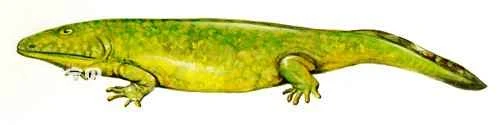
Ichthyostega
Some scientists believe that the driving force behind lobe-finned fish leaving the water and moving onto land may have been precisely the desire to obtain more water. This hypothesis suggests that some lobe-finned fish in the Late Devonian period may have faced extreme drought, forcing them to seek new ponds or streams to survive. This necessitated their journey onto arid land. As a result, some lobe-finned fish found new water sources and were able to continue their fish-like lifestyle; most explorers likely perished tragically; however, the most successful were probably those individuals who learned new ways of life on land and their descendants. They thus created entirely new terrestrial habitats, freeing vertebrates from the limitations imposed by aquatic environments and laying the foundation for advancements in evolution.
So far, the earliest vertebrate discovered by scientists to have taken to land is a primitive amphibian called "Ichthyostega".
The skull structure of the ichthyosaur is robust, and the position and shape of the bony plates on its operculum are very similar to, and even more advanced than, those of advanced lobe-finned fish. The skeletal features of the ichthyosaur exhibit a remarkable combination of amphibian and fish characteristics; its vertebrae are slightly more advanced than those of lobe-finned fish, but it still retains fish-like fin rays on its tail. Strong pectoral girdle, pelvic girdle, and the associated fully developed fore and hind limbs indicate that the ichthyosaur was fully capable of moving freely on all fours on the ground.
Starting with ichthyostega-like ancestors, amphibians (class) differentiated into three subclasses in the process of adapting to terrestrial environments: Labyrinthodontia, Schizothodontia, and Lithostomata.