More than 300 years ago, in the 18th century, the systematic classification of biology was still very incomplete. Linnaeus, a famous taxonomist at the time, collectively referred to those "worms" with roughly elongated bodies, lacking an exoskeleton, and moving by peristalsis through skin muscle contractions and body fluid pressure as worms.
In fact, the term "worms" is a collective name for many primitive animals that have just developed a three-layered body structure, encompassing a vast and complex group of animals. The term "three-layered" refers to the formation of a mesoderm between the endoderm and ectoderm, building upon the body structure of animals like corals or sponges, which typically have only two layers (endodermis and ectoderm).
Besides being produced from the mesoderm, all worms share other common characteristics, such as bilateral symmetry, body segmentation, and the formation of rudimentary appendages—parapodia.
Based on the presence or absence of a body cavity, scientists first classify worms into three main categories: acoelom, pseudocoelom, and true coelom. Acoelom worms include two major phyla: Platyhelminthes and Nematoda. Pseudocoelom worms include phyla such as Nematoda, Nematoda, Rotifers, Gastrochaetes, Kinorhynchoda, and Acanthocephala. True coelom worms include phyla such as Echinodermata, Sipuncula, Gillardia, and Annelida.
Fossils of acoelomate worms and pseudocoelomate worms are extremely rare, with only some parasitic fossils and imprint fossils remaining.
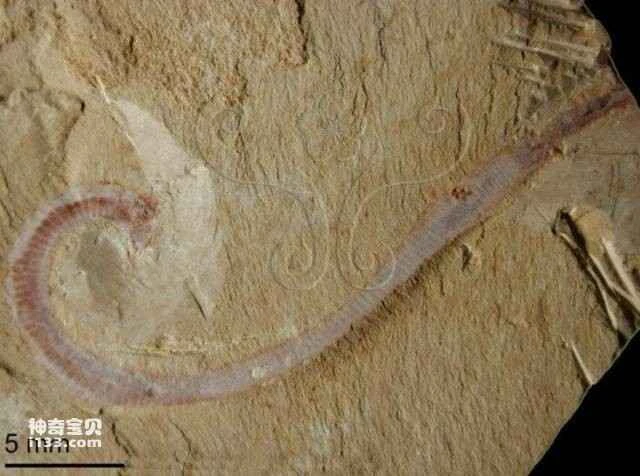
Captianshan worm
While fossil remains of true coelomic worms are rare, their jaws (teeth) and trace fossils are relatively abundant. In the 1990s, Chinese scientists discovered a large number of Cambrian fossils in the Chengjiang area of Yunnan Province, known as the "Chengjiang Fauna," including fossil remains of worms belonging to the phylum Gynostemma pentaphylum, such as *Tetracentronus*, *Cyclophorus*, and *Archaeopteryx*. These ancient creatures, which lived more than 500 million years ago in the mud and sand of the ancient ocean floor, provide scientists with invaluable clues for studying early animal evolution and the early ecological environment of Earth.