Besides corals, coelenterates also include hydras and jellyfish.
Both cnidarians and sponges belong to the diblastic phylum, but they are more advanced than sponges because they have developed specialized nerve cells and primitive muscle cells. Cnidarians also possess a central cavity for digestion, also called the digestive cavity or intestinal cavity, which is what gives them their name "cnidarian." This cavity has another interesting characteristic: unlike higher animals which have two openings—an inlet for food and an outlet for excrement—they have only one opening, which serves as both the inlet for food and the outlet for excrement.
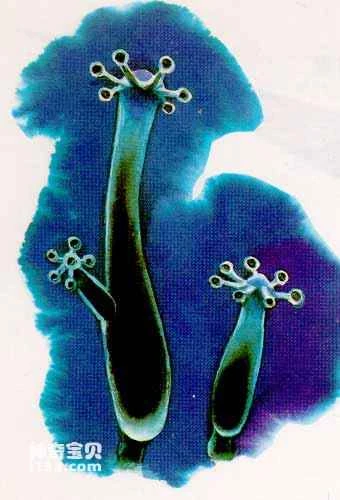
Hydra
Cnidaria appeared in Earth's oceans as early as the Precambrian period. 76% of the fossils discovered in the Precambrian Ediacaran fauna of Australia are cnidaria, primarily primitive jellyfish. This demonstrates that the Precambrian oceans were truly a world of jellyfish. Since the Cambrian, various other phyla of cnidaria have flourished and remain very diverse today; currently, approximately 9,000 to 10,000 species of cnidaria are known.
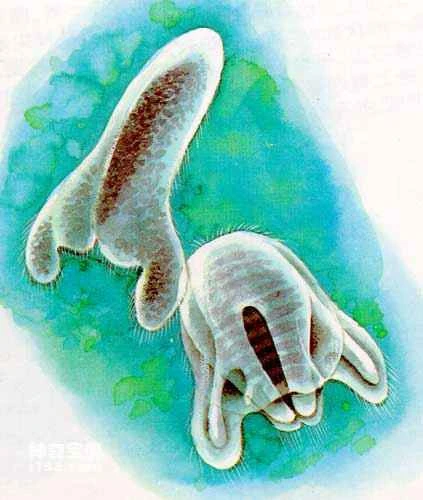
jellyfish
Based on their body structure, scientists first divided cnidarians into two subphyla: Cnidaria and Acnobasidia. Cnidaria includes four classes: Hydrozoa, Primitive Jellyfish, Scyphozoa, and Anthozoa. Acnobasidia, on the other hand, consists only of the class Ctenophora, and all of these are modern animals with no fossil representations found.
Most hydra are marine animals, with a few inhabiting freshwater. They exhibit a wide variety of forms, but the basic types are polyps and medulla. Most hydra exhibit alternation of generations between the polyp and medulla forms throughout their lives; a few species lack the medulla form or have an underdeveloped medulla form, while others have neither. Polyps are very small, generally no more than 2 to 3 centimeters in diameter, smaller than the polyps of anthozoa. They can be pouch-shaped, cup-shaped, or cylindrical, and mostly live in colonies.
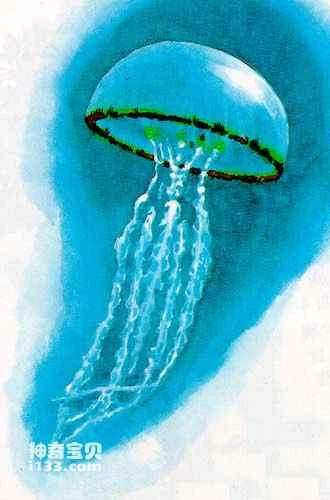
Jellyfish
Foraminifera are fossil representatives of the class Hydrozoa, appearing from the Cambrian period and continuing until the Cretaceous period before becoming extinct. They were all reef-building organisms that lived a sessile, benthic life on the seabed, and their peak period was the Silurian and Devonian periods, which were also the main periods of reef building.
The primitive jellyfish class had oval and disc-shaped bodies. They appeared in the Precambrian period and became extinct in the Ordovician period.
All members of the class Scyphozoa are marine organisms that either swim freely or live a sessile lifestyle. Most of them are large jellyfish; for example, the jellyfish, which we are familiar with and often eat, is a type of Scyphozoa. The subclass Conophyta is the main fossil representative of the Scyphozoa, and their fossils are mainly found in strata from the Early Cape period to the Permian period, especially in the Silurian and Devonian strata.