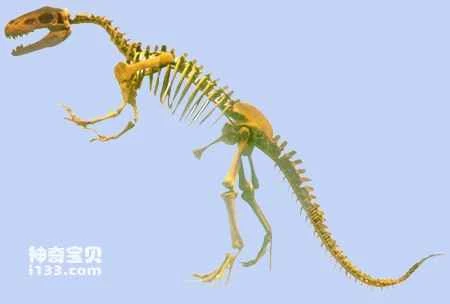
In 1942, a carnivore's right lower jaw, containing the third to second premolars, was discovered in the swamp facies strata of the Hatvan site in the Panno Basin of Hungary. M. Kretzoi analyzed the fossil specimen and concluded that the central cusp of its lower premolars was relatively thin, while the accessory cusps in front of and behind the central cusp were robust; the posterior lower molars were short and wide, with the anterior cusps being thicker and the posterior cusps thinner, and they were closely spaced. Based on these characteristics, Kretzoi established a new genus and species, *Agriarctos gaali*.
Crezzo's research article sparked great interest in the fields of zoology and paleontology. Many scholars proposed that the dental features of *Pyracantha glaucus* are similar to those of pandas, and that it should be classified as an early representative of the panda family, since *Pyracantha glaucus* dates to the Late Miocene, approximately 7 million years ago.
From then on, the Ge's suburban panda was regarded as the ancestor of the East Asian panda, and the pandas distributed in mainland China became "Chinese European species".
As time went on, researchers seemed to have settled on the claim that the Chinese panda was of European descent. Despite differing opinions, such as the statement made by Mr. Pei Wenzhong, the discoverer of the red panda (in a verbal exchange with the author), that whether the ancestors of the Chinese panda came from Europe remains to be studied, as there is too little material on *Panda gerberis* and the evidence is insufficient to be convincing.
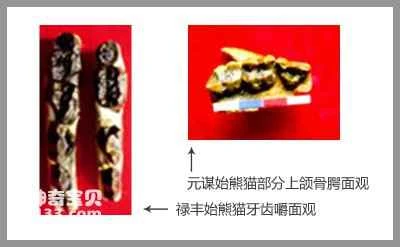
The mystery of the origin of pandas was not solved until the 1980s by Chinese scientists. They discovered fossils of *Ailuropoda lufengensis* and *Ailuropoda yuanmouensis* in the Late Miocene (about 8 million years ago) swamp facies strata of the Lufeng Basin and Yuanmou Basin in Yunnan Province, respectively.
These new discoveries have put an end to the long-standing question of the origin of pandas.
It can now be said that pandas originated, grew, and thrived on the land of China, and are a truly Chinese species.