Life originated in the primordial ocean, and the earliest vertebrates also emerged in water. Armored fish and placoderms once flourished in Earth's waters, but they quickly faded from the scene. Many factors contributed to their extinction, but the primary reason was likely the rise and development of earlier, more advanced fish. These advanced fish, what we commonly refer to as fish, possessed such sophisticated adaptations to aquatic life that they could be found in almost every corner of the Earth's waters. The idiom "the sea is wide enough for fish to leap" truly captures their evolutionary success.
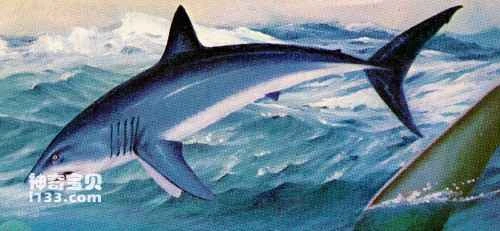
Shark - a type of cartilaginous fish
There is a Chinese idiom, "Hu Fu Qi She" (胡服骑射), which refers to the Han Chinese people of the Central Plains during the Warring States period. Because of their emphasis on etiquette, they always wore long robes with wide sleeves. When they fought against the nomadic Hu people of the north, they fought on horse-drawn chariots. This made them appear cumbersome and inflexible. In contrast, the Hu people wore short, practical clothing, rode fast horses, and were very agile, able to shoot arrows accurately from horseback. As a result, the clumsy Han Chinese always suffered losses in battle against the Hu. Later, the state of Zhao, one of the Han Chinese states, implemented reforms, adopting the Hu people's habit of wearing short clothing and their horseback archery skills, which greatly increased the fighting power of their army.
Compared to placoderms, one of the most important advanced traits of higher fishes is practically a story of "adopting nomadic dress and riding horses" in the animal kingdom. Higher fish no longer have large, heavy, and inflexible bony plates that are connected as one piece. Instead, they have various small scales that can move flexibly among themselves, which greatly enhances their mobility.
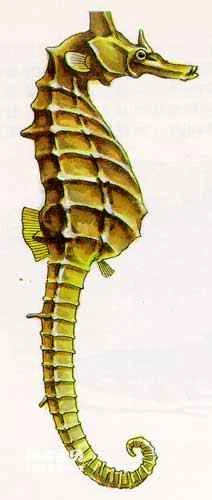
Seahorse – a type of bony fish
Among the many advanced traits of higher fish, one anatomical innovation is particularly significant. In the early stages of fish evolution, the first pair of gill arches behind the jawbone specialized into the hyoid arch, and the bones above it specialized into the hyoid bone, which supports and connects the jawbone to the skull (the skeleton that encloses and protects the brain). The hyoid bone played a crucial role in the evolution of fish and in the transition from fish to terrestrial vertebrates. Because one end of the hyoid bone connects to the posterior part of the skull (i.e., the cranium) and the other end connects to the jawbone, the gill slits, originally located between the skull and the hyoid arch, were greatly reduced. In more primitive fish, they became spiracles, but in highly advanced fish, they disappeared completely.
Higher fishes include cartilaginous fishes (class).