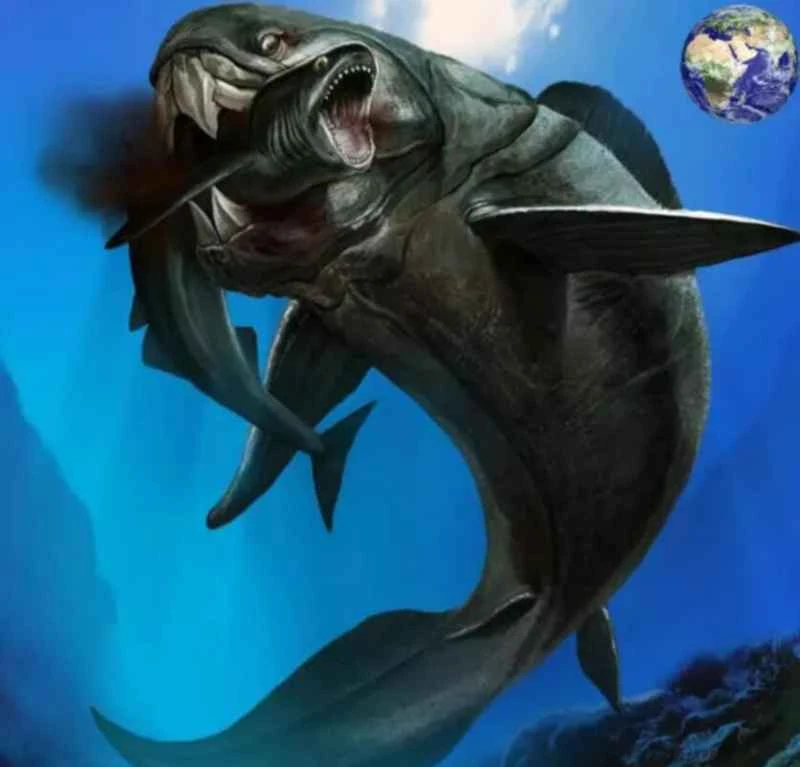
The sharks we are familiar with belong to the cartilaginous fish family.
Cartilaginous fish are almost entirely marine animals. Throughout their entire life cycle (the entire process of a life form from beginning to end), their skeletons remain cartilaginous, with the hard parts usually consisting only of teeth and spines. Most cartilaginous fish fossils are known from these parts, and occasionally, well-calcified skulls, jaws, and vertebrae are also preserved as fossils.

Slit-mouth shark
The most primitive cartilaginous fish is represented by the slit-mouthed shark, whose most complete fossils were discovered in the Late Devonian Glivland Black Shale off the southern coast of Lake Erie in the United States. Interestingly, while modern sharks typically have transverse slits in their mouths, the slit-mouthed shark's mouth is a vertical slit. The slit-mouthed shark's maxilla is connected to the skull by two joints: one is the postorbital joint, located just behind the eye socket; the other is located at the back of the skull, where the skull connects to the dorsal aspect of the hyoid bone via a connecting rod. This connection between the maxilla and skull is called a double connection, a rather primitive method. The slit-mouthed shark's teeth have a high central cusp and a low cusp on each side, a structure shared by many ancient cartilaginous fish.
The structure of the slit-mouth shark represents a primitive pattern among cartilaginous fishes in many ways, and can be considered close to the base point of the main evolutionary line of cartilaginous fishes. Later sharks may have evolved from here along their respective evolutionary paths. These include the orders Scutigera, Gastropoda, Dimetrodon, Hexanodon, Lamniformes, and Rays. These orders form one of the most abundant groups of cartilaginous fishes: Elasmobranchii. Another group of cartilaginous fishes, with fewer species and living in the deep sea, forms a separate group of cartilaginous fishes due to their unique self-connecting skull-jawbone structure: Holocera. The chimaera is a representative of Holocera, whose evolutionary history can be traced back to the Early Jurassic period.
Numerous grinding plates suitable for grinding have been found in strata from the late Paleozoic era, collectively known as the tardigrade sharks, whose phylogenetic relationship is still uncertain.
Fossilized teeth of the slit-mouthed shark have been found in the Carboniferous strata of Zhanyi, Yunnan, my country; and fossilized spines of the bow-sharp shark have been found in the Late Triassic strata of Kunming.