During the Middle Devonian, some more advanced bony fishes emerged. Part or all of their skeletons ossified into hard bone. The outer layer of the skull consisted of numerous bony plates joined together to form a complex pattern, covering the top and sides of the head and extending posteriorly over the gills. The gill arches were composed of a series of articulated chains of bone; the entire gill region was covered by a single bony plate—the operculum. Therefore, they formed individual water outlets for the gills at the movable edges of the posterior part of the operculum. Their spiracles were greatly reduced in size, or even disappeared. Most bony fishes connected their jaws to the skull via a hyoid bone—a lingual connection.
These bony fish have a central, spool-shaped vertebra called a vertebral body. These vertebrae are interconnected, forming a mobile backbone that supports the body. Spines extend upwards from the vertebrae, called medullary spines; the vertebrae at the tail also extend downwards, called vascular spines. The thoracic vertebrae are connected to the ribs on either side.
The “extra” fins have degenerated and disappeared; all functional fins are supported internally by bony fin rays.
The scales covering their bodies are completely ossified. Primitive bony fish had relatively thick scales, usually rhomboid in shape, and can be divided into two types: one is the dentate scales represented by early lobe-finned fish, and the other is the bony scales represented by early ray-finned fish. As bony fish evolved, the thickness of the scales gradually decreased, and eventually, advanced bony fish had only a thin layer of bony scales.
Primitive bony fish had functional lungs, but in most later bony fish, the lungs were transformed into swim bladders, which help control buoyancy.
In 1990, Yu Xiaobo, a researcher at the Institute of Vertebrate Paleontology and Paleoanthropology of the Chinese Academy of Sciences, discovered the spotted-scaled fish in the western suburbs of Qujing, Yunnan Province. He identified it as a primitive lobe-finned fish that lived more than 400 million years ago during the Early Devonian period. Lobe-finned fishes are a branch of the large family of bony fishes, another branch being ray-finned fishes.
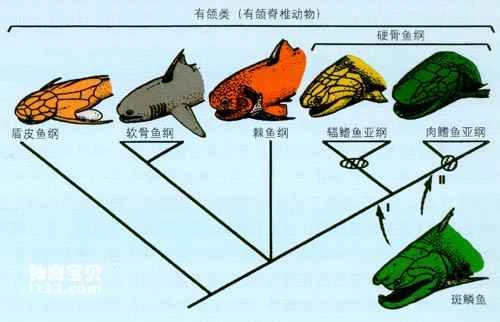
Evolutionary position of spotted scale fish
In April 1999, Zhu Min, a researcher at the Institute of Vertebrate Paleontology and Paleoanthropology of the Chinese Academy of Sciences, discovered through further research on the spotted scale fish that it may not only be the most primitive lobe-finned fish, but also the most primitive representative of all bony fishes. The many non-bony fish characteristics retained in the spotted scale fish filled a morphological gap between bony and non-bony fishes.
During the Middle Devonian period, bony fishes diverged into two major branches that went down different evolutionary paths: ray-finned fishes (subclass) and lobe-finned fishes (subclass).
In general, no other group of aquatic animals on Earth has achieved the evolutionary success of bony fishes. Even the most highly developed and complete aquatic invertebrates, such as various mollusks and the complex ammonites that evolved during the Mesozoic Era, do not reach the level of adaptation to aquatic life that bony fishes possess. Bony fishes have occupied every ecological niche in all waters on Earth, roaming everywhere from small streams to large rivers, from tiny ponds deep inland to various lakes, from shallow bays to the vast oceans at all depths. The size differences between bony fish species are also enormous; some fish never grow to more than 1 centimeter, while tuna can grow to enormous sizes. The body shapes and ecological adaptations of bony fishes are also incredibly diverse, each with its own strengths. Moreover, the number of bony fish species and individuals far exceeds the total number of many other vertebrates combined. Therefore, bony fishes are the true conquerors of the waters on Earth.