The most primitive jawed fish discovered to date are placoderms, which first appeared in the Late Silurian period and flourished during the Devonian period.
Placoderms also have bony plates that protect their bodies, usually covering the front part of their bodies. The bony plates of armored fish are a single, undivided, and immobile cylindrical structure that contains the entire body; while the bony plates of placoderms are divided into several pieces that can move between each other, making placoderms much more agile in movement than armored fish.
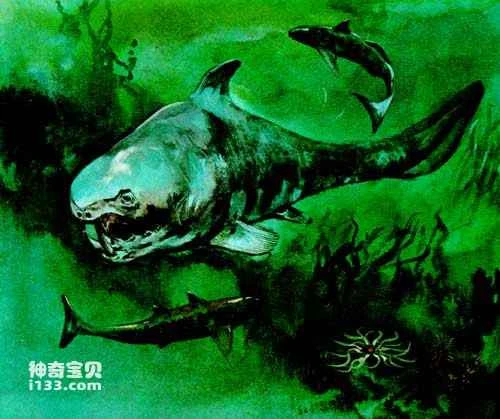
Fear Fish
These advantages of placoderms enabled them to outcompete armored fishes in the struggle for survival, leading to the development of a diverse group of fishes during the Devonian period. These included the following orders: Arthrocercoidea, Platyhelminthes, Armored Fishes, Sharpediformes, Phyllotychiformes, Pleurodontidae, and Archaeodontidae. Among these groups, Arthrocercoidea and Armored Fishes were the most abundant.
The head and body of these arthropods were encased in strong bony plates, each part forming a self-contained system connected by only one pair of joints. The structure of their jaws was unique; unlike most vertebrates, when feeding, the lower jaw remained stationary while the upper jaw rose and then slashed downwards like a guillotine. Some of these fish developed into enormous forms during the Middle Devonian, such as *Deinosuchus*, which could reach 10 meters in length! They possessed massive skulls, powerful jaws, and large, sharp, plate-like teeth at the front. These plates formed sophisticated, scissor-like edges, highly effective predation devices. *Deinosuchus* could prey on any type of fish at the time, truly a apex predator of the primitive oceans. Fossilized placoderms with similar head plates to *Deinosuchus* have been discovered in Jiangyou County, Sichuan Province, my country; this fish is known as *Jiangyou fish*.
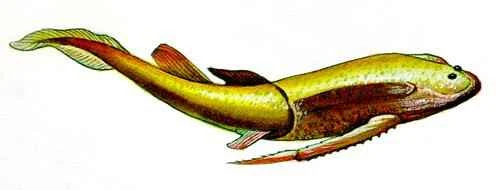
Scaled fish
Armored fishes were small, primitive jawed fishes that lived during the Middle and Late Devonian periods, typically only about 30 centimeters in length. Their heads, trunks, and pectoral fins were covered with bony plates composed of multiple scales. The scales on the trunk were particularly well-developed, resembling a box made of bone covering the fish's body. Numerous fossils of armored fishes have been discovered in my country, especially in Yunnan Province, including the most common *Goulinyu*, as well as *Wudingyu*, *Yunnanyu*, and *Dianyu*.
The posterior part of the trunk of the *Gorgosaurus* is bare, while the anterior part is encased in bony plates; the head armor is hexagonal with a "V"-shaped sensory groove. Some *Gorgosaurus* fossils still retain impressions of the soft tissues. Scientists have discovered through these impressions that there was a pair of air sacs on either side of its esophagus that connected to the pharynx, which were likely rudimentary lungs with respiratory function. Similar structures have also been found in some early bony fishes, leading scientists to speculate that lungs existed in the origin of vertebrates, only to undergo secondary degeneration in later fish-like vertebrates.