From childhood to adulthood, pork has been the most consumed meat, making it the undisputed king of livestock in the hearts of urban and rural residents across my country. Pork is rich in protein, ensuring healthy growth and development; pig skin is rich in collagen, aiding skin metabolism; and pig bones contain collagen, strengthening bones. We can use them to make bone broth, stew vermicelli, make meatballs, craft leather shoes, and craft brushes, among other things. If your knowledge of pigs is limited to this, let me introduce this gentle and lovable creature. Actually, there's much more to it than you might not know.
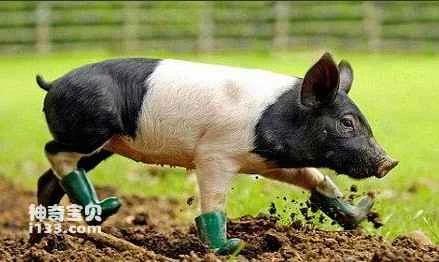
Pigs contain a large amount of collagen, which can be extracted and converted into gelatin. This gelling agent is then used in food, such as in the production of gummy candies. Besides candy, pork gelatin is also used in some beers, wines, and juices to improve the dullness of beverages, acting as a clarifier by reacting with tannins in the liquid to absorb dark substances.
Fatty acids extracted from pork bone fat can be used to make shampoos and conditioners, giving hair a pearly shine. These fatty acids are also used in various body creams, foundations, and anti-wrinkle creams. Glycerin, derived from pork fat, is also an ingredient in many toothpastes.
Surprisingly, cigarette manufacturers use hemoglobin from pig's blood in cigarette filters. This component acts as an "artificial lung" in cigarettes, effectively reducing the toxicity of cigarettes to the human body.
In fact, nothing about a pig is wasted. Pig snouts can be used to make fried dog food, while pig ears, due to their resemblance to human tissue, are used in chemical weapons testing. Pig bone gelatin is used to help load bullets with black powder or smokeless powder. Tattoo artists even buy pigskin to practice their skills, and because pigskin resembles human skin, it is sometimes used on burn patients. Even pig manure and urine have extremely high value; they are currently among the highest quality and most abundant fertilizers in my country, and a major source of organic fertilizer.

In short, pigs truly deserve the old saying, "Every part of a pig is a treasure."
Scientists have also discovered that pigs aren't inherently dirty. They don't have many sweat glands on their skin, so they like to soak in water to cool down on hot days. Pigs are also hygienic; they always try to stay as far away from where they eat and sleep as possible when defecating or urinating. It's just that people keep them in pigsties, which prevents them from getting too dirty.
Pigs typically explore their environment by using their senses, such as seeing, hearing, smelling, nibbling, and rooting, in order to gain knowledge and adapt to their surroundings.
Pigs have a highly developed sense of smell, capable of detecting and distinguishing any odor. This is due to their well-developed snouts, extensive olfactory regions, large villi on the olfactory mucosa, and densely distributed olfactory nerves. Piglets can identify scents within hours of birth to locate teats, and within three days they will consistently choose a teat for nursing without confusion. Sexual relations between male and female pigs also rely on the sense of smell. Boars can detect estrus sows from over two kilometers away, and estrus sows will exhibit a "stand still" reaction even when the boar is not present, upon smelling the boar's distinctive sex hormone scent. Pigs can also use their sense of smell to locate food buried deep underground and accurately pinpoint any foreign objects underground. Measurements show that the part of a pig's brain responsible for olfaction is roughly the same size as the parts responsible for hearing and vision combined, making their sense of smell several times more developed than a dog's and 7-8 times more developed than a human's. Therefore, with proper training, pigs can sniff out landmines buried in the ground, can be used as customs detection animals, and even serve as guard dogs. It is said that a farmer, to prevent his cattle from being bitten by snakes while drinking at a pond, raised two pigs to guard the pond instead, with excellent results. In the United States, some people have raised pigs in their fields, and the number of venomous snakes in the fields has significantly decreased. This suggests that pigs can deter snakes. Scientists have experimentally proven that raising pigs to prevent snake bites has a scientific basis, because pigs have a thick layer of fat that can neutralize snake venom and prevent it from entering the bloodstream.
Pigs also have highly developed hearing. Their large ears and deep, wide ear canals allow them to keenly detect even the faintest sounds. Furthermore, their flexible head movements allow them to quickly determine the direction of a sound source. Their auditory analyzers are also sophisticated, capable of distinguishing sound intensity, pitch, and rhythm, making them easily conditioned to quickly establish conditioned reflexes to various commands and auditory stimuli. After training, pigs can dance, drum, swim, salute, spin in place, open and close cages, push carts upright, and even produce sounds similar to human speech, all in a shorter time than dogs.
When you think of pigs, what's the first thing that comes to mind? A gluttonous, lazy, and stupid pig? By now, you should realize that pigs are actually far more intelligent than we imagine; they are animals that appear foolish but are actually quite wise. It's fair to say that among the animals people commonly eat, pigs are undoubtedly the most intelligent. In many ways, even dogs aren't as smart as pigs!
Experiments have revealed that pigs possess an astonishing memory. They can remember the locations of different food storage areas and the size of each storage compartment. If they sniff out which of their companions knows the location of the food storage area, they will immediately follow that pig. The pig being followed is also very clever; it will find a way to shake off its follower and enjoy the food alone. In some regions of France, a precious black truffle grows underground. Local farmers use pigs as invaluable assistants in harvesting this truffle. Pigs can smell the truffle growing 25-30 centimeters underground from as far as 6 meters away. While dogs can also perform this task, training dogs is much more difficult than training pigs, and they must be trained to search daily; if there is a gap of a few days, they will forget. Pigs, however, will not forget the skill they have learned, even if they only search once a week. Professor Held of the University of Bristol said, "Because of their excellent memory, once they learn something, it is very difficult for them to forget it."
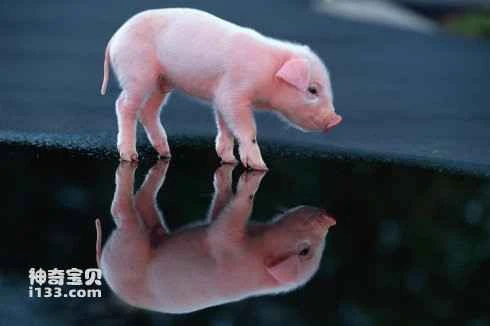
Mirrors are often used to test self-awareness and higher intelligence. Most infants can recognize themselves in the mirror after 18-21 months. Later, it was discovered that chimpanzees, elephants, dolphins, and several types of birds also possess this ability. Now, experiments have shown that pigs can also recognize themselves in a mirror and use the mirror's reflective function to observe their surroundings and find food. Pigs can also recognize shapes and can group similarly shaped pieces of wood together, just like a three-year-old child. Current research has found that with special training, pigs have even learned to use high technology, enjoy computer games, and adjust indoor heating according to temperature. They are also the only working animals capable of using self-service food machines!
In fact, experiments conducted as early as the 1990s had already found evidence that pigs are also intelligent. In the experiments, pigs were trained by researchers to move a pointer on a screen with their snouts and use the pointer to find the graffiti they first saw. The results showed that the time they took to complete this task was almost the same as that of chimpanzees, demonstrating their remarkable intelligence.
Biologists have discovered that pigs' metabolism, heart structure, and tooth arrangement are similar to those of humans. Their vascular system is identical to that of humans and chimpanzees, and they even share many of the same habits as humans. Professor Shuk of the University of Illinois at Urbana-Champaign said, "Pigs like to lie around everywhere, and if you give them water, they'll drink it. Given the opportunity, they might even smoke and watch TV."
A pig's life is a happy one. Even if the whole world calls it stupid, it doesn't care or complain. It still eats heartily and sleeps lazily. Adorable pig, we all know you selflessly give away every part of your body, but who knew you also possessed such a broad mind and a clever brain!