Recently, nearly a hundred Chinese Crested Tern, known as the "mythical bird," arrived in Qingdao, much to the delight of birdwatching enthusiasts in the city.
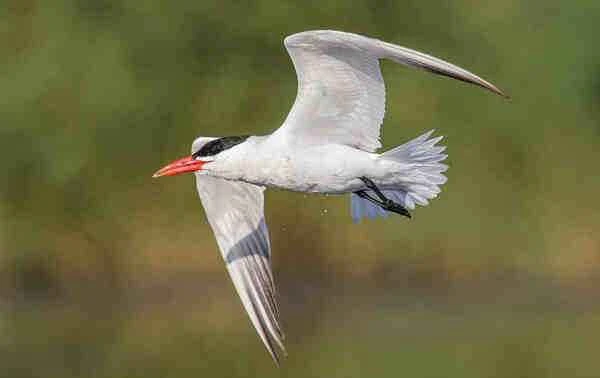
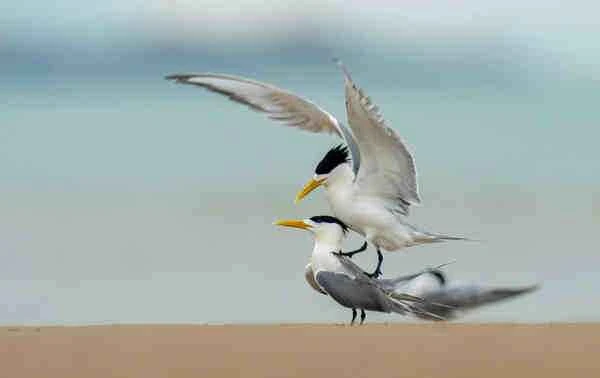
The Chinese Crested Tern is a medium-sized waterbird, measuring 38-42 cm in length. Its forehead, crown, and crest are black; upperparts are pale grey; wings are grey with black outer webs on the outer primary flight feathers. The tail is white and deeply forked. The underparts are white. The bill is yellow with a broad black tip. The legs are black. Non-breeding plumage is similar to summer plumage, but the forehead and crown are white. The iris is brown. The bill is slightly thicker and more curved than that of other terns, yellow in color, and has a black subterminal patch at the tip.
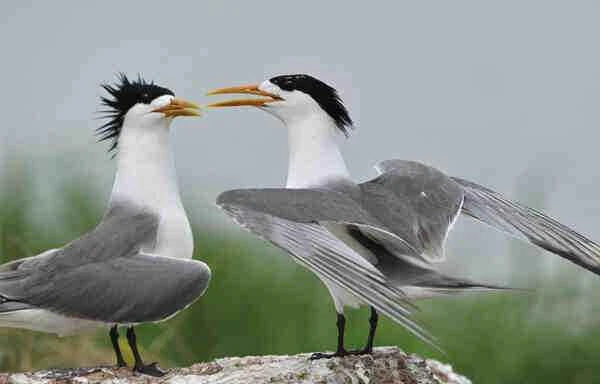
The Chinese Crested Tern is one of the rarest birds in China, listed as Critically Endangered on the IUCN Red List of Threatened Species, at the highest level of danger of extinction. Because of its small population and near extinction, it is often found among flocks of terns, making it difficult to observe. People know little about its habits, and it is described as mysterious, precious, rare, and uncommon, leading scholars to call it a "mythical bird."
The Chinese Crested Tern was first recorded in 1861, but remained extremely rare until 2000 when it was widely believed to be extinct. However, in 2000, four adults and four juveniles were rediscovered in the Matsu Islands off the coast of Fujian Province, becoming major news in the ornithological community. In 2004, another breeding colony was discovered in the Jiushan Islands off the coast of Zhejiang Province. These two colonies are the only two remaining populations in the world.
On August 19, 2016, Yu Tao, a member of the Qingdao Birdwatching Association, spotted the Chinese Crested Tern again near the estuary of the Dagu River in Jiaozhou Bay during a waterbird survey. The initial sighting recorded four Chinese Crested Terns, including two adults and two juveniles. Further detailed investigation revealed six more adults in the intertidal zone approximately 500 meters west of the initial sighting location, and one adult was also found at the estuary of the Yanghe River. The Chinese Crested Terns discovered in Qingdao are dispersed birds after completing their breeding season.
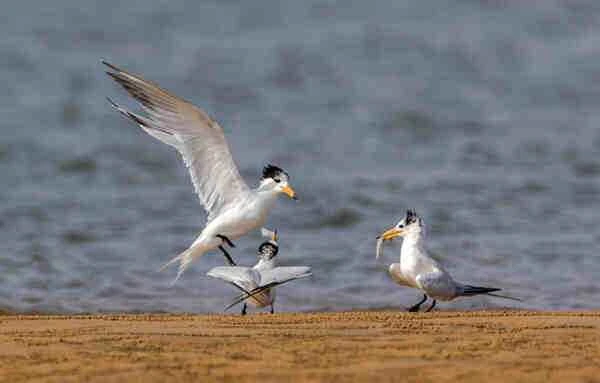
In April 2021, the Chinese Crested Tern was listed as a critically endangered species by the International Union for Conservation of Nature (IUCN) and is one of the "100 most endangered species". There are currently about 100 individuals left in the world. It is listed as a Class I protected animal in my country.
On October 7, 2021, Xu Keyang and Yu Tao, investigators from the Qingdao Birdwatching Association, made a surprising discovery during a routine survey of waterbirds in Jiaozhou Bay: 37 individuals of the critically endangered Chinese Crested Tern. This is the largest single record of the Chinese Crested Tern outside of its breeding season to date. The global population of the Chinese Crested Tern is estimated at only around 100 individuals, meaning this record represents nearly 40% of the species' global population. Since 2016, the Chinese Crested Tern has visited the Dagu River estuary in Jiaozhou Bay for five consecutive years, indicating that the Dagu River estuary wetland has become an important migratory stopover for this species.
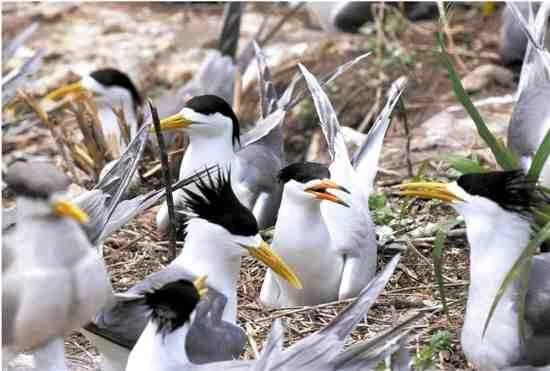
Xue Lin, president of the Qingdao Birdwatching Association, explained that as the number of Chinese Crested Tern continues to increase, the association conducts daily monitoring of areas with high concentrations of these terns. They also comprehensively record the overall distribution, adult-to-juvenile ratio, individual molting status, food structure, breeding behavior, population changes, flag records, and stress factors of the Chinese Crested Tern in Jiaozhou Bay. It is expected that the number of Chinese Crested Tern in Jiaozhou Bay will reach its peak in October, which is still more than a month away. It is believed that as time goes on, even more Chinese Crested Tern will gather in Jiaozhou Bay.
However, Xue Lin also reminded birdwatchers that in order to further ensure a peaceful and comfortable living environment for these "mythical birds," the Chinese Crested Tern habitat on Hongdao Island will be closed to the public starting August 23rd. Bird photographers and birdwatchers will not be allowed to visit at this time. "We must all work together to protect the habitat of these rare species so that they can thrive. I hope that one day in the future, the bird habitat can be fully opened to the public, allowing more people to appreciate these critically endangered species, and also ensuring that our future generations can enjoy them," Xue Lin said.
Protect wild animals and ban the consumption of wild game.
Maintaining ecological balance is everyone's responsibility!