Scientific name: *Casuarius* spp. (genus *Casuarius*) | Order: *Casuariiformes* | Family: *Casuariidae*
Extant species: Southern cassowary (C. casuarius) , Northern cassowary (C. unappendiculatus) , Dwarf cassowary (C. bennetti)
Distribution: New Guinea and surrounding islands , northeastern Australia (Queensland rainforest)
Size: Southern cassowary stands 1.5–1.8 m tall and weighs ~70–80 kg ; dwarf cassowary is smaller. Tags: Flightless giant forest bird | Helmala (cerebellum) | Low-frequency "chest-feeling" call | Dangerous inner toe claws
I. Quick Overview: Why is it called "the most dangerous bird"?
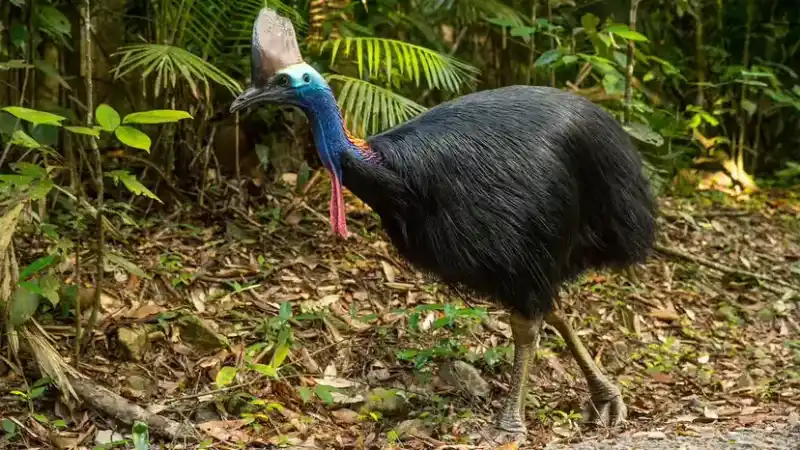
The southern cassowary (Casuarius casuarius) lives only in Australia, and land clearing, vehicle collisions, wild boars, and wild dogs are its main threats to survival.
Powerful hind limbs + dagger-like inner claws : The inner claws on each foot can reach 7–12 cm , which, when combined with front kicks/downward chops, can cause severe lacerations and puncture wounds .
Highly mobile : It can run at high speeds (~50 km/h) even in dense forests, and turn and jump nimbly.
Protective "armor" : The body is covered with dense, coarse, straight black feathers , like a "raincoat"; the chest and abdominal muscles are well-developed and the pelvis is stable.
Behavioral characteristics : They generally avoid humans , but may become aggressive when provoked, protecting their young, accidentally ingesting human food , or when surrounded.
Safety tips: Do not approach, feed, or chase ; when encountering obstacles on forest trails, slow down and give way , keeping obstacles in front of you.
II. What is a cassowary? — A giant rainforest bird belonging to the order Cassowaries.
Cassowaries and emus belong to the same order Casuariiformes and are typical flat-chested birds with no flight muscles (ratites) .
Habitat : Moist tropical rainforests – New Guinea and surrounding islands, lowland-hill rainforests of northeastern Australia.
Ecological niche : Large frugivorous animal in the forest, adept at traversing shrubs and fallen trees.
Flight ability : Cannot fly - wings are extremely small, like "broken wings", feathers are long and coarse , more like "mane".
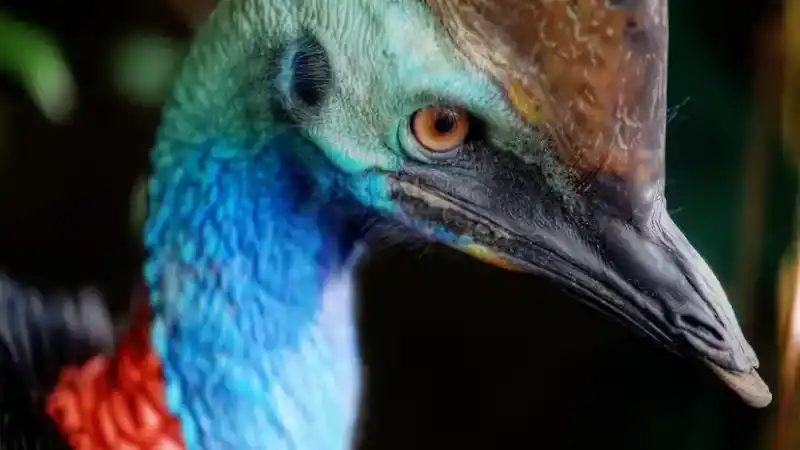
A close-up of a Southern Cassowary in the Dantry Rainforest of northern Queensland, Australia.
III. What does it look like? — A combination of "helmet, beard, hair, and boots".
Casque : A helmet-shaped protrusion on the top of the head, covered with keratin , with a hard outer shell and a porous interior .
Possible functions: ① Protection (head protection when hitting dense vines); ② Acoustics (or participation in low-frequency sound resonance/amplification); ③ Display (individual age/health signals).
Face and neck color : bare skin appears bright blue/purple ; southern and northern cassowaries have wattles , with significant individual differences in color and shape.
Feathers : Black, long and separated , which helps to conduct water and prevent scratches from thorns .
Foot claws : Three toes, with the inner toe claw being the longest and sharpest , which is its "signature weapon".
IV. What to Eat? — The Ecological Value of the "Rainforest Seeder"
Cassowaries are a keystone species .
Diet : Mainly consists of ripe fallen fruit , but also includes fungi, insects, and small vertebrates (opportunistic).
Seed dispersal : Its large size makes it possible for it to ingest and disperse large-diameter seeds ; its excrement contains "organic fertilizer," promoting seedling regeneration and rainforest diversity.
Ecological significance : Some large rainforest trees (such as species endemic to northern Australia) are highly dependent on long-distance dispersal .
Fifth, the "head of the family" is the father: a unique approach to reproduction and childcare.
Division of labor between male and female : After laying eggs, the female bird leaves , while the male bird incubates the eggs and raises the chicks alone (raising the chicks for up to 9 months).
Breeding strategy : Female birds can breed with different males in one season to expand gene output ; male birds bear the cost of raising young.
Nesting site : A simple nest made of fallen leaves and branches on the woodland ground.
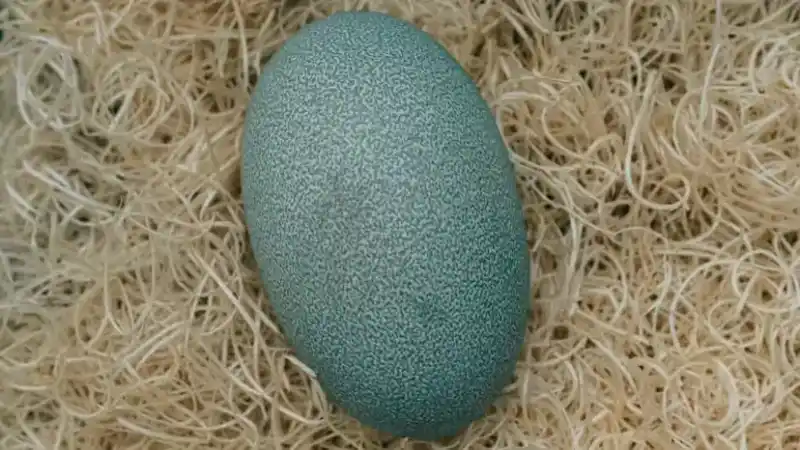
The female cassowary lays a bright green egg in the nesting material.
VI. Cassowaries vs. Emus: Same Order, Different Families
| Dimension | Cassowary | Emu |
|---|---|---|
| division | Cassavaidae | Dromaiidae |
| Habitat | Predominantly rainforest (New Guinea/Northeast Australia) | Open scrubland and grassland (Australian continent) |
| headdress | The helmet-like protuberance is prominent , and some species have a dewlap. | No helmet-like protuberance, little bare skin on the neck |
| Danger | The inner toe claw is long and sharp, with strong attack power. | Be alert and run quickly; relatively low aggression. |
| color | Blue/purple and red drooping neck (partial) | Body feathers are brownish-gray with mixed colors |
VII. Why can't it fly? — A trade-off between feathers, bones, and ecology
Feather morphology : Long, thick, and straight feathers with strong water separation ability, which are not wing-shaped feathers capable of generating lift .
Skeletal muscles : The sternum is flat and lacks the keel process to support the flight muscles; the hind limb-pelvis-tailbone muscles are well-developed, with running/kicking being the priority .
Ecological drivers : In the forest , high-speed escape and strong counterattack are more effective than flight; evolutionary selection favors ground-based living performance .
8. Why is it dangerous? — The combination of "speed + claw"
Speed and forest penetration ability : It can still achieve high-speed straight-line/change-of-direction maneuvers in dense forests .
Weapon system : Inner toe claw (3–5 inches) + powerful front kick/down kick that can cause deep wounds and massive bleeding .
Triggering scenarios : When protecting young animals/being threatened/being approached or having food snatched; human feeding can induce begging and collision behaviors .
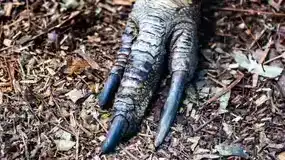
The claws on the inner toes are especially frightening, reaching up to 5 inches in length!
Although such incidents are relatively rare , the consequences can be severe if they occur . The best "defense" is to avoid getting close and provoking such situations .
IX. Guidelines for the "Safe Distance" Between Humans and Turkeys
When encountering someone on a forest path : Slow down, step aside to let them pass , and keep large trees/shrubs as cover; do not look directly at them or approach too closely.
Never feed them : This is to avoid creating a conditioned reflex and feeding aggression.
Keep chicks away : The danger threshold is significantly reduced when chicks are present.
Vehicles please note : Slow down on tropical highways passing through forest sections and be aware of areas near the forest edge.
Viewing method : Prioritize zoos/compliant wildlife parks and follow the guidelines of the keepers and guides.
10. Where can we see them? — The "low-frequency, low-profile" forest hermits
In the wild : Concealed by dense forests, their low-frequency rumbling calls, which can be felt in the chest , are close to the lower limit of human hearing; their hearing is excellent , and they often avoid you before you even get close.
Organizations : Regular zoos and conservation parks allow for close and safe observation; their extremely low-frequency "thumping" sound can be heard.

Adult cassowaries and chicks.
XI. Conservation Status: Rainforest Shrinkage, Road Casualties, and External Threats
Key threats include habitat loss/fragmentation , road vehicle collisions , nest attacks by invasive/free-range animals such as dogs and wild boars , and illegal hunting and feather trade .
Overall assessment : The IUCN currently lists it as LC (Least Concern) in most areas, but populations are declining in many regions ; it is often listed as a key protected species at the local level.
Key initiatives : rainforest land buyback and restoration , corridor connectivity , canine control , public education and ban on feeding .
Readers can understand the card at a glance.
Danger source : Inner toe claw + explosive force (the real physical basis for "injury")
Identification features : bluish-purple head and neck + thick, straight black feathers + helmet-like calcaneus
Ecological role : Large seed disperser , maintaining rainforest biodiversity
Encounter Rules : Do not approach, do not feed, slowly back away , and place an obstacle between you and the bird.
FAQ (Frequently Asked Questions)
Q1: Do cassowaries really attack people on their own initiative?
A: Tendency to avoid . Risk increases when caring for young, being approached, provoked, or learning to beg for food . Avoiding approach and feeding can significantly reduce conflict.
Q2: How fast is it? Why is it so difficult to deal with?
A: It still maintains high speed and agile turning in the forest; the long claws on its inner toe can cause puncture/tears, which is the physical source of its "danger".
Q3: What is the function of the helmet?
A: There is no definitive conclusion yet. Hypotheses such as protection/acoustic amplification/display coexist, suggesting it may have multiple functions .
Q4: Why can't it fly?
A: Flat chest structure , extremely short wings , and feathers without lift structure , indicating that evolution prioritized running and living in the forest .
Q5: What is the relationship between you and the emu?
A: They belong to the same order Cassowariformes , but are in different families ; they have significant differences in habitat, appearance and behavior.