Scientific name: Nigersaurus taqueti | Genus: Nigersaurus | Group: Sauropoda (Diplodocus type)
Period of existence: Early to Middle Cretaceous (approximately 115–105 million years ago)
Size: Approximately 9 meters in length and weighing about 4 tons (comparable to an African elephant but with a lighter frame).
Habitat: The former river-flood plains and humid woodlands of the present-day Sahara. Nickname: "Mesozoic Cow" (grazing with its head down in a "grazing" manner).
Keywords: Nigersaurus, 500 dinosaur teeth, dental battery, Cretaceous Niger, low-lying dentition
I. Why are they called "Mesozoic Dairy Cows"? — From mouthparts to feeding methods, they are "herbivorous machines".
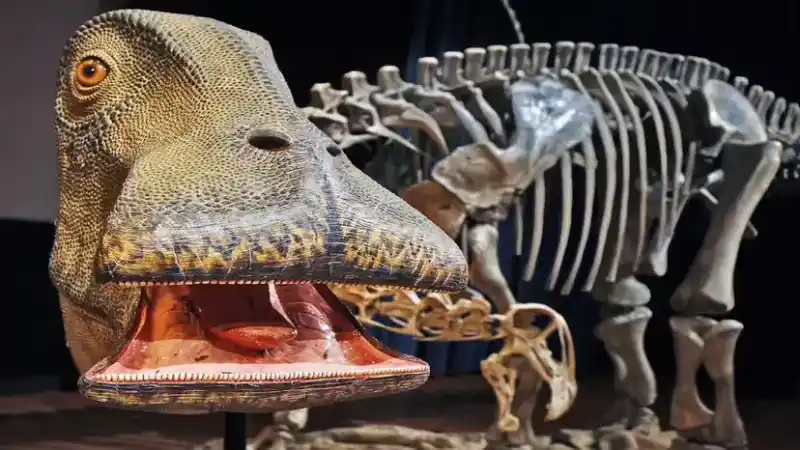
This is a reconstructed skeleton of Nigersaurus, a very peculiar herbivorous dinosaur. This is a sculpted model of Nigersaurus's distinctive head shape, reconstructed by scientists based on their estimations. Behind it, a casting model based on the Nigersaurus skeleton was assembled to its correct shape. Image credit: Bill O'Leary/The Washington Post/Getty Images
The most counterintuitive feature of the Nigerosaur is its extremely flat and wide snout and its row of prominent scissor-like teeth .
Extra-wide snout : When viewed from above, it resembles a vacuum cleaner head ; the upper jaw "incisor area" is extremely wide, and the snout tip is slightly curved.
Dental batteries : **Each jaw consists of dozens of rows of "dental columns"** arranged in a tight "dental array". Multiple teeth are stacked vertically on one column . When the upper tooth wears down, the lower tooth immediately takes its place .
Number and distribution of dental columns : approximately 60 rows of slender teeth in the upper jaw and approximately 68 rows of sharp teeth in the lower jaw, with a total of 500+ teeth in the oral cavity (including new teeth that are being replaced and are "in the queue").
Tooth replacement is fast : the crown wears out quickly, and studies suggest that it takes about 14 days for a new tooth to be in place – equivalent to a lawnmower with its own consumables supply.
These characteristics collectively served to graze on low-lying vegetation : Nigerosaurus swept horizontally close to the ground , snipping at tender vegetation such as ferns, horsetail, and low-growing angiosperms like cattle and sheep. Compared to most sauropods that "raise their heads to feed," Nigerosaurus was a "head-down" species, hence the name "Mesozoic dairy cow."
II. How were 500+ teeth that "relay" together accommodated?
The "500+" we're referring to doesn't mean "500 teeth in a row," but rather the total number of replacement teeth in each row of teeth :
Tooth column = "cell" of a tooth battery : the active occlusal tooth is at the top, and several reserve teeth are arranged in sequence below.
Multiple rows arranged side by side, like "sardines in a can" : the rows are very close together, covering the front edge of the snout , forming an ultra-wide cutting edge .
Advantages : ① High shearing efficiency ; ② Wear-resistant (constantly updated); ③ Low maintenance cost (high-frequency cutting without complex jaw muscles).
3. Why is it one of the "strangest sauropods" even though it is not the largest in size?
Compared to common sauropods that often reach 12–26 meters in length, Nigerosaurus was only 9 meters long and weighed about 4 tons , classifying it as a "small sauropod." However, its skull and neck-to-torso design has paleontologists calling it "outlandish."
Featherweight skull : The skull plates are as thin as ~2 mm , in exchange for energy efficiency when bending down to eat and swinging rapidly, resulting in a lightweight design.
The spine is highly pneumatic (air sac) : a large proportion of the vertebrae are cavities (analogous to the air sac system of birds), and bone mass < cavity volume appears in some vertebral segments - weight loss but difficult to preserve .
Short neck + low head : The front teeth at the snout and the relatively short neck make it more suitable for large-scale "carpet-style" biting rather than picking branches with the head tilted back.
The combination of a low skull, wide snout, tooth array, and lightweight skeleton makes it the most "herbivorous" sauropod of its age .
IV. How exactly does it live? —Time, place, and neighbors
Timeline : Approximately 115–105 million years ago (Early–Middle Cretaceous) .
Location : present-day Niger (southern edge of the Sahara), then a humid landscape of forests, river channels, and floodplains .
Neighboring predators : Potential threats include giant crocodilians such as Sarcosuchus (Demosuchus).
Recipe : Ferns, horsetails, low-growing angiosperms , and other easily cut soft vegetation; group-harvesting by creeping and biting is extremely efficient.
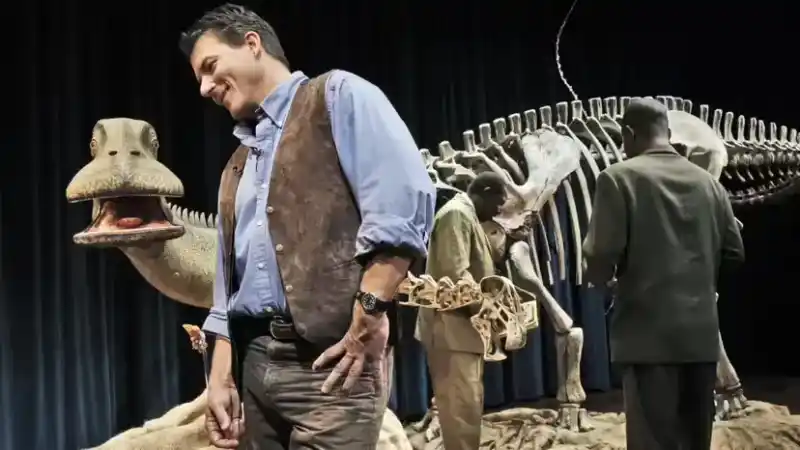
Dr. Paul Sereno (left) with Nigerian archaeologists Dr. Maga Abdullaye (center) and Dr. Id Omaru (right) on stage, displaying the reconstructed skeleton of Nigerosaurus.
V. Should the head always be down? — A brief history of the controversy surrounding posture.
Early studies speculated, based on the orientation of the semicircular canals (LSCs) in the inner ear, that Nigerosaurus " normally lowered its head " and walked with its nose pointing downwards at approximately 67° . Subsequent papers (2009, 2013) pointed out that LSC alone is insufficient to determine the daily head position of sauropods .
Current reasonable interpretation :
The posture of bowing the head while eating is almost certain;
The posture of walking silently/being alert can be changed according to the situation;
The conclusion that "absolutely" requires a life of looking down still needs more comprehensive evidence (cervical spine articular surface orientation, soft tissue estimation, etc.).
VI. Discovery and Naming: A Half-Century "Jigsaw Puzzle"
1950s : French teams collected scattered bone fragments in the Sahara, which have not yet been named .
Since 1997 : Paul Sereno's team has successively found more complete skulls and skeletons , which can restore **about 80%** of the skeleton, revealing the "vacuum cleaner nozzle + teeth battery".
1999 : Named Nigersaurus taqueti (in honor of paleontologist Philippe Taquet).
Challenges : The thin, fingernail-like bone plates and honeycomb-like vertebrae are extremely fragile and prone to weathering, making collection and restoration highly difficult .
7. Why can this "herbivore machine" thrive in the Sahara?
Resource matching : The low-lying grass belts in the floodplains are abundant and renew quickly;
Low feeding cost : wide leading edge shears + rapid tooth replacement , supporting high-frequency biting and cutting ;
Lightweight and mobile : Feather-thin skull + highly aerodynamic vertebrae , reducing energy consumption during head raising, neck swinging, and walking;
Risk hedging : Group activity plus visibility in open areas (speculated) could help deal with ambushes.
Quick glance cards (to help readers "understand at a glance")
Key selling point : 500+ teeth that will be constantly replaced , concentrated at the anterior edge of the snout , designed specifically for low-position "grass-scraping" biting .
Memorable features : flat, wide "vacuum cleaner" nozzle , small head, short neck , and light frame .
Living environment : River network—meadow—forest edge , slowly advancing, sweeping across the foraging area.
"Cutting-edge technology" : Tooth battery (upper grinding and lower filling), highly air-filled vertebrae (bone volume < cavity), rapid tooth replacement ~14 days/tooth (estimated value).
Frequently Asked Questions (FAQ)
Q1: Does Nigersaurus really have 500 teeth?
A: The total number of teeth in the oral cavity (including replacement teeth) is 500+ . Its "tooth battery" consists of multiple rows of tooth columns arranged side by side, with multiple teeth stacked vertically in each row. As the upper layer wears down, the lower layer replaces it, so the total number far exceeds the number of teeth visible on the occlusal surface.
Q2: What does it eat? Why does it have so many teeth?
A: Primarily low-lying, soft plants (ferns, horsetails, dwarf angiosperms). High-frequency shearing and rapid wear require continuous fillings ; multiple teeth and rapid tooth replacement provide a double guarantee of efficiency and durability .
Q3: Compared to Brachiosaurus and Diplodocus, is it "short"?
A: Yes, 9 m / ~4 t is considered small for a sauropod; however, its feeding efficiency and adaptability are extremely high, which is another "successful route".
Q4: Did it really keep its head down the whole time?
A: The reliance on head-down posture while eating is plausible; however , daily head position remains controversial. LSC alone is insufficient to draw a conclusion; multiple pieces of evidence, including those related to the cervical spine, ligaments, and muscles, are needed.
Q5: Why did it not make its "full debut" until the 1990s?
A: The bone is extremely thin and highly cavitary , making it extremely difficult to preserve and repair; it was only through systematic excavation and advancements in CT/repair technology at the end of the 20th century that the "vacuum cleaner nozzle + dental battery" could be clearly reconstructed.