Many people mistake penguins and puffins for relatives at first glance—their black and white plumage, orange feet, and waddling gait make them look like they're wearing the same "seabird suit." But if you want to understand the difference between penguins and puffins , the answer isn't just black and white: they are not closely related, live on opposite sides of the earth, one can fly while the other cannot, and they swim in different ways in the sea.

A Quick Look at the Core Differences
| Dimension | Penguin | Puffin |
|---|---|---|
| pedigree | Spheniscidae (Penguinidae) | Family Alcidae / Fratercula |
| Number of species | There are approximately 18 extant species (17–20 in different classification systems). | Four species (e.g., Atlantic puffin) |
| Geographical distribution | Southern Hemisphere (from Antarctica to South America, Australia and New Zealand, etc.) | Northern Hemisphere (North Atlantic–Arctic Ocean coast, Iceland accounts for a large proportion of the global area) |
| Will it fly? | It cannot fly ; its wings have evolved into flippers. | It can fly , with short wings flapping at high frequency; it is also adept at short-duration diving. |
| underwater propulsion | Propelled by flapping its " wings " through the water, it can reach speeds of approximately 30+ km/h. | Use your wings and feet for short dives, each lasting about 20–30 seconds. |
| body shape | There are significant differences between little blue penguins and emperor penguins; emperor penguins can weigh around 30 kg . | Small and compact in size, typically large enough for an adult to encircle with their arm; weighing approximately 0.5–0.8 kg. |
| social contact | Most species are highly gregarious , forming breeding grounds/penguin colonies during the breeding season. | They are highly gregarious and have dense breeding grounds; they can be attracted by simulated bird decoys. |
| recipe | Mainly fish, krill, and cephalopods | They primarily feed on small fish (such as grass carp and capelin), and also consume crustaceans. |
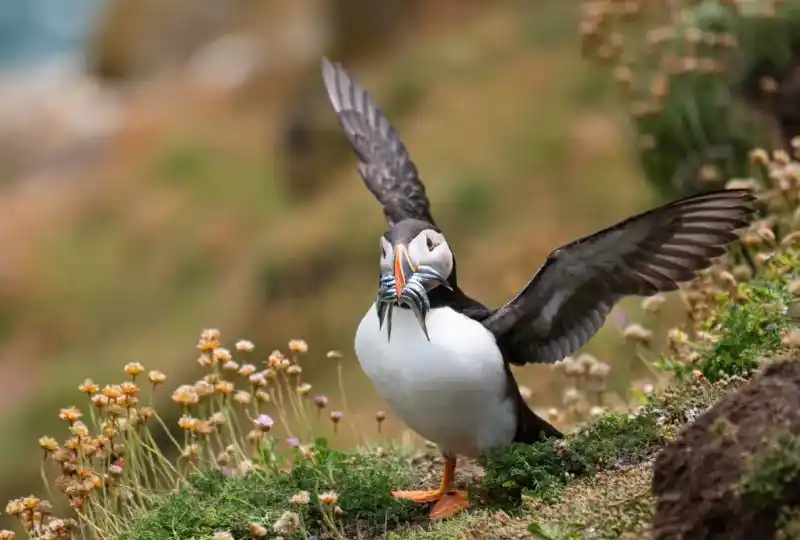
| Mouthparts and fish transport | Bares along the mouth rim and throat sac help catch fish | Small barbs on the upper palate are used to "hook" fish and bring them back to chicks; it is common to see multiple birds carrying fish side by side . |
| Migration methods | Migration /Moving with ocean currents and feeding zones | dual-mode migration of flight and swimming |
| perch | Mostly treeless islands, coastlines, and ice floes. | Sea cliffs, grassy slopes, and caves (either self-dug or utilizing rabbit burrows). |
1) They are not closely related: they have similar names and appearances, but are not closely related.
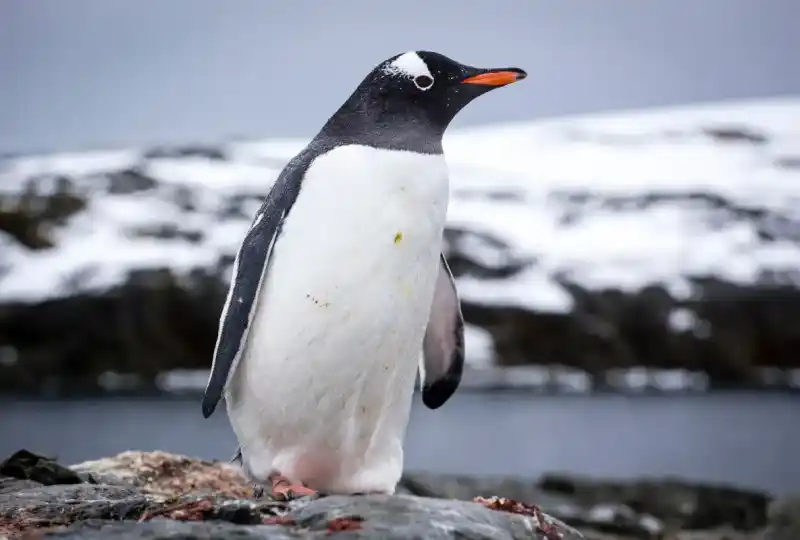
Penguins belong to the order Sphenisciformes/family Spheniscidae and are a highly specialized group of flightless diving seabirds .
Puffins are a branch of the family Alcidae (crows/puffins), flying diving seabirds , with the representative genus being Fratercula (such as the Atlantic puffin F. arctica ).
There are many historical "misunderstandings" about the names: early naturalists often confused the names of "chubby" chicks/similar sizes, but the two have long been separated in taxonomy .
2) One in the south and one in the north: They almost never appear in the same frame.
Puffins breed in the Northern Hemisphere, with the sea cliffs along the North Atlantic coast being a classic sight; Iceland accounts for a large proportion of the global population.
Penguins are found throughout the Southern Hemisphere, from Antarctica to the sub-Antarctic islands, the southern tip of South America, and the cold and temperate seas surrounding Australia and New Zealand.
Conclusion: Geographically, they are basically "misaligned," making it difficult for tourists to see them in the same location at the same time.
3) Flying vs. Flying: Two Evolutionary Paths of Wings
Penguins ' wings are completely flipped : their bones are short, thick, and dense, and their joints have reduced flexibility. They can "fly" underwater , but they have lost their lift function in the air. The trade-off is that they cannot fly , but the benefit is that they are extremely efficient underwater , able to dive deep for long periods of time and quickly "dive" to catch food.
Puffins still have flight feathers : they fly in the air by flapping their short wings at high frequency , and when they enter the water, they also use their wings as propulsion, but their diving time is shorter (mostly in the tens of seconds), making them more like a compromise between "air and water amphibious".
4) Who can dive deeper? Who can pretend to be a fish?
Diving and Speed : Penguins are far ahead in underwater speed and maneuverability , with some species exceeding 20 mph (≈32 km/h) . Puffins excel at short dives, being agile but not deep or fast .
Puffins' "black technology" for catching fish : The tiny horny spines on their palates can "hook" fish, so you often see them carrying a row of small fish horizontally back to their nests to feed their chicks; records show that they can carry dozens of small fish at once (this varies greatly between different species and sea conditions). Penguins rely more on their throat pouch and oral cavity structure to hold onto their prey.
5) Social interaction and "housing": communal living, but with different building methods.
Penguins : From "pebble nests" on beach pebbles to "egg-laying" in the snow to sheltering in caves/shrubs, each has its own way of life; when the breeding ground is large in scale, it is called a "penguin colony/breeding ground".
Puffins prefer to burrow in grassy slopes and sea cliffs (either by digging their own burrows or borrowing burrows), and their density can be very high; researchers often use simulation models to help "attract birds" for easier monitoring.
Pairing relationship : Both tend to be monogamous , but may switch partners depending on reproductive success rate/partner survival.
6) Size difference: The "Northern Little Flying Hero" can be carried, while the "Antarctic Submersible" cannot.
Puffins : Common weight is 0.5–0.8 kg (slightly higher or lower depending on the population), and they are not difficult to hold (under research conditions).
Penguins : The range is huge, from little blue penguins weighing just over 1 kg to emperor penguins weighing around 30 kg ; holding an emperor penguin is about the same as carrying a heavy suitcase .
This is also a physical and bone density "hint" that puffins can fly while penguins cannot.
7) What do they eat?
Commonalities : They are all mainly small fish , but also include crustaceans and cephalopods.
Differences : Penguins hunt efficiently in deeper, colder waters (such as Antarctic krill and squid); puffins, on the other hand, "quickly retrieve and return" prey in the upper coastal waters .
8) It doesn't matter who is cuter, what matters is protection.
Penguins : Many factors are affected by climate warming, sea ice changes, fishery stress , and breeding ground disturbances.
Puffins are extremely sensitive to abnormal sea temperatures, fluctuations in baitfish resources, plastic pollution, and oil spills .
The best way to birdwatch is from a distance without disturbance : do not feed, disturb, or trample on the vegetation in the breeding grounds; sightseeing boats/viewing platforms should adhere to distance and time regulations.
Conclusion: Puffins can fly, penguins can "swim" ; one in the north, one in the south, they are not closely related.
Comparing them side by side is like categorizing bagels and donuts as "circle pastries": they look similar, but their recipes, textures, and preparation methods are completely different .
Want to see flying "black and white clown faces"? → Go to the North Atlantic to see puffins ;
Want to see diving champions who can't fly but can "fly" in the sea? → Go to the Southern Hemisphere to see penguins .
FAQ (Frequently Asked Questions by Readers)
Q1: Which is smarter, a puffin or a penguin?
There is no single standard. Both are highly adapted to their respective ecological niches: the puffin's "retrieving multiple fish" and homing to a fixed point, and the penguin's group coordination and deep-diving navigation, all reflect different dimensions of learning and instinct .
Q2: Where is the best place to see puffins?
Sea cliffs along the North Atlantic coast (such as Iceland, the Faroe Islands, Norway, and some islands in the United Kingdom ) are classic spots; it is necessary to be during the breeding season (late spring to summer) and maintain distance.
Q3: Are penguins necessarily found in Antarctica?
Not entirely. Many penguins live in temperate or even subtropical zones (such as the Galapagos penguin), but they are generally found in the Southern Hemisphere .
Q4: How deep can a puffin dive?
Most of their dives are short and shallow (on the order of tens of seconds), far less than the deep-diving ability of most penguins; however, their feeding efficiency is sufficient for raising chicks.
Sources
Bukaty, Robert F. "Penguin-like puffins resurface in Maine." Associated Press. MSNBC. Aug. 30, 2007. (Aug. 14, 2008)http://www.msnbc.msn.com/id/20462551/
Gaskell, Jeremy. "Who Killed the Great Auk?" Oxford University Press. 2000. (Aug. 14, 2008)http://books.google.com/books?id=tsUzeXV_7jcC
"Penguin." HowStuffWorks. (Aug. 14, 2008) https://animals.howstuffworks.com/birds/penguin-info.htm/printable
"Puffin Questions." Project Puffin. (Aug. 14, 2008)http://www.projectpuffin.org/questions.html
Reynolds, K. "Eudyptes chrysolophus." Animal Diversity Web. 2001. (Aug. 14, 2008) http://animaldiversity.ummz.umich.edu/site/accounts/information/Eudyptes_chrysolophus.html
Street, R. and A. Emily. "Fratecula arctica." Animal Diversity Web. 1999. (Aug. 14, 2008) http://animaldiversity.ummz.umich.edu/site/accounts/information/Fratecula_arctica.html
Taylor, Kenneth. "Puffins." National Geographic. January 1996.
"What makes a penguin a penguin?" Earth Guide. Scripps Institution of Oceanography. (Aug. 14, 2008)http://earthguide.ucsd.edu/penguins/penguin.htm