Influenced by evolutionary theory, especially by the German Darwinist Ernst Haeckel, a young Dutch doctor named Dubois firmly believed that he could find the ancestors of humans in Indonesia (then a Dutch colony known as the East Indies), a tropical region abundant with modern-day relatives like orangutans and gibbons. After publicly announcing his intention to search for the "missing link" between humans and apes in Indonesia, Dubois set off for the country in the late 1880s. He hired 50 convicts to search diligently along the Solo River on Java Island, and finally, in 1890, discovered a human mandible in a place called Kadenbrubs. In 1891, he found a skull with many ape-like features in the village of Trinil; the following year, he found a femur similar to that of modern humans in the same location, its morphology indicating that the owner of the femur was capable of bipedal walking. Dubwa believed that the skull and femur discovered at different times should actually belong to the same individual, which must be the ancestor of modern humans. So he published a paper in 1894 and named these fossils Homo erectus. Later generations also often referred to these ancient humans as Java Man.
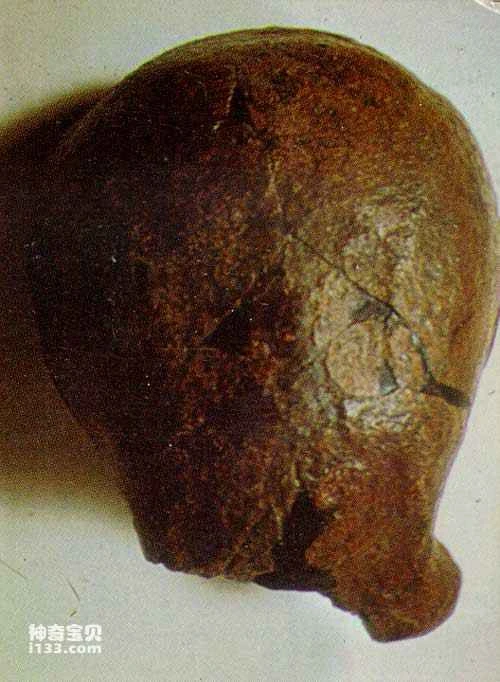
Java Man skull
The discovery immediately sparked heated debate. Some questioned the geological age of the fossils; others refused to believe that a femur resembling that of a modern human could fit together with the skull of an ape, concluding that the fossils were simply those of a large gibbon; still others believed the material was merely the remains of an imbecile or deformed modern human. These doubts and debates buried Dubwa's discovery for over 30 years. It wasn't until 1928, when the renowned Chinese paleontologist, paleoanthropologist, and prehistoric archaeologist Pei Wenzhong discovered the first Peking Man skull at Zhoukoudian in the suburbs of Beijing, that the paleoanthropological community reaffirmed Java Man as the first discovered Homo erectus.

Cyathea Riverbank