Humanity's understanding of its own developmental history began with modern Homo sapiens, then with early Homo sapiens, then Homo erectus, and finally established Homo habilis and Australopithecus as the ancestors of humankind.
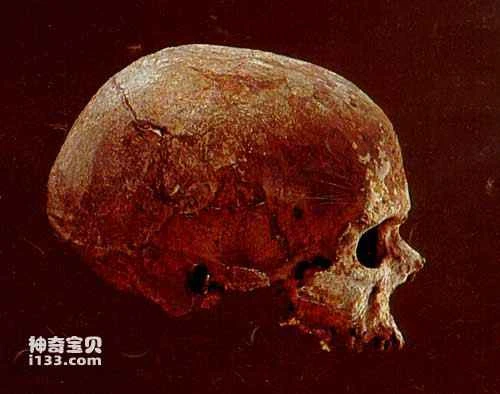
Cro-Magnon
This process of understanding began in the mid-19th century. As Darwin's theory of evolution gradually gained acceptance, anthropologists embarked on the arduous task of searching for humanity's own ancestors. This work naturally began in Europe, which was then considered by Westerners to be the cradle of humankind due to its technological superiority. However, until the 20th century, the human fossils discovered in Europe, apart from some late Homo sapiens who lived relatively recently (such as Cro-Magnon), consisted mostly of Neanderthals (or early Homo sapiens) who lived between 200,000 and 40,000 years ago.
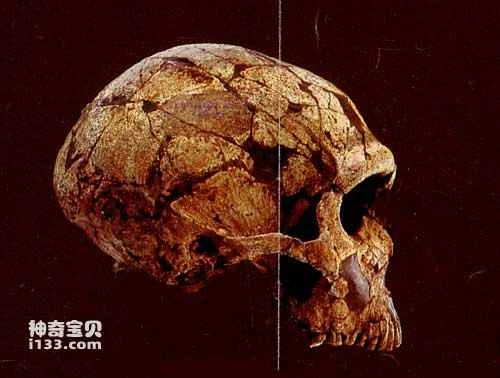
Neanderthals
In 1848, some hominid fossils were discovered in Gibraltar, in the southwestern corner of Europe. These fossils represent the earliest known hominids, later called Neanderthals (or simply Neanderthals), but they did not attract much attention at the time. The name Neanderthals comes from the Neander Valley near Düsseldorf, Germany. In August 1856, the skull and some limb bones of an adult male were discovered in a cave there, and the fossils were named Neanderthals. Afterward, Neanderthal fossils began to be discovered in large quantities across a vast area, from Spain and France in the west to northern Iran and Uzbekistan in the east, from Palestine in the south to the 53rd parallel north in the north. Neanderthals lived between 200,000 and 37,000 years ago.
Neanderthals had a brain volume of 1300 to 1700 ml; compared to Homo erectus, their skulls were smoother and less rounded, with reduced cranial thickness; the degree of forward protrusion of their face (from the brow ridge down to the lower dental arch) was similar to that of Homo erectus. The unusually prominent nasal bones of European Neanderthals suggest that their noses must have been very high; however, due to their large teeth and upper jaw, it is speculated that their noses could not have had the narrow nasal cavities of modern Europeans, but rather a nasal cavity that extended significantly forward. That is to say, they possessed a large nose, as high as that of modern Europeans and as wide as that of modern Africans; moreover, their nostrils likely faced even further forward.
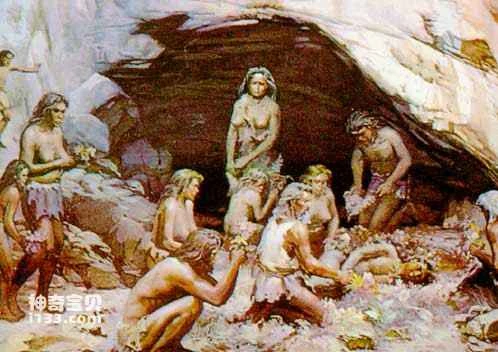
Neon funeral
The Neanderthals created the stone tool industry known as the Mousterian culture, characterized by small points and scrapers. Given the cold climate of Europe at the time, the Neanderthals were able to use fire and had already developed the ability to make it. They also began to practice burying the dead.
Besides Neanderthals, several early Homo sapiens fossils have been discovered in Europe that simultaneously possess primitive traits of Homo erectus and advanced traits of Homo sapiens. These include the Petralona Man of Greece (dating from approximately 160,000 to 240,000 years ago, though this is debated) and the Tortaville Man of southwestern France (also known as Arago Man, dating back approximately 200,000 years). Some scholars consider them transitional types between Homo erectus and early Homo sapiens. Furthermore, the Steinheim Man of Germany (dating back 200,000 to 300,000 years) and the Swanscombe Man of England (dating back approximately 250,000 years) have been discovered. Their skull features are very similar, and their morphology appears more advanced than that of Neanderthals, yet they predate Neanderthals. Therefore, some scholars call them "progressive Neanderthals" or "pre-Neanderthals" and believe they are the ancestors of later Homo sapiens; while other later Neanderthals are called "typical Neanderthals," which became extinct or were replaced by later Homo sapiens around 33,000 years ago.
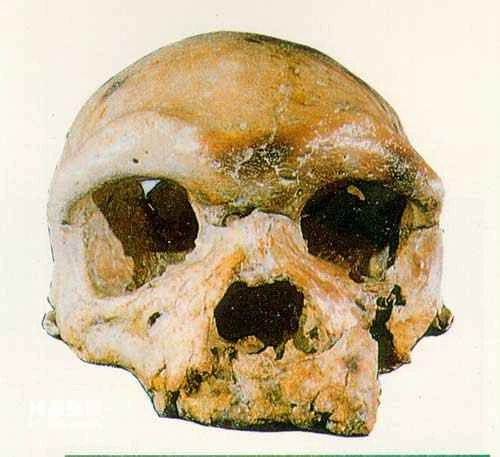
Dali people
In Africa, early Homo sapiens include the Bodo people (dating back approximately 200,000 to 300,000 years ago), who are considered a transitional type, and the Broken Man (dating back 130,000 years ago), who were discovered in Ethiopia.
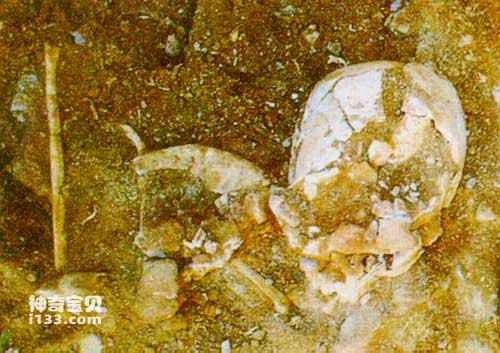
Jinniushanren
Early Homo sapiens fossils in China were all discovered after 1949. The materials mainly include Dali Man (discovered in Dali County, Shaanxi Province), Jinniushan Man (discovered in Yingkou County, Liaoning Province), Xujiayao Man (discovered in Yanggao County, Shanxi Province), and Dingcun Man (discovered in Xiangfen County, Shanxi Province) in the northern region, and Maba Man (discovered in Qujiang County, Guangdong Province), Yinshan Man (discovered in Chaohu City, Anhui Province), Changyang Man (discovered in Changyang County, Hubei Province), and Tongzi Man (discovered in Tongzi County, Guizhou Province) in the southern region.
Other early Homo sapiens in Asia include the Angdong Man (also known as the Solo Man) found along the Solo River in Indonesia, whose morphology shows some transitional characteristics from Homo erectus to early Homo sapiens.
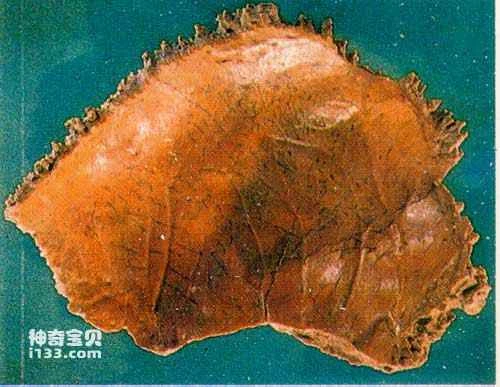
Xujia Kiln People
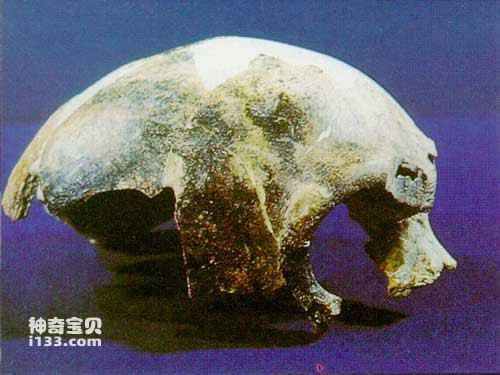
Maba people