Ancient humans were fascinated by their origins and created a wide variety of myths and legends. For example, in China, our ancestors told stories of Pangu creating the world and Nuwa creating humans from clay thousands of years ago. In ancient Egypt, legend has it that humans were sculpted from clay by the god Hanum, who had the face of a deer and the body of a human, in a pottery workshop, and then brought to life by the goddess Het. In ancient Greece, myths say that humans and animals were created from clay by Prometheus, who then stole fire from the heavens and taught humans various survival skills.
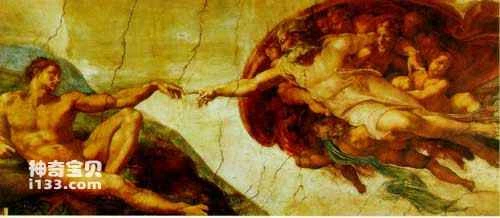
Michelangelo's masterpiece based on the Bible—The Creation of Adam
As human society developed, these myths and legends were gradually embellished for specific purposes, becoming doctrines or teachings, and thus part of religions. Among them, the most influential in human history is the Western concept of "God creating man."
The Old Testament, the fundamental text of Judaism, describes how God created the world and humankind in six days. On the first day, He created light to separate day from night; on the second day, He created air to separate heaven from earth; on the third day, He created land, sea, and various plants; on the fourth day, He created the sun, moon, and stars to govern the years, seasons, and times; on the fifth day, He created various animals that lived on land and in the water; on the sixth day, He created men, women, various crops, and livestock; on the seventh day, God was tired and rested, creating nothing more.
The Christian Bible also tells a similar creation story. It says that after God Jehovah created heaven and earth, the world was a barren wasteland. So God sent rains upon the earth, causing plants to grow. Then Jehovah created a man from the dust of the ground in his own image, naming him Adam, and created the Garden of Eden in the east, a lush garden full of beautiful fruit for Adam to live in. Later, God felt that Adam was lonely, so He created a woman from one of Adam's ribs and named her Eve. Eve ate the forbidden fruit, angering God, who banished Adam and Eve from the Garden of Eden to live on earth. Adam and Eve became the ancestors of all humankind, and their descendants multiplied on earth. As humanity multiplied, many began to fall into sin. To punish humanity's sins, God sent a great flood. However, a merciful God felt that some good people and many other creatures were innocent, so He built a great ark called Noah's Ark to save them.
Darwin
In the Christian-dominated Middle Ages, people firmly believed in the biblical story of God creating man. In 1650, an Irish archbishop named James Usher even calculated, based on the Bible, that the exact time of God's creation was 4004 BC. Around the same time, another priest calculated the creation time even more precisely to 9:00 AM on October 23, 4004 BC!
After the European Renaissance, people's minds gradually broke free from the constraints of Christianity, and some naturalists, based on their own explorations, began to question the doctrines of the Bible. With the development of science, the idea of God creating man became increasingly untenable. By the time Darwin published his scientific masterpieces such as *On the Origin of Species* and *The Descent of Man, and Selection in Relation to Sex*, although some staunch theological defenders still opposed evolution and the view that humans originated from apes, the creationist view, including the idea of God creating man, had been fundamentally shaken.
One of the most powerful forces shaking creationism is the large number of fossil discoveries and scientific research on paleontology, especially the discovery of ancient human fossils.