Over 100,000 years ago in Africa, the earliest humans appeared whose anatomical structure was completely identical to that of modern humans. They are called Late Homo sapiens, Modern Homo sapiens, or simply Modern humans by paleoanthropologists. The main morphological differences between Late Homo sapiens and Early Homo sapiens are the smaller size of their face and front teeth, the weakening of their brow ridges, and the increased height of their skull, making their overall skull and facial features increasingly resemble those of modern humans.

yellow race

white people
Because some regional morphological differentiations that had already appeared in the Homo erectus stage in various regions of human evolution gradually became more apparent in the early Homo sapiens stage, coupled with the different effects of natural selection in different regions, some obvious differences in morphology appeared in the late Homo sapiens of different regions. This racial differentiation has led to the situation we have today, in which, due to differences in skin color, hair shape and color, eyes, nose and lips, the world's humans can be divided into four major races: Mongoloid (also known as Asian), Caucasoid (also known as European), Negroid (also known as Equatorial), and Australoid (also known as Australoid).

Black people

Brown people
Although the earliest discovered fossils of Late Homo sapiens are from Cro-Magnon in France, the earliest known fossils of Late Homo sapiens to date are all from the African continent, including Boundary Cave Man (dating back over 100,000 years) and Cressis Estuarine Man (dating from 120,000 to 130,000 years ago to 60,000 years ago, with Cressis Estuarine Man living in the region for at least 60,000 years), Omo Man in Ethiopia (dating back 130,000 years), and modern Homo sapiens (dating back 120,000 years) found in the Letori region of Tanzania. Meanwhile, more advanced stone tool technology, developed from narrow blades, began to appear in Africa before 100,000 years ago. At this time, Europe was still dominated by Neanderthals who possessed relatively primitive Mousterian technology.
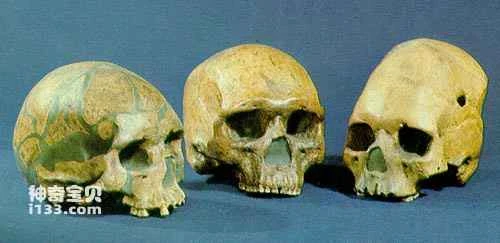
Upper Cave Man
The earliest fossils of late Homo sapiens discovered in China are the famous Upper Cave Man from Zhoukoudian. These fossils were excavated in 1933 from the Upper Cave on Longgushan Mountain, including three complete skulls, three skull fragments, four mandibles, three mandible fragments, dozens of scattered teeth, and several vertebrae and limb bones. However, due to the Japanese invasion of China and the subsequent Pacific War, these materials, along with all the Peking Man fossils at the time, were lost in the hands of several Americans. Fortunately, before these precious materials disappeared, models were made from them, which have become important evidence for our re-examination of human development during this period.

Liujiang people
After liberation, a series of important late Homo sapiens fossils were discovered in vast areas of my country. These included the Liujiang Man skull (found in Liujiang County, Guangxi), which was comparable in evolutionary level to Upper Cave Man; the Ziyang Man skull (found in Ziyang County, Sichuan), which was more advanced than Upper Cave Man and Liujiang Man; and the Chuandong Man skull (found in Puding County, Guizhou), as well as scattered fossil materials respectively known as Hetao Man, Laibin Man, Lijiang Man, and Huanglong Man.
Building upon a series of unique traits inherited from Homo erectus to early Homo sapiens in China, late Homo sapiens in China essentially established the characteristics of modern Mongoloids, although they still retained some primitive traits to varying degrees. Given their classification as primitive Mongoloids, the Upper Cave Man is particularly similar to modern Chinese, Eskimos, and Native Americans, while the Liujiang Man shows clear similarities to the Kellogg skull discovered in Australia.
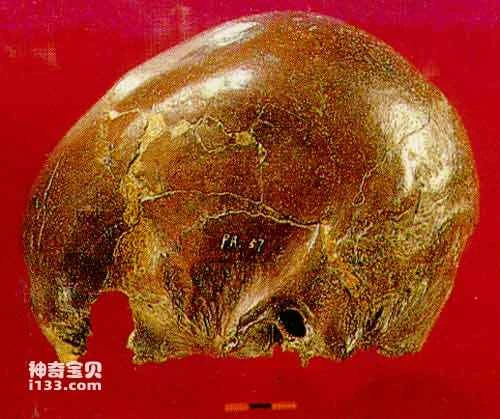
Ziyang people
The human fossils discovered in Australia all belong to modern Homo sapiens, with the earliest dating back only 30,000 years. Therefore, it is estimated that humans first arrived in Australia no earlier than 50,000 years ago.
Human fossils discovered in Australia clearly fall into two categories. One type features robust skeletons and large builds, such as the Xhosaurs, Targai, Mosgil, and Coa Swamp Man; the other features lighter skeletons and more slender builds, such as the Kelloggs and Mungo Lake Man. Their cultures also differed.
These robust-boned types share a clear morphological similarity with Homo erectus and early Homo sapiens (Ongdong) found in Java; on the other hand, those with delicate and slender bones show a clear resemblance in skull features to those of Liujiang Man in China, indicating a certain degree of kinship between them. Furthermore, the Wajak human skull from the Holocene in Java, the human skull fossils discovered in Tabon Cave in the Philippines, the Nia skull from Kalimantan, and the Eitapu skull from New Guinea all exhibit traits that are similar to both Australian Aboriginal people and the primitive Mongoloid population represented by late Homo sapiens in China.
The facts described above suggest that the origins of Australian Aborigines may have two sources. Many scholars, after analyzing these factors, particularly the geographical distribution of two distinct types of hominid fossils in Australia, believe that the migration of humans from Asia to Australia occurred through two unrelated migrations: one was the southern route, in which a group of robust, muscular individuals from Southeast Asia migrated from Java through Timor to northwestern Australia, then south along its west coast; the other was the northern route, in which a group of slender, light-boned individuals from southern China migrated through Indochina, Kalimantan, and New Guinea to northeastern Australia, then south along its east coast, with some also migrating via land bridges. Later, these two groups of people from different origins intermingled and intermarried, resulting in modern Australian Aborigines, whose morphology lies between the two ancestral types.

Yellow-skinned people about to cross the land bridge into the Americas
During the Last Glacial Period, more than 10,000 years ago, temperatures on Earth were very low, glaciers developed on a large scale, and sea levels were low. The seabed of the modern Bering Strait was exposed, forming a land bridge connecting northeastern Asia and northwestern North America. A group of people of East Asian descent living in Siberia, chasing their prey, bravely crossed this land bridge and set foot on the North American continent, gradually spreading throughout the Americas in the following years.
Native Americans (including Indians and Inuit) are morphologically very similar to the Mongoloid populations of Siberia and other parts of East Asia. Therefore, the time between them and the Mongoloid populations of East Asia is not very long, estimated to be no more than 14,000 to 20,000 years.
The earliest known artifacts of Paleolithic culture discovered in the Americas are a point dating back 11,500 years, unearthed in 1932 near Clovis, New Mexico, USA; mammoth bones were also found at the same location. Prior to this, in 1926, another point from a slightly later period was discovered near Forsom, New Mexico, accompanied by the bones of an extinct bison species.