Some scholars, both domestically and internationally, argue that *Eosimias sinensis* is not a higher primate because it exhibits many primitive characteristics compared to early higher primates in Africa, and its provenance is incomplete. However, the discovery of *Eosimias sinensis* in the Yuanqu Basin of Shanxi Province soon added a significant weight to the Chinese side of the balance in the origin of higher primates.
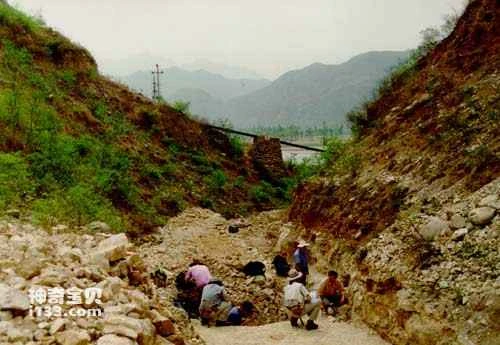
Tong Yongsheng [right] and others excavating in Yuanqu
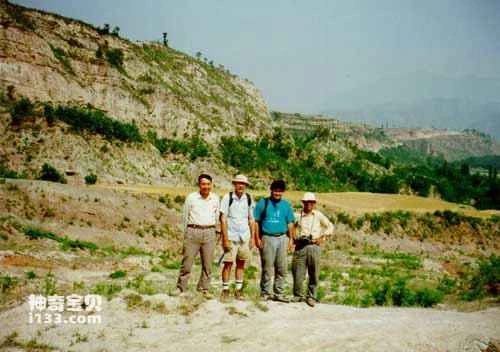
Wang Jingwen [right] and Huang Xueshi, among others, conduct research in Yuanqu.
The Yuanqu Basin is the cradle of early Tertiary strata and paleomammalian research in China; however, many important fossil sites there are now submerged beneath the waters of the Xiaolangdi Reservoir. In 1993, the Institute of Vertebrate Paleontology and Paleoanthropology organized an expedition led by paleomammalian expert Wang Jingwen to conduct rescue excavations at these sites. However, due to a lack of funding, they had to seek assistance from international colleagues.
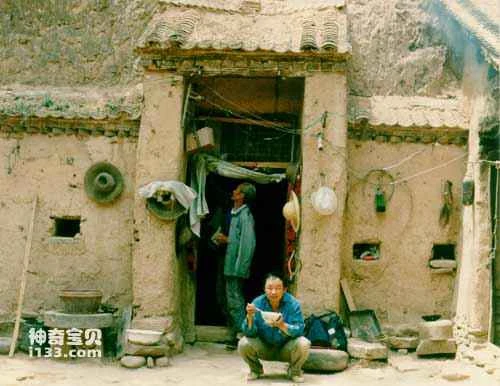
Guo Jianwei rests in front of a farmer's cave dwelling during his inspection.
It was the Carnegie Museum of Natural History again! Mary Dawson and Christopher Beard recognized the importance of these fossil sites. With limited funds, they organized a large team including paleontologists, geologists, and paleomagnetists, and established a joint expedition with researchers from the Institute of Vertebrate Paleontology and Paleoanthropology, including Wang Jingwen, Tong Yongsheng, Huang Xueshi, and Guo Jianwei. From 1994 to 1997, they conducted four quarters of fieldwork.
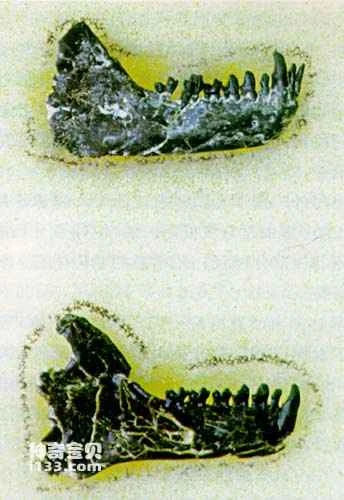
fossil of Dawn ape
The joint expedition achieved fruitful results, excavating a large number of vertebrate fossils; among them, in May 1995, an almost complete mandible of the Eosimias, with almost all of its teeth, was unearthed. It is slightly larger than the Chinese Eosimias, and the comparable parts are obviously very similar. In a series of traits, it shows characteristics of higher primates, mainly manifested in: (1) a short and deep mandibular symphysis; (2) vertical growth of the lower incisors; (3) large and prominent canines; (4) the enlarged base of the outer cusps of the last two premolars is slightly oblique in the dentition; (5) the triangular seat of the last molar is wider than the calcaneal seat; (6) the labial-lingual and mid-distal surfaces of the last molar are degenerate; (7) the mandibular angular process is rounded, thus providing a larger attachment area for the pterygoid muscles. At the same time, it also shows more primitive characteristics than all other higher primates in some other traits, and these primitive characteristics show its similarity to the ancient Eosimias, thus providing some evidence for the theory of the origin of higher primates as Eosimias. It was named Dawn ape; the associated fauna is called the Naduqi Zhaili mammal fauna, dating back to the late Middle Eocene, about 40 million years ago.
Shortly thereafter, Tong Yongsheng discovered the upper and lower teeth of a similar species of Dawn ape in the slightly earlier Shalamulunian Upper River mammal group in the Yuanqu Basin.