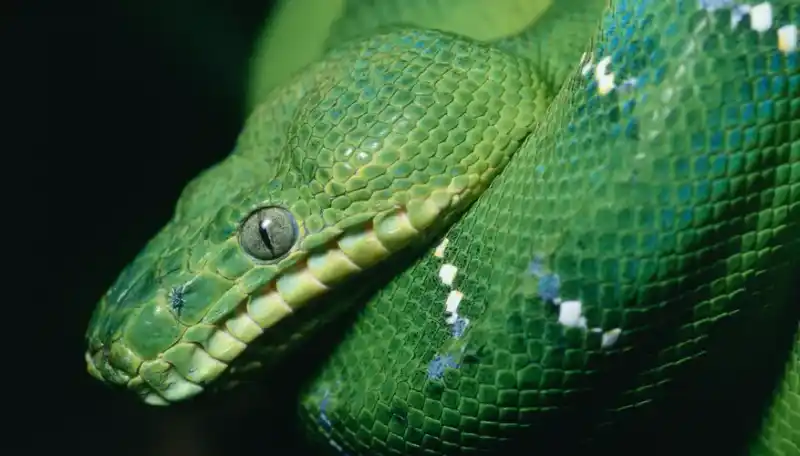
The emerald tree python is a striking member of the python family, known for its vibrant green coloration and non-venomous contractile movements. This arboreal snake is native to the dense rainforests of northern South America, embodying the richness of tropical biodiversity.
Geographical distribution and range
| area | nation |
|---|---|
| Amazon Basin | Spanning French Guiana, Suriname, Peru, Colombia, Ecuador, and Venezuela |
| Guyana | Certain populations in Guyana, northern Brazil, and Bolivia |
A 2009 study highlighted that populations south of the Amazon and west of the Rio Negro River may represent a distinct species, reflecting the region’s diverse genetic landscape.
Habitat characteristics
The emerald tree python thrives in the dense, moist environments typical of lowland tropical rainforests and forest swamps. Key characteristics of its habitat include:
| feature | describe |
|---|---|
| tree crown | High dwellings in the tree canopy, using branches for support and camouflage |
| Rainfall | Areas with annual rainfall exceeding 59 inches |
| Near water source | It is usually located near a river, but open water is not essential. |
These snakes are perfectly adapted to their environment and rarely descend to the forest floor.
Adaptation to arboreal life
The emerald tree python exhibits several adaptations that enhance its survival ability in its treetop habitat:
| Adaptability | Function |
|---|---|
| curl tail | It is easy to climb and move between branches. |
| camouflage | The green color blends seamlessly with the leaves, helping to evade predators and prey. |
| Thermal induction pit | Detecting warm-blooded prey from a distance |
They can coil tightly around the corners of trees, and their flexible tails allow them to carry out effective ambush strategies.
Ecological role
The emerald tree python plays a vital role in its ecosystem:
| Role | Influence |
|---|---|
| predators | Helps control the population of small mammals and marsupials |
| prey | Occasionally hunted by Guyana crested eagles |
Despite their powerful hunting abilities, emerald pythons also possess natural camouflage abilities that provide crucial protection against potential threats.
Conclusion: The important role of the emerald python in the rainforest ecosystem
The emerald python is not only a fascinating example of evolutionary adaptation but also a vital component of the ecological balance of the South American rainforest. Understanding their habitats and behaviors helps highlight the importance of protecting these biodiverse environments.