Bird migration is one of the most spectacular periodic behaviors in nature. Not all birds migrate; many resident birds can stay in one place year-round as long as their habitat can meet their needs for climate , food , and breeding . For those birds that need to "move" with the changing seasons, migration is a mandatory course written into their genetic clock.
What are "migratory birds"? — Definition and commonalities
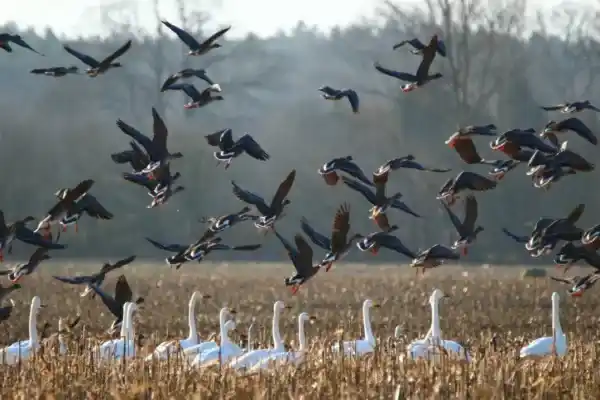
Migratory birds (birds that migrate) are birds that move long distances each year during a fixed season (including flying birds, as well as a few seabirds and wading birds that can endure long-distance drifting or are carried by the wind). They may breed on one continent and overwinter on another, or they may migrate north and south on the same continent.
Migratory birds generally possess the following characteristics:
High endurance body type : Optimized wing-to-chest muscle ratio, suitable for long-distance flight; many species gain significant fat reserves (energy reserves) before takeoff.
Immunity and metabolic adaptation : Transcontinental migration means exposure to different parasites and pathogens, and migratory birds have more "flexible and energy-efficient" immune strategies.
Plastic physiology : Some species change their plumage color, weight, and organ volume during migration (such as shortening the intestines to reduce the burden).
Amazing orientation capabilities : It integrates multimodal information such as the solar and celestial "astronomical compass" , the geomagnetic "magnetic compass" , landmark clues and olfactory/acoustic landscape .
Why do birds "know" it's time to set off? — Triggers and navigation of migration
The biological clock synchronizes with the external environment : the body's diurnal and annual rhythms (regulated by sunlight duration/temperature/hormones) sound the "start" signal at the appropriate time.
Navigation principles
Sun and star positioning : During the day, refer to the sun's position; at night, refer to the rotation trajectory of stars.
Geomagnetic sensing : Magnetoreceptor molecules in the retina and iron-containing structures in the trigeminal nerve endings work together to form a "magnetic compass".
Experience map : Young birds are born with a rough template of "direction and distance", which is refined year by year through route memory as adults, forming a cognitive map .
Major global migration routes (briefly described)
The East Atlantic Passage : runs through the western side of Eurasia and Africa, connecting the Scandinavian/Western European breeding grounds with the West African wintering grounds.
The Central Asia-South Asia corridor crosses the Central Asian Plateau and the Himalayan front, leading to the Indian subcontinent and South Asian wetlands.
The Circum-Pacific Passage : Starting from Alaska and Northeast Asia, it travels south along the Pacific coastline to reach Oceania and the islands of the South Pacific.
List of 20 representative migratory bird species (grouped by migration route)
Each of the following items is accompanied by its Chinese name, scientific name, and key features for easy browsing and popular science dissemination.
Eastern Atlantic Passage (Europe–West Africa)
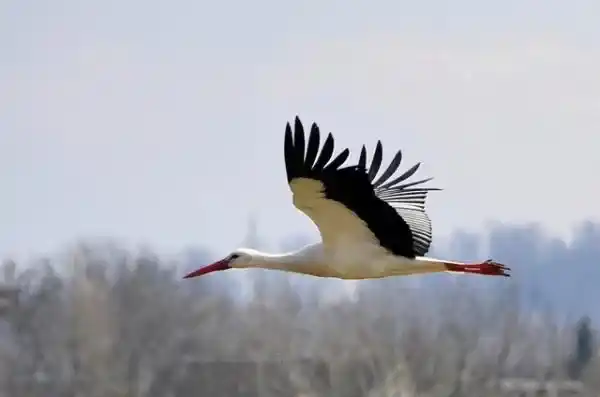
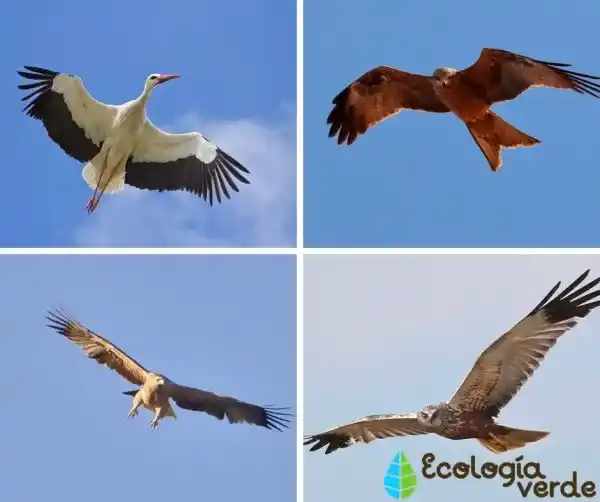
White Stork — Ciconia ciconia
A master of high-altitude gliding; relying on thermal airflow for energy-efficient flight, they migrate south from Europe to sub-Saharan Africa to overwinter.Black Kite — Milvus migrans
Cleaners of urban and agricultural landscapes; capable of long-distance migration by gliding with the wind, and highly adaptable to human landscapes.Booted Falcon (Steppe Eagle Falcon) – Aquila (= Hieraaetus) pennata
Medium-sized eagles migrate in both directions during the spring and autumn, crossing the Mediterranean-Sahel belt.Western Marsh Harrier — Circus aeruginosus
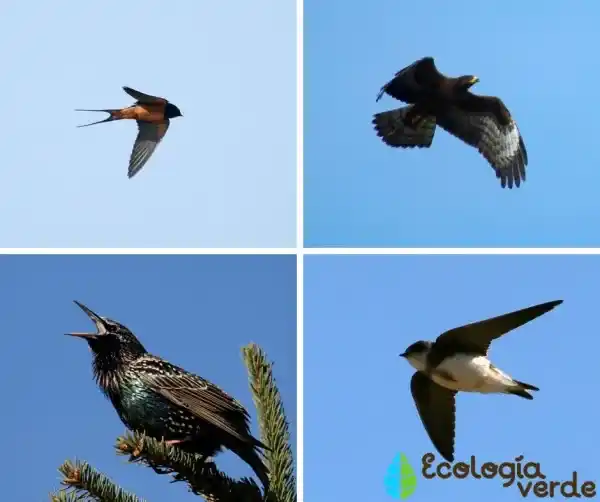
Carnivorous birds of prey that live in symbiosis with wetlands; they migrate along river mouths, reed beds and inland lakes.House swallow — Hirundo rustica
One of the most familiar migratory birds to humankind; relying on landmarks and geomagnetic navigation, it travels between Eurasia and Africa every year.European Bee Hawk — Pernis apivorus
Specialized feeders that consume beehive larvae and beeswax migrate across the Mediterranean.European starling — Sturnus vulgaris
Bird murmuration is a common sight in autumn and winter; some populations migrate long distances.Sand Martins — Riparia riparia
They burrow and breed on sandy banks; they migrate in strips along river valleys and coastlines.Eurasian Green-winged Teal — Anas crecca
Small ducks that often overwinter in large flocks; they migrate along the Atlantic and Mediterranean wetland chains.Ordinary swifts — Apus apus
A true "life in the air": flying to eat, sleeping in the air, and traveling between Europe and Africa across the Sahara.
Central & South Asia Corridor
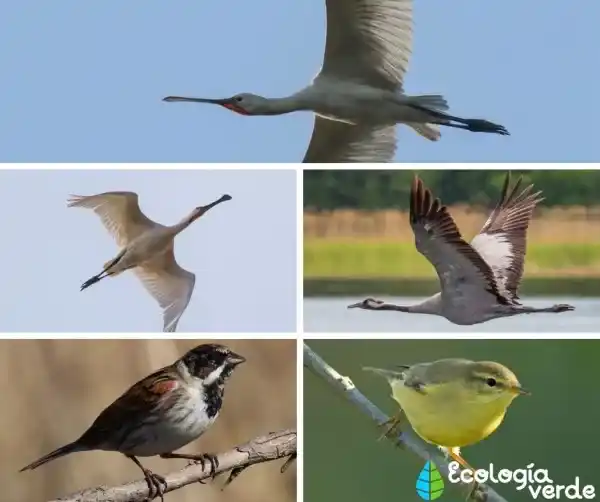
Eurasian Spoonbill — Platalea leucorodia
They are known for foraging in shallow waters; their migrations rely on inland lakes and estuary wetland rest stops.Arctic Gull — Larus hyperboreus
The Arctic gulls are strong, and some populations migrate south to the northern coast and coastal areas of Eurasia to overwinter.Grey crane — Grus grus
Large flocks of cranes fly over the plateaus and grasslands; their wintering grounds are concentrated along the Mediterranean coast and the Indian Peninsula.Reed Bunting — Emberiza schoeniclus
Small passerines that migrate along reed belts; moving back and forth between Eurasian wetlands.Willow Warbler (Forest Warbler) — Phylloscopus trochilus
Weighing only a dozen grams, it travels across continents; it achieves its "micro-sized long-distance voyage" by relying on high fat reserves.

Pacific Flyway
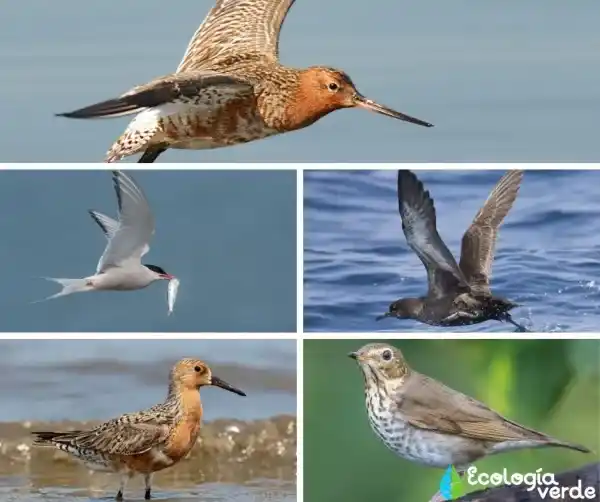
Bar-tailed Godwit— Limosa lapponica
Record holder for non-stop flight : Alaska to New Zealand, covering over 10,000 kilometers without stopping .Arctic Tern — Sterna paradisaea
The champion of total annual migration distance : flying tens of thousands of kilometers from the Arctic breeding grounds to the Antarctic waters for wintering.Dark-colored petrel — Ardenna grisea
Typical oceanic seabird; migrates bidirectionally across the equator, following ocean currents and high-yield fishing grounds.Red Knot— Calidris canutus
It relies on "key transit points" for abundant lipid replenishment (such as tidal flats rich in mollusks); it has high conservation value.Catharus ustulatus
They breed in North American coniferous forests and migrate to South American tropical forests; they migrate at night, orienting themselves by the stars and geomagnetism.
Migration trivia (quick overview)
Complete migration vs. partial migration : Within the same species, northern populations may migrate entirely south, while temperate populations may only move short distances during the harsh winter.
Daytime and nighttime migration : Raptors mostly take advantage of warm air currents during the day ; small passerines prefer low-altitude, stable air currents at night , which both cools them down, saves water, and helps them avoid raptors.
The importance of stopover sites : migratory birds need "refueling stations" (wetlands/tidal flats/farmland) along the route, and damage to one site will reduce the survival rate of the entire route.
Impacts of climate change : Mismatched rhythms (such as an earlier peak insect season) can decouple migration time from peak food availability, affecting reproductive success.
Terminology Overview
Flyways : Relatively stable networks of migratory corridors and stopover sites for migratory birds on a continental scale.
Hyperphagia : Overeating before migration to accumulate fat as "fuel" for long voyages.
Astronomical compass/magnetic compass : An intrinsic navigation system oriented by the sun/stars or the Earth's magnetic field.
References
Gwinner, E. (2003) Circular rhythms in birds. New Perspectives in Neurobiology, Vol. 13 (6), pp. 770-778.
Fanjus de Moles, ML (2007) Animal navigation. Survey & Science online journal, pp. 66-73.
Pérez-Tris, J. & Santos, T. (2004) Research on bird migration in Spain: historical trajectory and future prospects. Ardeola, Vol. 51 (1), pp. 71-89.
Spanish Bird Guide. SEO BirdLife.