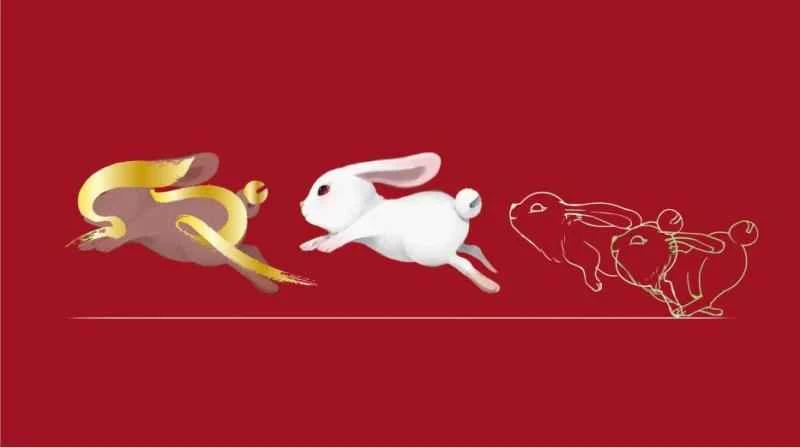
With its fluffy appearance, lively and endearing charm, large, expressive eyes, and the Eastern concept of "animism," "Tu Yuanyuan," the mascot for the 2023 CCTV Spring Festival Gala, officially debuted on December 22. This is also the first Spring Festival Gala mascot IP in its 40-year history to be generated based on a comprehensive and systematic big data survey, incorporating the preferences of countless viewers.
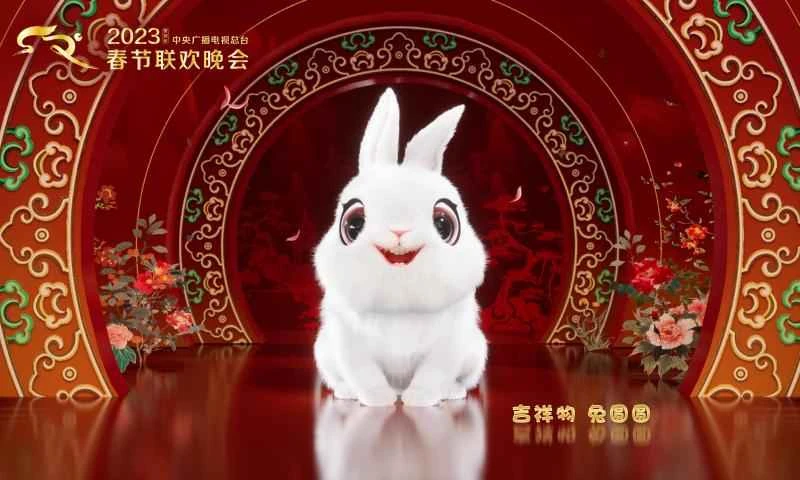
But if you think this is just a cute little creature, you're underestimating it. The real secret of "Rabbit Round Round" lies in its iconic four incisors.
The "Anhui pika" is the earliest known rabbit-like animal in the world, living during the Early Paleocene epoch, about 62 million years ago. Its image is based on an ecological reconstruction of the Anhui pika fossil discovered by scientists at the Institute of Vertebrate Paleontology and Paleoanthropology, Chinese Academy of Sciences (IVPP). It possesses typical characteristics of a "rabbit ancestor" dating back approximately 62 million years and offers crucial clues to a classic scientific question in rabbit-like research over the past 300 years.
Are rabbits and mice actually related?
In daily life, whenever you see rabbits, they always seem busy, constantly chewing their food. This is because a rabbit's incisors grow continuously, and if they aren't properly ground down, they will grow outwards rapidly. Overgrown incisors can prevent a rabbit's lips from closing, making it unable to eat normally, and in severe cases, even leading to death.
For rabbits, this is a life-or-death struggle to grind their teeth. And for scientists, these incisors are also quite important. Li Qian, a researcher at the Institute of Vertebrate Paleontology and Paleoanthropology, told the *China Science Daily* that this is a distinctive feature that distinguishes rabbits from other mammals.
However, among mammals, besides rabbits, only mice possess incisors that grow throughout their lives, so rabbits and mice have long been considered closely related. Li Qian mentioned that as early as 1735, Linnaeus, the founder of modern taxonomy and a naturalist, classified rabbits and mice together as rodents.
"It wasn't until 200 years later that scientists began to point out the differences in the morphology of the incisors of rabbits and mice. Moreover, the upper incisors of lagomorphs have a pair of smaller incisors hidden behind them, which is significantly more complex than that of rodents. Not only that, but more and more scholars have discovered more differences between the two, and have turned to the conclusion that there is no kinship between rabbits and mice."
This debate has lasted for nearly 100 years and has raised a classic scientific question in the history of lagomorph research: where exactly does the rabbit fit in the family tree of mammals in the history of life evolution?
"Tracing one's roots" is the forte of paleontologists. The only way to find out how lagomorphs originated and whether they are related to rodents is to look for clues in fossils.
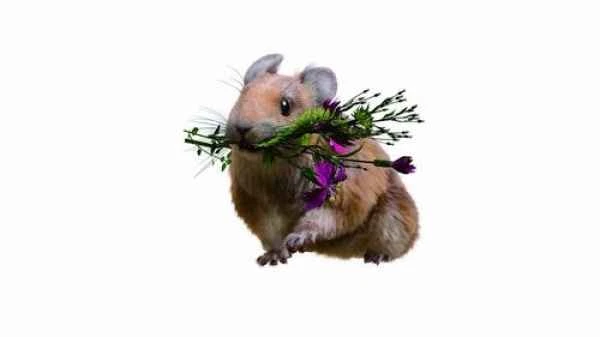
The Mole Rabbit and the Oriental Dawn Mouse share the same "roots".
Since the 1960s, the Chinese Academy of Sciences has organized large-scale expeditions to the "red beds" of South China, discovering a unique Asian mammal fauna in the Paleocene strata. This provided an opportunity to explore the origins of rodents and lagomorphs.
In the 1970s, a field expedition team from the Institute of Vertebrate Paleontology and Paleoanthropology discovered several important skull fossils in the same stratigraphic layer in Qianshan, Anhui Province (dating back to the Early Paleocene, approximately 62 million years ago), which preserved incisors. After research by Li Chuankui, a paleomammalogist and researcher at the Institute of Vertebrate Paleontology and Paleoanthropology, they were named Anhui mosa pika and Oriental dawn mouse, respectively.
Upon first seeing the Anhui pika specimen, Li Chuankui, with his keen eye, jokingly remarked to himself, "A rabbit? A rabbit mother?" Later, after detailed morphological research, he discovered that the Anhui pika's characteristics were very similar to those of rabbits, suggesting it might be an ancestral type of lagomorph. Meanwhile, the Oriental pika may have already possessed the "biting" function unique to rodents, approaching an ancestral type of rodent.
"More importantly, the study also found that the two have many overlapping characteristics, and the ancestral types of rabbits and mice are 'intertwined'," Li Qian added.
The long-debated origins of lagomorphs and rodents have both found their roots in Qianshan, Anhui. Some jokingly say that this truly demonstrates the close relationship between pikas and rodents: even the oldest fossils are preserved together.
In 1980, Li Chuankui brought his research on the pika and the Oriental dawn mouse to the "International Conference on the Origin of Rodents" held at the Carnegie Institution of Pittsburgh, USA. At that time, he proposed the view that pikas and mice share a common origin, which attracted widespread attention from the international academic community.
Before the 20th century, paleontologists primarily determined the phylogenetic relationships of biological groups based on the morphological characteristics of fossils. With the rapid development of molecular biology, the evidence has become increasingly substantial.
In 2005, Asher et al. published an article in *Science*, combining morphological data from fossils and extant lagomorphs with molecular biological data. Their analysis revealed that in the early Cenozoic, the ancestral types of lagomorphs diverged from other placental animals along with rodents. This research was further supported by a 2013 big data matrix analysis, which showed that the ancestral groups of lagomorphs and rodents only separated at the beginning of the Cenozoic, each embarking on an independent evolutionary path.
Thus, the theory that "mouse and rabbit share a common origin" was definitively established. The debate over the origin of rabbits finally came to an end.
"Rabbit Round Round" = Chinese Science Story + Traditional Chinese Culture
Li Chuankui made invaluable contributions to the search for the ancestors of rabbits. Besides the Anhui pika, in 1965, he studied Eocene lagomorph fossils in northern my country, including the world's oldest and most primitive lagomorph at the time—the Luohe Lushi rabbit (approximately 46 to 43 million years ago). In 2007, he and his team discovered the ancient Dawson rabbit (approximately 53 million years ago) in the Early Eocene strata of the Eren Basin in Inner Mongolia. This rabbit, intermediate between the pika and lagomorphs, broke the age record of the Luohe Lushi rabbit, earning it the title of "World's First Rabbit"...
It is thanks to the research teams led by the older generation of paleontologists who have traveled across the mountains and deserts of our motherland for decades, filling in the gaps step by step, that my country has nearly complete fossil evidence of rabbit evolution.
It can be said that the mascot of the 2023 Spring Festival Gala, "Tu Yuanyuan," not only embodies the connotation and beauty of the rabbit zodiac, but also makes the outstanding scientific achievements and tenacious scientific spirit of Chinese scientists shine brightly.
(Originally published in the China Science Daily, December 23, 2022, page 1, top news)