The Arctic tern is the bird that flies the farthest on Earth, and its ability to travel long distances is unparalleled. Arctic terns migrate south from their northern breeding grounds to the oceans near Antarctica, and then north back to their breeding grounds, covering a total distance of more than 40,000 kilometers, which is the longest known migration route for any animal.
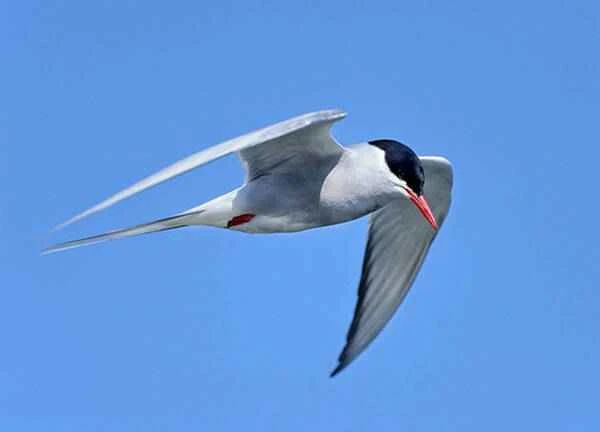
The Arctic tern is a medium-sized bird. It measures 36 cm in length, has a wingspan of 76-85 cm, and weighs 80-120 grams. A distinctive feature is the black patch on its head. The Arctic tern is similar to the common tern and the red-crowned tern, but their coloration and appearance differ slightly. Compared to the common tern, the Arctic tern has a longer tail and a more monochromatic beak, while compared to the red-crowned tern, its body color is slightly darker and its wings are longer.

The Arctic tern is a graceful seabird capable of long-distance flights. During the Northern Hemisphere summer, Arctic terns breed within the Arctic Circle. They skim low over the waves, catching small fish and crustaceans for food. When winter arrives and the coastal waters freeze, the terns embark on their long migration. They fly south, cross the equator, circumnavigate half the globe, and arrive at the icy Antarctic, where they enjoy the Southern Hemisphere summer. Only when the Southern Hemisphere winter arrives do they fly north again, returning to the Arctic. They make this round trip between the poles once a year, traveling tens of thousands of kilometers.

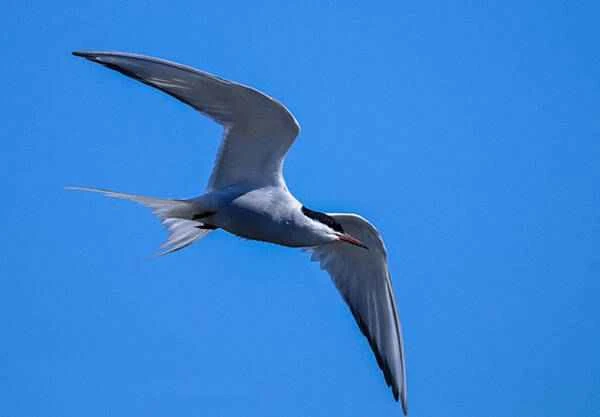
Among all migratory animals, the Arctic tern's ability to traverse long distances is unparalleled. In summer, they inhabit the area from the Canadian Arctic Circle to Massachusetts in the United States, and in winter, they fly to the other pole—Antarctica—to overwinter. The tern has a forked tail and narrow, long wings. These wings provide much greater buoyancy than those of other birds when in flight.
Every March, Arctic terns, having spent several months in Antarctica, gather in small flocks to prepare for their northward migration, embarking on an exceptionally long journey of approximately 18,000 kilometers to return to their breeding grounds in the Arctic. Before their long journey, they completely molt their old feathers and grow new ones. They depart from the Antarctic Peninsula, fly to southern Africa, cross mountains, continue north through the entire tropics, fly along the West African coast to Europe, and finally settle in the Arctic. Departing from late summer in Antarctica, they arrive in the Arctic just as summer begins. No other animal enjoys the longest hours of sunlight. After completing the longest migration of any animal on Earth, they settle in the Arctic in early May to begin a new breeding cycle.
Although humans are the most intelligent of all beings and have created highly modern airplanes, traveling between the poles is by no means an easy task. Therefore, the spirit and courage of terns in their pursuit of light, undeterred by hardship, are particularly worthy of emulation. This is because they always spend their days in the polar summer, when the sun never sets, making them the only creatures on Earth that live in perpetual light.
Moreover, they possess remarkable resilience. In 1970, an Arctic tern with a leg band was captured, and it was discovered that the band had been placed on it in 1936. This means the tern had lived for at least 34 years. Based on this, it must have flown at least 1.5 million kilometers in its lifetime. Tracking studies of Arctic terns have revealed that they can live for over 33 years, and a lifespan of 20 years is likely quite common.