The fastest sprinting bird on Earth is the peregrine falcon. A medium-sized raptor belonging to the family Falconidae and genus Falcon, it is the national bird of the United Arab Emirates and Angola. While peregrine falcons are not typically fast fliers, reaching speeds of only 50-100 kilometers per hour, they are the fastest swooping birds, reaching speeds exceeding 300 kilometers per hour. Because this swooping hunting ability is not innate, peregrine falcons exhibit a rare behavior in nature: teaching their chicks hunting techniques.
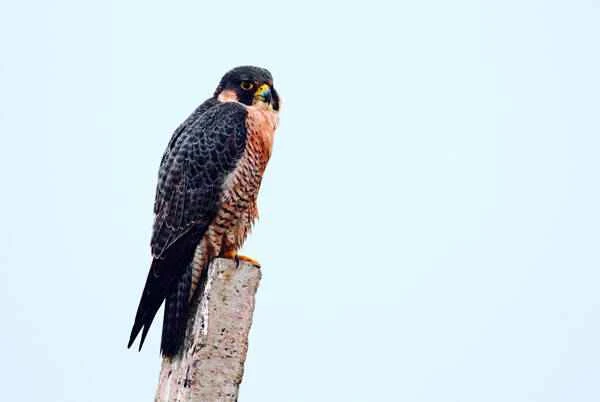
Peregrine falcons are fierce and will attack even birds much larger than themselves, such as golden eagles, gyrfalcons, and buzzards, though their motivation is usually to defend their nests and territories. Because they primarily hunt in the air, they need to be faster than other birds of prey, hence their relatively large weight, narrow wings to reduce drag like those of high-speed aircraft, and relatively short tail feathers.
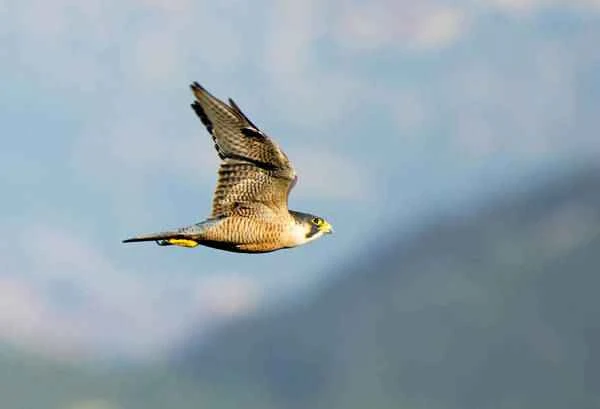
Peregrine falcons spend most of their hunting time in the air. When they spot prey, they first quickly ascend to a high altitude, gaining a commanding position. Then, they fold their wings so that the flight feathers are parallel to their body's longitudinal axis, tuck their head to their shoulders, and swoop down from the sky at a speed of 75-100 meters per second, almost vertically. When they approach their prey, they slightly spread their wings and use the impact of the high-speed dive to forcefully strike with their hind toes or seize the prey with their sharp, dagger-like talons, injuring or killing it instantly. Anyone who has witnessed a peregrine falcon hunting will never forget it. Finally, it takes its prey to a relatively secluded spot, holds it down with its feet, plucks its feathers with its beak, and then tears it into small pieces to swallow. Sometimes they also hunt on the ground. Adapted to this hunting method, its tarsi have become short and stout, and its toes for grasping prey have become slender and long.
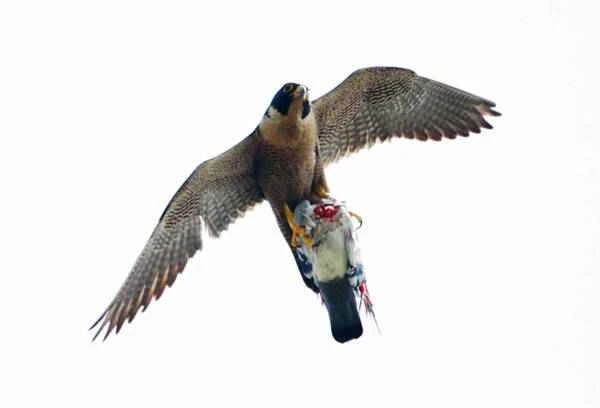
Peregrine falcons primarily hunt birds in flight. However, like many other falcons, they also catch large flying insects, such as beetles, and also eat bats and rodents. Males are smaller and catch prey of varying sizes, from tits to jays, and even pigeons. Females are larger and catch prey ranging in size from blackbirds to wood pigeons. They also catch ducks, and even geese and herons, but these catches are quite specific, and northern peregrine falcons, being larger, do not need to carry their prey back to cliffs during their migration routes; they are generally eaten on the spot. Their primary prey consists of small to medium-sized birds such as wild ducks, gulls, doves, crows, and chickens, and they occasionally prey on small mammals such as rodents and hares.