Around 66 million years ago, dinosaurs, who had ruled the Earth for 200 million years, suddenly went extinct. The current authoritative explanation is that an asteroid impact caused dust to fill the sky and acid rain to fall, cutting off the food source for dinosaurs and many other plants and animals, leading to their extinction. This "dinosaur killer" is known as the Chicxulub meteorite.

For many years, the scientific community has never stopped researching the extinction of dinosaurs. The timing and location of the "killer" meteorite impact on Earth were crucial to the extinction of dinosaurs, a point that has been extensively argued in recent years. A new study claims to have filled an important gap in the puzzle of the dinosaur extinction mystery.
New research by Professor Gareth Collins of Imperial College London suggests that the angle of the meteorite impact was also crucial—whether the angle increased or decreased did not necessarily lead to the extinction of dinosaurs.
In an interview with BBC science correspondent Jonathan Amos, he explained: "Clearly, the geological features of the location and the angle of impact made for a perfect storm."
Research indicates that within hours of the Chicxulub meteorite impact, a tremendous force caused the extinction of dinosaurs and 75% of other life on Earth, altering the planet's appearance and destiny.
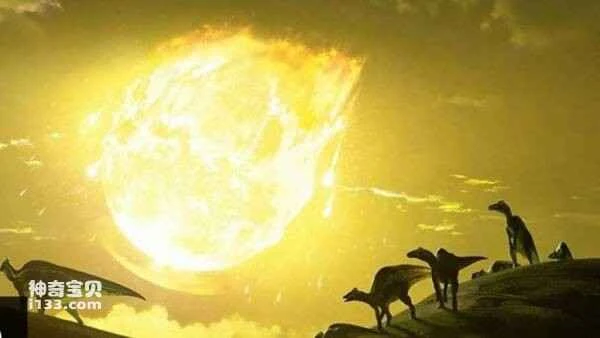
Impression: Dinosaurs and a Meteorite Impact
A meteorite impact alone wouldn't have been enough to wipe the dinosaurs off the planet; the location, timing, and angle of the impact were all crucial.
In the BBC documentary "The Day the Dinosaurs Died," Professors Jo Morgan and Sean Gulick led a research team that explained in detail the rock core fragments of the Chicxulub Crater in the Gulf of Mexico, discovering that the location and timing of the meteorite impact were remarkably coincidental.
If the time and place conditions were not met, it might not have been enough to cause such extinction damage to so many dinosaur species.
Because the meteorite struck the Gulf of Mexico, the rock layers melted, and sulfides from the limestone were ejected into the air, blocking out the sun and eventually creating a long, cold winter that enveloped the Earth.
They say that if the asteroid had struck the Pacific or Atlantic Ocean, there would have been less evaporation of rock layers and less sulfide buildup, allowing sunlight to still reach the surface and potentially enabling dinosaurs and other life forms to survive.
Professor Collins' research shows that the angle at which the meteorite struck Earth was a major reason for the prolonged environmental disaster that followed; only a very small number of species survived to the end.
He said, "At impacts of 45 to 60 degrees, the rock fragments vaporize to an extremely high degree, and the molten magma is violently ejected into the atmosphere, causing significant and long-lasting climate change."
"If the angle of impact is small or large, the amount of these substances entering the atmosphere will be greatly reduced."
Scientists believe that the angle at which that meteorite impacted Earth was the most "lethal" and had the greatest destructive power. (English video)
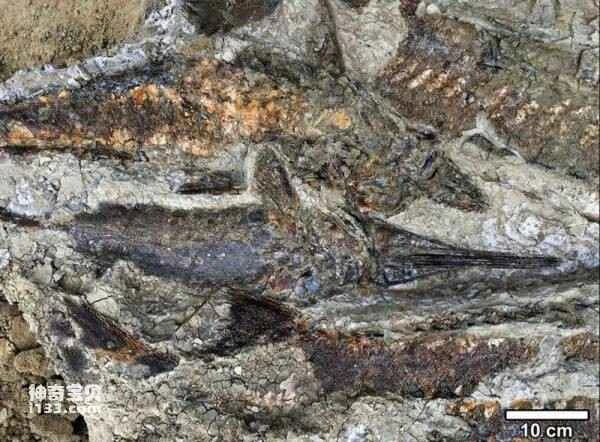
The fossilized fish lay piled up layer upon layer. Perhaps the massive shockwave triggered a tsunami, and the fish, their gills full of lava particles, were tossed ashore by the towering waves, piling up in heaps.
The Chicxulub meteorite was 12 kilometers in diameter. When it struck Earth, billions of tons of liquefied and vaporized rock erupted, covering the sky and the surrounding area for thousands of kilometers with a layer of magma.
Researchers believe the impact of the meteorite was equivalent to a magnitude 10 or 11 earthquake shockwave, spreading globally and triggering a lake tsunami. Similar to a tsunami, a massive wave rolls in, carrying everything in the lake up to the ground and eventually becoming fossils.
In 2019, geologists Walter Alvarez and his father Luis Alvarez from California, along with other colleagues, published their findings on these fossils in the journal PNAS, suggesting that the Mexican sinkhole may very well be the landing site of the dinosaur terminator.
Professor Alvarez said, "When we proposed the mass extinction hypothesis of the dinosaurs, it was based solely on the discovery of unusual iridium deposits, which are like fingerprints or imprints of comets or asteroids. Since then, more and more evidence has emerged. However, the discovery of such a death site was completely unexpected."
Phil Manning of the University of Manchester, another co-author of the research report, believes that the site where the Tanis fossils were unearthed is the place that unlocks the mystery of the dinosaurs' end and is one of the most important scientific research sites in the world.
Chicxulub: A Collision That Changed Earth's Fate
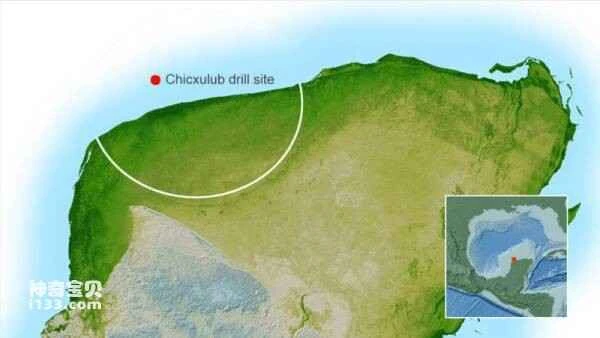
The outer edge of the Chicxulub crater beneath Mexico's Yucatan Peninsula (white arc).
A massive meteorite, 12 kilometers in diameter, struck Earth, creating a crater 30 kilometers deep and 100 kilometers wide.
Subsequently, the bottom of the crater collapsed, expanding its diameter to 200 kilometers and increasing its depth by several kilometers.
Today, most of this impact crater lies on the continental shelf, covered by 600 meters of sediment.
The portion of the impact crater on land is covered with limestone, and its edges are a series of sinkholes arranged in an arc.
Scientists have begun drilling in that area in recent years to study the structure of the impact crater in depth.
Mexican sinkholes
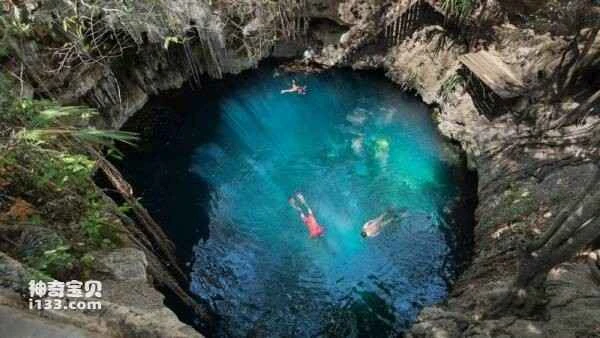
Mexico's famous sinkholes are meteorite impact craters covered with limestone.