The Brazilian red-eared slider, also known as the red-eared slider, gets its name from the two thick red stripes on the sides of the back of its head. Most species are found in Brazil. The Brazilian red-eared slider is a globally recognized ecological killer, listed by the World Conservation Organization as one of the 100 most destructive species, and many countries have classified it as a dangerous invasive alien species! China has also listed it as an invasive alien species, and the damage it has caused to China's natural environment is incalculable.
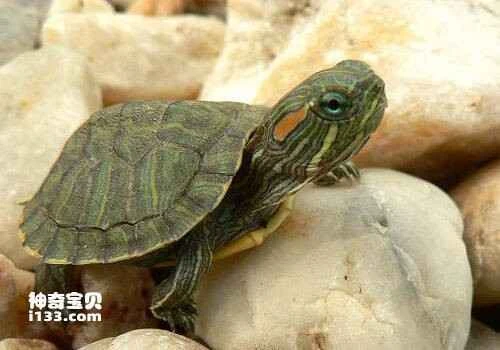
Habitat and Habits: The Brazilian red-eared slider lives in valleys and streams, leading an amphibious lifestyle, specifically a semi-aquatic one. During the day, it prefers to hide in caves or dark, secluded places, sometimes bathing in the water or basking in the sun. It is most active at dusk, especially after rain. It has climbing and gregarious habits, is docile and timid, prefers quiet places and dislikes noise, and prefers cleanliness and dislikes dirt. Its optimal water temperature for growth is 25–35℃, and its feeding temperature is 20–35℃, but its appetite is strongest at water temperatures of 29–32℃. It stops eating at 36℃, hibernates at 38℃, and can tolerate temperatures up to 40℃. When the temperature drops below 16℃, it enters a hibernation state, and below 1℃, there is a risk of death from stiffness. Because the Brazilian red-eared slider breathes with lungs, it needs to surface to breathe, and the length of these surfacing intervals is directly related to the water temperature and the intensity of its activity. When the water temperature is below 12℃, they can remain submerged for extended periods, breathing weakly through their throats. When the water temperature rises to 25℃, they will surface to breathe after about 25 minutes. In spring, when the water temperature rises above 16℃, a small number of turtles begin to forage. Above 20℃, they generally feed normally, but in small amounts. When the temperature is low, their activity time is from 10 am to 3 pm; when the temperature is high, they are more active from evening to dawn. From November to March of the following year, when the temperature is low, they often hide in dark places, remaining inactive and not eating. They begin to emerge from hibernation in early April. From May to September, as the temperature rises, their activity range expands, and their activity gradually increases. On sunny days in early spring and late autumn, they like to bask in the sun to warm themselves. June to August is their most active period. During the midday heat of summer, they generally rest in sheltered land or their nests. At dusk and night, they are mostly active in the water, with activity gradually decreasing after 10 pm. After mid-October, temperatures gradually decrease, activity significantly weakens, and they enter a semi-hibernation state. As temperatures continue to drop, hibernation deepens.
Red-eared sliders are omnivorous. They are wild turtles in the wild, primarily feeding on meat. They are not selective about their feeding time, eating both day and night. When hungry, they will compete for food, and larger turtles may even eat smaller ones.
Harm: Red-eared sliders must never be released into the wild, and the government should prohibit citizens from buying and releasing them. They are listed as one of the world's most dangerous invasive species due to their massive depletion of resources. When introduced, like the golden apple snail, red-eared sliders were initially bred for food. They share characteristics such as large size, wide diet, strong adaptability, rapid growth and reproduction, high yield, strong disease resistance, and high economic value, leading to their widespread farming throughout China. However, due to their high reproductive rate, high survival rate, and superior foraging and food-competing abilities compared to any native Chinese turtle species, releasing them into the wild, with virtually no natural predators and in large numbers, will severely threaten the survival of native Chinese turtles and similar species. In tourist areas suitable for survival, coupled with active public releases, one can often see ponds teeming with red-eared sliders!
Therefore, those who enjoy releasing animals should remember not to buy Brazilian turtles for release, otherwise releasing them will become "killing".