Flamingos are highly recognizable waterbirds: slender legs, an S-shaped neck, a downward-curving beak, and striking pink plumage. Many people believe that pink is a "natural color," but it mainly comes from carotenoids in their food, such as small crustaceans and other aquatic microorganisms. Flamingos have a fine "filter structure" inside their beaks, allowing them to filter food from shallow water and muddy bottoms, making them particularly reliant on environments such as salt lakes, lagoons, and shallow wetlands.
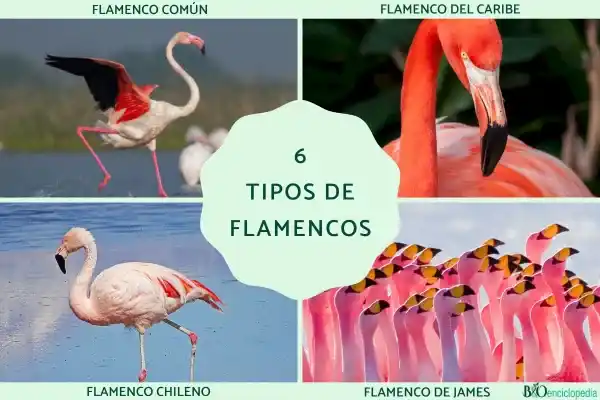
Although flamingos look similar, different species exhibit significant differences in body size, distribution range, leg and beak color details, and black tail feathers. Below is an introduction to six common flamingo species worldwide, supplemented by information on more threatened species and their main sources of stress.
1) Greater Flamingo ( Phoenicopterus roseus )
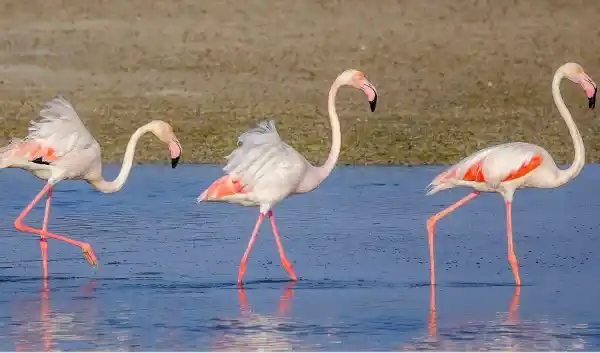
The Greater Flamingo is one of the most typical and "tall" flamingos, commonly found in shallow wetlands such as coastal lagoons, salt pans, and saline lakes, and its distribution spans multiple temperate and subtropical regions. Its plumage is typically pale pink to rose pink, with the shade closely related to the amount of carotenoids in its diet.
These flamingos are extremely gregarious, often forming large colonies of tens of thousands. During the breeding season, they build cone-shaped mud nests in shallow water, with the parents taking turns guarding the eggs and chicks. Despite their wide distribution and relatively stable population, they are still affected by factors such as wetland shrinkage, pollution, and water level changes caused by prolonged droughts.
2) American Flamingo/Caribbean Flamingo ( Phoenicopterus ruber )
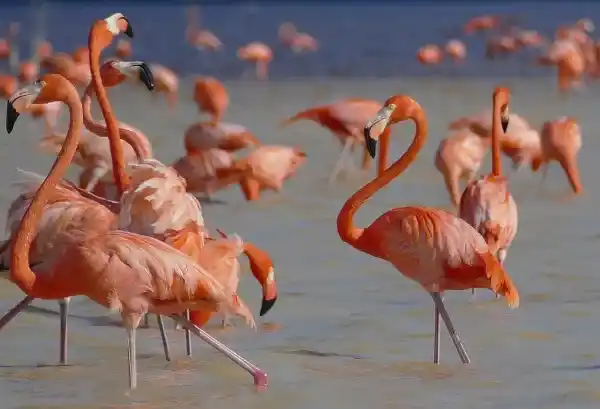
The American flamingo is mainly distributed in tropical regions of the Americas, ranging from southern Florida in the United States to the Caribbean islands, Central America, and parts of northern South America, and can also be found in places such as the Galapagos. It is the largest flamingo in the Americas and one of the largest flamingos in the world.
Its plumage ranges from light pink to deep red, depending on the abundance of crustaceans and other food sources. They rely on a filter plate in their beak to filter large quantities of water, preferring shallow lakes and coastal waters with high salinity or alkalinity. They migrate between different foraging sites, often forming sizable groups. Most exhibit stable pair bonds, but interbreeding is also possible.
3) Lesser Flamingo / Phoenicopterus minor
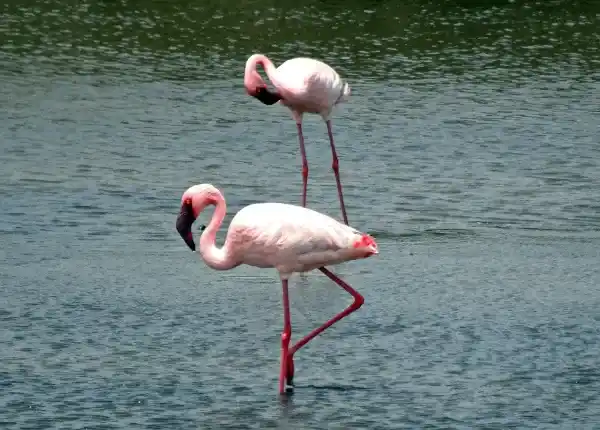
The Lesser Flamingo is one of the smallest flamingos, generally not exceeding 1 meter in height. It is mainly distributed in Africa, particularly in the East African Rift Valley; it can also be found in parts of South Asia, such as Pakistan and northwestern India.
One key distinguishing feature is the beak color: it is usually deep red with a distinctly black tip . They also build mud nests in shallow waters and breed once a year. Due to their high dependence on lake water quality and food composition, Lesser Flamingos are relatively sensitive to habitat disturbance, pollution, and hydrological changes.
4) Andean Flamingo ( Phoenicoparrus andinus )
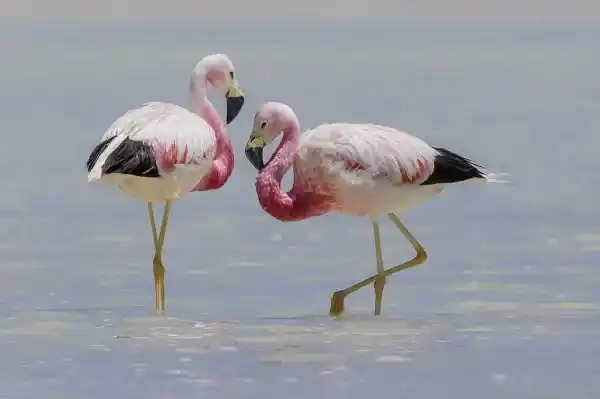
The Andean flamingo has a relatively limited distribution, mainly inhabiting high-altitude salt lakes and wetlands in the central Andes Mountains. It belongs to another extant genus of flamingos— Phoenicoparrus (also often referred to as "parina" flamingos in some parts of South America).
Its physical details are quite distinctive: the most striking feature is its yellow legs (uncommon among flamingos). In addition, its beak and tail usually have relatively obvious black areas, making it easier to distinguish from other High Andean flamingos under good observation.
5) Chilean Flamingo ( Phoenicopterus chilensis )
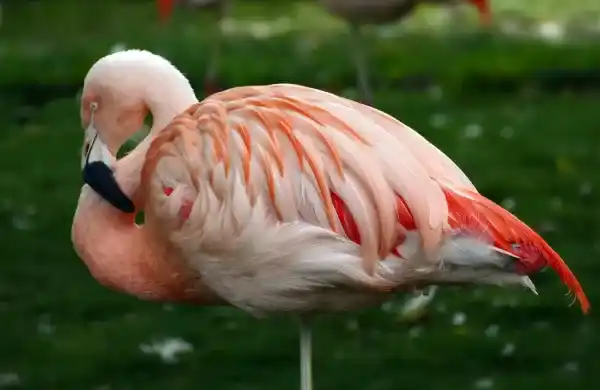
Chilean flamingos are mainly distributed in southern South America, especially in the salt flats and lagoons of Chile, and also live in some waters in Peru and Argentina. They are medium-sized, generally about 1–1.4 meters tall.
The key to identifying it lies in its legs: the legs are generally gray , but noticeable pink patches are often visible at the joints, making it appear as if the "knees" are pinkish (in reality, the visible bends are not true knee joints). This feature is very useful when mixing with other groups.
6) James Flamingo ( Phoenicopterus jamesi )
The James Flamingo has a similar distribution to the Andean Flamingo, and also mainly lives in the high-altitude wetlands of the Andes, but it is generally considered to be a smaller flamingo species in the Andes region.
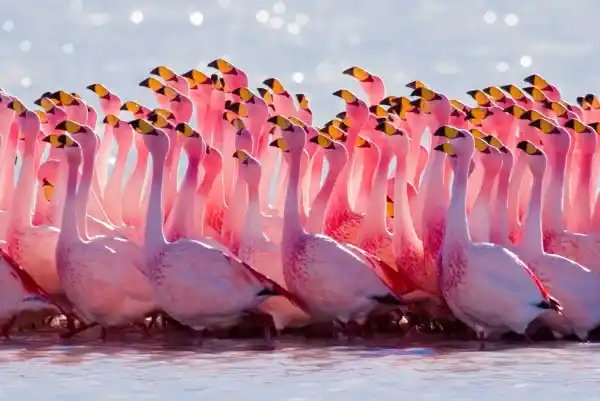
Compared to other flamingos, its beak curvature is often less pronounced , and the front half of the beak is frequently yellowish or light-colored . Black feathers may also appear on its tail, but in many cases, its overall appearance is more "pale" than that of the Andean flamingo. Due to the inherent fragility of high-altitude wetland environments, it is also more sensitive to fluctuations in water levels, changes in food sources, and human disturbance.
More Threatened Flamingos: Common Risks and Major Stresses
Flamingos are highly dependent on wetland ecosystems, which are often most vulnerable to human activities and climate fluctuations. Therefore, some flamingo species are considered to face greater survival pressure. Overall, many flamingos are not classified as "critically endangered," but some species are often considered to be of high concern.
Chilean Flamingo ( Phoenicopterus chilensis )
It is often described as near threatened and shows a declining population trend.
Key pressures include mining and energy development, hunting and trapping, human management changes to water bodies and wetlands, and ongoing disruptions from tourism and recreational activities.
Lesser Flamingo ( Phoenicopterus minor )
It is also often described as near endangered , with its numbers declining in some areas.
Threats include mining and energy projects, changes in water management, transportation infrastructure construction, pollution, and human interference related to engineering activities.
James Flamingo ( Phoenicopterus jamesi )
It is often described as near threatened , with relatively stable populations in some areas.
The main stressors are related to the development and disturbance of high-altitude wetlands, such as mining, hunting and trapping, water regulation, and tourism activities.
Andean Flamingo ( Phoenicoparrus andinus )
It is often considered to be the more threatened species, commonly described as vulnerable and declining in number.
In addition to development, pollution and disturbance, extreme weather and hydrological changes caused by climate warming will further affect the stability of its high-altitude wetland habitats.
The key to protecting flamingos is to protect wetlands: maintaining suitable water levels and quality, reducing pollution, minimizing disturbances near breeding grounds, and conducting more cautious development and management around sensitive water areas.