The sperm whale (scientific name: *Physeter catodon*), also known as the giant sperm whale, is the largest toothed whale on Earth and one of the most mysterious marine mammals. Sperm whales are renowned for their enormous size, unique head structure, and deep-sea hunting abilities. This article will provide a detailed introduction to the sperm whale's morphological characteristics, habits, distribution areas, food sources, reproductive behavior, and differences from other whales, helping you gain a comprehensive understanding of this marine behemoth.
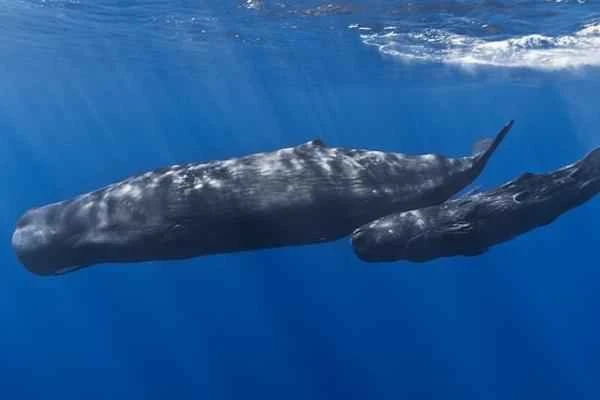
I. Characteristics and Classification of Sperm Whales
Sperm whales belong to the suborder Odontoceti and are the largest living toothed whales. Compared to other whales (such as baleen whales), sperm whales have many unique morphological characteristics:
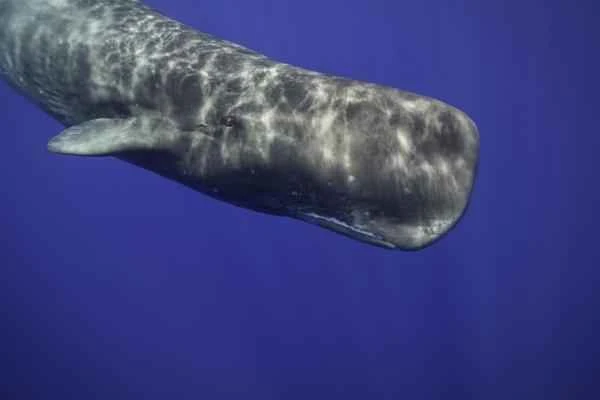
Unique head : Sperm whales have an extremely large square forehead that accounts for 1/3 of their total body length. There is a special organ here filled with waxy oil (spermaceti), which not only helps them regulate buoyancy, but may also enhance their deep-diving and sonar positioning capabilities.
Streamlined body shape : Sperm whales have streamlined bodies, and their skin is mostly gray or brown with obvious wrinkles. Occasionally, albino individuals also exist, becoming "white giants" in the ocean.
Finger evolution : The forelimbs evolved into flippers, there are no hind limbs, the tail fin is horizontal, and the dorsal fin is small, which facilitates rapid swimming in the deep sea.
Thick subcutaneous fat : There is a thick layer of fat under the skin, which effectively protects against the cold environment of the deep sea.
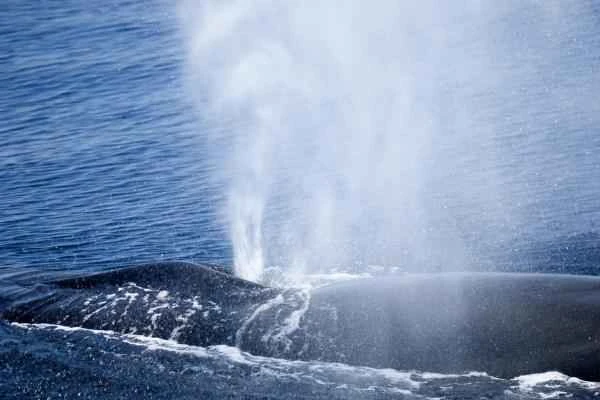
Unique blowhole : The sperm whale's blowhole is located on the left side of its head, and it sprays water at a unique angle, making it easy to identify.
Huge size : Adult males can reach 16 to 20 meters in length and weigh over 50 tons, making them the largest living toothed animals.
Currently, three species of sperm whales are known:
Sperm whale (Physeter catodon) : The largest species, widely distributed in the world's oceans.
Pygmy sperm whale (Kogia breviceps) : Small in size, only 2.7 to 3.4 meters long.
Baby sperm whale (Kogia sima) : Approximately 3 meters in length.
This article focuses primarily on the common large sperm whale (P. catodon).
II. Distribution of Sperm Whale Habitats
Sperm whales are a widely distributed deep-sea mammal found in almost all temperate, tropical, and polar seas worldwide.
Deep-sea creatures : They prefer deep waters far from the continental shelf and are commonly found in areas where ocean currents converge and in deep waters such as submarine canyons and abysses.
Sperm whales occasionally approach land : They can be seen in some areas on the continental slope and in deep waters near the shore, but rarely enter shallow waters.
Highly migratory : Sperm whales undertake large-scale seasonal migrations depending on the season and food resources.
Adapted to extreme environments : It can move freely in waters deeper than 3,000 meters and is an important apex predator in the deep-sea ecosystem.
III. Sperm Whale's Diet and Hunting Methods
Sperm whales are apex predators of the ocean , renowned for their powerful sonar systems and exceptional deep-diving abilities.
Main diet : Primarily deep-sea giant squid (such as the giant squid Architeuthis), but also preys on various fish, octopuses, and crustaceans.
Sonar hunting : Precisely locates prey in the extremely low-light environment of the deep sea by emitting strong echolocation signals (pulse sound).
Deep diving capability : It can easily dive to depths of over 1,000 meters, with extreme records reaching 3,000 meters. Each dive lasts 30-90 minutes.
Powerful hunting : According to research, sperm whales can also stun their prey with powerful sonic waves (sonar "bombardment"), making it easier for them to hunt.
Their appetite is astonishing : an adult sperm whale needs to consume up to 1 ton of food per day.
IV. Sperm Whale Reproduction and Life Cycle
Reproductive characteristics : Females reach sexual maturity at 8-10 years old and males at about 10 years old, but most of them actually participate in reproduction at 25 years old or older.
Breeding cycle : They breed once every 4-6 years, with only one calf per birth. The gestation period lasts 14-16 months, and the lactation period is about 2 years. The growth cycle of calves is relatively slow, and the population recovery is slow.
Long lifespan : Sperm whales can live for more than 70 years.
Social structure : Female whales and calves form stable matrilineal family groups, while males mostly live alone or form small "male whale alliances" after reaching adulthood.
V. Behavior and Sociality of Sperm Whales
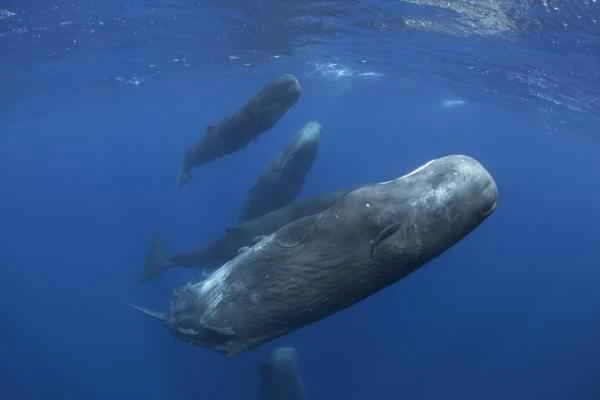
Highly social : Mother whales and calves often form small groups of multiple individuals, taking care of and protecting each other, especially the weaker members.
Self-defense strategy : When threatened, adult mother whales will surround their calves, forming a "protective circle" to defend against predators such as sharks and killer whales.
Vocal communication : Sperm whales use complex "click sounds" for group communication and social interaction.
Males are solitary : Adult male whales mostly cruise alone and only encounter females during the breeding season.
VI. Differences between sperm whales and baleen whales
Many people classify sperm whales as "whales," but they differ significantly from typical baleen whales:
| Comparison items | Sperm whale (toothed whale) | Baleen whales (such as blue whales and humpback whales) |
|---|---|---|
| Tooth/whisker structure | The mouth contains large, sparse, cone-shaped teeth. | It has barbels but no teeth; it filters planktonic organisms through these barbels. |
| feeding habits | Actively hunts squid and fish | Primarily composed of plankton and krill, passive filtration. |
| Head shape | Square forehead, jet nozzles offset to the left | The head is long and narrow, with the jet vent in the center. |
| Family affiliation | Physeteridae | Balaenidae, etc. |
| Behavioral characteristics | Sonar echolocation, deep-sea hunting | Filter feeding, long-distance migration |
VII. Current Status of Sperm Whale Conservation
Sperm whale populations are threatened by overhunting, marine pollution, and other factors. The International Whaling Commission has banned commercial hunting of sperm whales, but illegal hunting and human activities persist. Protecting sperm whales and their deep-sea habitats is a crucial issue for global marine ecological conservation.
bibliography
Beatty, R., Beer, A., and Deeming, C. (2010). The Book of Nature. Doreen Kindersley, UK.