Frigatebirds (Fregata magnificens), also known as black-bellied frigatebirds, are the aerial rulers of the ocean, their black plumage, majestic bodies, and powerful flight capabilities leaving a lasting impression. As apex seabirds, frigatebirds not only soar through the air with ease but also play an indispensable role in the marine ecosystem. Their characteristics, behaviors, and even reproductive methods are wonders of nature. Today, we'll take a closer look at frigatebirds and see why they have distinguished themselves in the natural world, becoming true "aerial rulers."
Scientific classification
First, let's look at the scientific classification of frigatebirds to understand their academic background.
Kingdom: Animalia
Phylum: Chordata
Class: Aves
Order: Procellariiformes
Family: Frigatebird (Fregatidae)
Genus: Frigatebird (Fregata)
Species: American frigatebird (Fregata magnificens)
Frigatebirds belong to the order Procellariiformes in the class Aves and are birds specifically adapted to marine environments. Their physical characteristics, flight abilities, and hunting methods are all closely related to the ocean.
Frigatebird's appearance features
Huge wings and long tail feathers
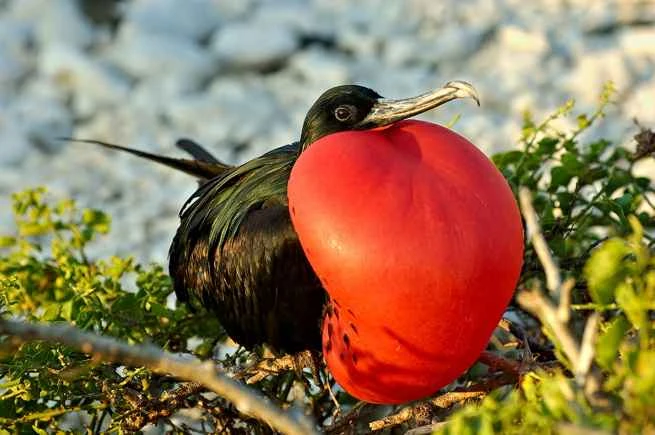
The most striking feature of the frigatebird is its pair of broad wings, with a wingspan reaching approximately 2.3 meters. These wings not only help them soar through the air but also provide sufficient power for long-duration flights. Their slender bodies and predominantly black or dark green plumage give them an aura of both power and mystery. Male frigatebirds, in particular, develop a large, red throat pouch that inflates their chests, a unique feature that is a key factor in attracting mates.
Besides their large wings, frigatebirds also have very distinctive tail feathers. Their tail feathers are long and thin, often forked, making them very elegant in flight. The flexibility of their tail feathers also helps them make rapid maneuvers in the air.
Differences between males and females
The male frigatebird is most distinctive in appearance. They possess a large, red throat pouch that inflates into a bright red balloon during the breeding season to attract females. The male attracts the female's attention by opening its throat pouch and emitting a loud call. The differences between males and females are quite obvious; females do not have such a prominent throat pouch and are slightly smaller, but are equally beautiful.
Frigatebird's flight ability
How to fly for a long time?
Frigatebirds are among the most adept fliers in nature. Their long, broad wings are perfectly suited for extended periods of flight over the sea. Frigatebirds can remain airborne for days with almost no need to land. Thanks to their powerful wings and stamina, they can glide, hover, soar, and even rest in mid-air. Their flight capabilities extend beyond simply hovering over the open sea; they can also navigate with ease through strong air currents.
Frigatebirds don't rely entirely on wing flapping for flight; they utilize air currents more for gliding. They use the upward force of these air currents to stay airborne for extended periods without frequent wing flapping. Their flight method is highly efficient and conserves energy.
High-altitude hunting
Frigatebirds' flying ability is also closely related to their hunting methods. Unlike other seabirds that hunt by diving, they catch schools of fish on the surface of the sea by flying. Frigatebirds hover above the sea, observing the movements in the ocean and searching for schools of fish. Once they spot a target, they quickly swoop down and grab the fish or other marine life that has fallen into the water.
The "Airborne Overlord" in Flight
Frigatebirds' flight patterns often make them the rulers of the skies. Over the ocean, frigatebirds are frequently among the highest-flying birds, their wings and tails allowing them to easily perform rapid turns and somersaults. Even when faced with challenges from other seabirds, frigatebirds can easily cope, demonstrating their domineering presence in the air.
Frigatebird's Dietary Habits
Hunting methods: Flying and foraging on the sea surface
Frigatebirds primarily feed on fish, catching prey on the sea surface using rapid flight and keen observation. They often use circling flight to locate schools of fish. Once a target is spotted, the frigatebird swiftly swoops down and uses its sharp beak to catch the small fish on the water's surface.
It's worth noting that frigatebirds don't dive to hunt like other birds. They primarily hunt by stealing rather than diving. Sometimes, frigatebirds will even steal food from other seabirds, especially when the other birds have caught larger prey; in these cases, the frigatebirds will use swift movements to compete for it.
Role in the food chain
As a crucial link in the marine food chain, frigatebirds play a vital role in predation and food exchange. They not only influence fish populations through their own hunting activities but also engage in complex interactions with other birds. Frigatebirds' competitive feeding behavior creates a delicate ecological balance with other birds, ensuring their place within the ecosystem.
Frigatebird breeding methods
Courtship and Display
Every year during the breeding season, male frigatebirds begin their courtship displays. Males inflate their throat pouches and emit loud calls to attract females. They stand on open ground or branches, displaying their health and reproductive capacity by expanding the size and changing the color of their throat pouches. Female frigatebirds choose suitable mates based on the size, color, and call of the male's throat pouch.
Nest building and raising chicks
Frigatebirds typically nest on islands, choosing tree branches or rock crevices as nesting sites. The female lays two eggs in the nest, and both the male and female share the responsibility of incubation. During incubation, the male frigatebird protects the nest from predators, while the female feeds and guards the eggs. After approximately 45 days of incubation, the chicks hatch.
Frigatebird chicks are not fully independent at birth and require constant feeding from their parents to grow. Males and females take turns feeding the chicks until they are able to fly and forage on their own. Typically, frigatebird chicks begin to learn to fly at 5 to 6 months of age and become fully independent within about a year.
Frigatebird's natural enemies
Natural enemies and ecological challenges
Frigatebirds have virtually no natural predators after reaching adulthood, but their eggs and chicks are targets for predators. Island predators such as snakes and eagles threaten frigatebird nests and chicks. Furthermore, frigatebird habitats are also threatened by human activities. With human development of marine and island environments, frigatebird habitats are gradually decreasing, and the ecological environment faces enormous pressure.
variety
The following is a table showing the different species of **frigatebirds (Fregata):**
| Variety Name | scientific name | Distribution area | Features |
|---|---|---|---|
| American Frigatebird | Fregata magnificens | Central America, the Caribbean, and islands in the eastern Pacific Ocean | The most common frigatebird species, males have a distinctive red throat pouch, are relatively large, and have a wingspan of up to 2.3 meters. They are mainly distributed on islands in tropical and subtropical regions. |
| Red-bellied Frigatebird | Fregata minor | Tropical islands in the Indian and Pacific Oceans | The male has a bright red abdomen, while the female's abdomen is lighter in color. They are relatively small, with a body length of about 80 cm and a wingspan of about 2.1 meters. During breeding season, the male inflates its red abdomen to attract females. |
| Frigatebird | Fregata ariel | Australia, South Pacific Islands | It is a smaller species, smaller than the American frigatebird, with a wingspan of about 2 meters. Males also have a red throat pouch, but it is relatively smaller. It mainly inhabits the South Pacific region. |
| Spotted Frigatebird | Fregata andrewsi | Maldives, Indian Ocean | This species is relatively small, with some spots on its feathers, and is predominantly dark in color. The male has a relatively small throat pouch and inhabits remote islands in tropical waters. |
| Frigatebird | Fregata luciae | Pacific islands, especially common in Fiji | This is a small species, the smallest in size, with a wingspan of only about 1.5 meters. Males have a small red throat pouch and inhabit tropical islands in the western Pacific Ocean. |
While these frigatebird species differ in appearance and distribution, they all share common characteristics, such as powerful flight and the courtship behavior of males using an inflated throat pouch. Each species of frigatebird has unique environmental adaptations and reproductive behaviors, but all demonstrate the remarkable adaptability of frigatebirds as aerial predators.
Interesting facts about frigatebirds
Frigatebirds ( Fragata ) are seabirds whose lifestyles and behaviors are full of fascinating details. Here are some interesting facts about frigatebirds that reveal their unique place and remarkable behavior in the natural world:
1. Long-duration flight without landing
Frigatebirds are among the few birds in nature capable of long-duration flights without needing to land and rest. They can remain airborne for days, even weeks, by gliding and utilizing air currents. Their large, strong wings support such extended flights without requiring frequent flapping, thus conserving considerable energy.
2. Males use an inflated laryngeal pouch to attract mates.
One of the most iconic behaviors of frigatebirds is that males attract females by inflating their throat pouches. The male's throat pouches are red, and when inflated, they can reach a rather exaggerated size, resembling a giant red balloon. Males will stand on the ground or branches and attract females by making loud calls while inflating their throat pouches. Larger throat pouches and louder calls are considered indicators of a male's health and reproductive ability.
3. Frigatebirds are "aerial predators".
Unlike many other birds, frigatebirds do not hunt by diving; they are better at catching food in the air. Frigatebirds use their keen eyesight to locate schools of fish on the water's surface by circling in the air. Once prey is spotted, they swiftly swoop down and seize the fish or other marine life with their sharp beaks. If other birds (such as seagulls) catch the food, frigatebirds will skillfully steal it, making them aerial "food-stealing experts."
4. Avoid contact with water to prevent getting wet.
Although frigatebirds feed on fish, they rarely come into contact with the water's surface. They are highly skilled fliers, able to hover above the water and swoop down to catch prey, but they typically do not perch or linger on the water's surface. Their feathers have a strong water-repellent property; even after catching food, they quickly fly away from the water to avoid getting their feathers wet, as heavy, wet feathers would hinder their flight.
5. Flight Altitude: Dominator of the Skies
Frigatebirds are exceptionally skilled fliers. They can reach extremely high altitudes, even soaring above the clouds. Their flight capabilities allow them to soar freely over the ocean, making them the "rulers" of the sea. Their exceptionally long wings allow them to utilize air currents for lift without expending excessive energy.
6. Relationship between frigatebirds and other seabirds: sometimes cooperative, sometimes competitive.
The relationship between frigatebirds and other seabirds involves both cooperation and competition. For example, when searching for food, they often observe the positions of other seabirds to locate potential schools of fish. When other seabirds dive and catch a fish, frigatebirds will circle in the air, trying to "steal" it from their grasp. However, frigatebirds also frequently share food resources with other seabirds, especially when food is scarce.
7. Frigatebirds have a long incubation period.
Frigatebirds have a relatively long incubation period, typically around 45 days. The female builds a nest on a branch or rock and incubates one or two eggs. Both male and female take turns incubating the eggs and guarding the nest. During incubation, the male frigatebird protects the nest from predators, while the female is responsible for finding food and feeding the incubating eggs.
8. The growth of baby birds: Parents take turns on duty.
The frigatebird's parenting process is also quite fascinating. For the first few months after hatching, the chicks are completely dependent on their parents for feeding. The parents take turns caring for the chicks, ensuring they receive sufficient nutrition. Until the chicks are able to fly, they are forced to remain in the nest, while the parents periodically fly away to hunt and feed them.
9. The smallest frigatebird species
Frigatebirds come in many species, with Fregata luciae (little frigatebird) being the smallest, with a wingspan of only about 1.5 meters. Compared to other species, this frigatebird is smaller in size and its red throat pouch is less conspicuous, but it still possesses powerful flight capabilities. They mainly inhabit islands in the South Pacific region.
10. Lifespan of a frigatebird
Frigatebirds typically have long lifespans, living up to 30 years in the wild. Adult frigatebirds are strong fliers with relatively few predators, enabling them to survive for extended periods in the air. Their breeding cycle is slow, usually occurring only once a year, which contributes to their relatively slow population growth.
11. Adaptability to the ecological environment
Frigatebirds are highly adaptable and can survive in a variety of marine environments. They are widely distributed in tropical and subtropical waters, from the Caribbean Sea to the Indian Ocean and Pacific islands. They not only adapt to vast marine environments but also inhabit rocks and trees on islands, demonstrating remarkable ecological adaptability.
Frigatebirds are not only masters of flight but also "survival artists" in nature. With their unique flight abilities, hunting skills, reproductive behaviors, and ecological adaptability, they occupy an important position in nature and have become the true rulers of the sea.
Protection level
The conservation status of frigatebirds ( Fregata ) varies depending on their species and distribution area. Generally, frigatebirds are not listed as endangered globally, but certain species face varying degrees of threat. Below is some detailed information about the conservation status of frigatebirds:
1. International protection level
According to the International Union for Conservation of Nature (IUCN) Red List, the overall conservation status of the frigatebird is as follows:
American frigatebird ( Fragata magnificens ) : Conservation status **Least Concern**. This species of frigatebird has a wide distribution, inhabits a variety of environments, and has a stable population.
Red-bellied Frigatebird ( Fragata minor ) : Conservation status **Least Concern**. This species is not under any particularly serious threat, and its population is relatively stable.
Great Frigatebird ( Fragata ariel ) : Conservation status **Least Concern**. This frigatebird is also widely distributed and highly adaptable.
The spotted frigatebird ( Fragata andrewsi ) : Its conservation status is **Near Threatened**. This species of frigatebird is threatened due to habitat loss and ecological destruction in certain areas.
Little Frigatebird ( Fragata luciae ) : Conservation status **Least Concern**. Although this species has a small distribution, there has been no significant population decline.
2. Local threats
Although most frigatebird species are generally classified as "Least Concern," they still face some localized threats, particularly habitat destruction and food shortages. The main threats include:
Habitat destruction : Many frigatebirds rely on the rocks and trees of tropical islands as habitats. Human activities such as tourism and urban expansion can lead to the destruction or disturbance of these habitats.
Climate change : Changes in marine ecosystems can affect the food sources of frigatebirds, especially fluctuations in fishery resources caused by marine pollution and climate change.
Introduction of predators : On some islands, invasive species such as rats, cats, and snakes pose a threat to frigatebird eggs and chicks.
3. Protective Measures
To protect frigatebirds, especially threatened species, many regions have implemented conservation measures:
Habitat protection : Strengthen the protection of islands where frigatebirds inhabit and limit human disturbance to these islands.
Ecological restoration projects : Ecological restoration is carried out in some areas, such as removing invasive species and restoring the natural habitat of frigatebirds.
International cooperation : Many countries and regions work together to protect frigatebirds and their habitats through international cooperation projects, especially in areas involving cross-border migration and habitat sharing.
In summary, most frigatebirds are classified as "Least Concern" globally, but due to habitat loss and threats from invasive species, localized conservation efforts remain crucial for certain species. Protecting frigatebirds and their habitats helps maintain ecological balance and ensures their continued flight in the future.