On May 19, 2016, *Current Biology* published the research findings of Lu Jing and other colleagues from the Institute of Vertebrate Paleontology and Paleoanthropology, Chinese Academy of Sciences, in collaboration with colleagues from the University of Oxford. Using high-precision CT scanning technology, they re-examined the brain and skull structure of the 410-million-year-old *Myamanichthys*, revealing that the intracranial cavity of *Myamanichthys* possessed typical characteristics of ray-finned fishes, such as lateral cranial canals and spiracles, providing new evidence for unraveling the mystery of the origin of ray-finned fishes. The study also discovered that the "integral layer" structure is not only found in lobe-finned fishes but also exists in some early ray-finned fishes, revising the traditional hypothesis that "integral layers" are a structure unique to lobe-finned fishes.
Bony fishes form the backbone of vertebrate evolution. They are divided into two main lineages: lobe-finned fishes and ray-finned fishes. Around 380 million years ago, during the Late Devonian period, lobe-finned fishes began to venture onto land, evolving into terrestrial vertebrates, including humans. However, the lobe-finned fishes that remained in the water gradually declined, and ray-finned fishes became the conquerors of Earth's aquatic environments. Today, ray-finned fishes boast a vast number of species (32,219, approximately half of all vertebrate species), dominating a wide range of ecosystems from rain-soaked ponds to deep-sea volcanoes. The vast majority of the diverse fish we encounter daily belong to the ray-finned fish family.
According to Dr. Lu Jing, the Late Silurian to Early Devonian periods (approximately 430 million to 400 million years ago) were crucial stages in the evolution of bony fishes, during which lobe-finned fishes and ray-finned fishes diverged. This was a turbulent era in geological history, with the Earth's environment changing multiple times in a short period. Old biological groups declined, creating new evolutionary opportunities. Fishes with upper and lower jaws developed into many new groups in different directions, laying the foundation for vertebrate evolution over the next 400 million years. The "Age of Fishes" had begun.
However, fossils of ray-finned fish from this period are extremely rare. Our understanding of the earliest ray-finned fish primarily comes from fossils of *Gnatella*, dating back 390-380 million years. This was a predator that could exceed half a meter in length, with a streamlined body, a large mouth, and sharp teeth. It left behind numerous, well-preserved fossils in Europe and North America. However, *Gnatella* already possessed most of the typical characteristics of ray-finned fishes, and a considerable gap remained between them and their most recent common ancestor, that of ray-finned and lobe-finned fishes. For over a century in paleontology, this gap has been a major mystery perplexing the scientific community.
The research results of Lu Jing et al. suggest that key evidence to fill this evolutionary gap and unravel the mystery of the origin of ray-finned fishes may have been discovered.
According to the article's corresponding author, researcher Zhu Min, from the Late Silurian to the Early Devonian, eastern Yunnan in my country was a tropical shallow sea near the equator, which became the cradle of early bony fish evolution. The Qujing Xitun fauna, which lived here 410 million years ago, was dominated by a diverse array of early lobe-finned fishes, numerous in number and species, likely feeding on smaller armored fish and placoderms. Among these lobe-finned fishes were a series of paleontological "star species," including *Platycodon grandiflorus*, *Yang's fish*, and *Ichthyostega*, providing a unique window into the early evolution of lobe-finned fishes.
Fossil evidence from the Xitun fauna suggests that in the early stages of bony fish evolution, the divergence between different groups was not so clear. For example, lobe-finned fishes like the spotted-scaled fish also exhibited some characteristics of ray-finned fishes. This indicates that the Xitun fauna was already quite close to the divergence point between the evolutionary paths of ray-finned and lobe-finned fishes.
In the 21st century, the Early Vertebrate Research Group at the Institute of Vertebrate Paleontology and Paleoanthropology, through years of fieldwork, discovered several unremarkable skull fossils, which, in terms of quantity and preservation, could not compare with star species such as the spotted-scaled fish and the Yang's fish. However, it is about to provide important evidence for the origin of ray-finned fishes. This fish is the *Mimimanichthys chenxiao*, which was initially classified as a lobe-finned fish.
The holotype of *Myamanichthys* is a thin, convex-shaped bony plate that, when the fish was alive, formed the top of its skull. The surface of this bony plate has countless tiny pores; this porous hard tissue structure, known as the "integrity," has long been considered a unique feature of early lobe-finned fishes. The earliest classification of *Myamanichthys* as a lobe-finned fish was primarily based on the presence of this integrity. However, the skull of primitive lobe-finned fishes is divided into anterior and posterior parts, while the skull of *Myamanichthys* is a single, integrated structure, similar to that of primitive ray-finned fishes. Therefore, the classification of *Myamanichthys* remains an unresolved issue in the scientific community. Further evidence is needed to determine its classification.
When the bone fragments were turned over, layers of complex and irregular, petrified structures were revealed, resembling contour lines of hills. These structures represent the intricate morphology of the brain cavity, blood vessels, nerves, and inner ear of an ancient fish from 400 million years ago. Studies of these structures using high-precision CT technology show that the Mimanichthys also possesses characteristics found in several other ray-finned fishes, with the most crucial evidence coming from its spiracles—the precursor to the human ear canal.
There is a myth in the Zhuangzi: Chaos was an ancient god who had no seven orifices; his friends Shu and Hu carved out seven orifices for him, and Chaos died afterward. The orifices on the skull are vital to life and have remained largely stable throughout evolutionary history. Human eyes, nose, and mouth appeared and were already in their rudimentary forms in the early history of vertebrates. Only the ear is an exception; it has undergone the most significant evolutionary reorganization and change.
Our ear openings, called spiracles in primitive aquatic vertebrates, evolved from the pair of anterior gill openings. The name "spiracle" is somewhat misleading; it has little to do with spraying water. Its function is primarily for respiration and sensation. Sharks and rays have sensory organs in their spiracles that aid in balance, and they also use them to draw in fresh water. Modern multifinned fish, living in oxygen-deficient waters, use spiracles on the top of their heads to inhale air, much like nostrils. After fish moved onto land, the spiracles became the channel connecting the inner ear to external sound sources, becoming an indispensable part of our auditory system.
A significant number of ray-finned fishes possess spiracles unlike those of other fish; these spiracles form a closed bony canal at the base of the skull, known as the spiracle. The same feature is also observed in the skull fossils of *Mimanichthys*. Furthermore, its skull contains a unique cavity in the inner ear region, a characteristic unique to ray-finned fishes. In extant sturgeon (a more primitive type of ray-finned fish), this cavity houses hematopoietic organs. Based on this new evidence, Lu Jing et al. classified *Mimanichthys* as a ray-finned fish, making it the most primitive and earliest known ray-finned fish, pushing back the earliest undisputed fossil record of ray-finned fish by 20 million years.
In that era when the "Age of Fishes" had just begun, a diverse array of bizarre bony fish inhabited the waters. The earliest ray-finned fish may have been among them, though their appearance likely differed from later, typical ray-finned fish. With the discovery of more complete fossil evidence of primitive bony fish, the origins of these conquerors of Earth's waters will become increasingly clear.
This research was supported by the National Natural Science Foundation of China and the Ministry of Science and Technology's 973 Program.
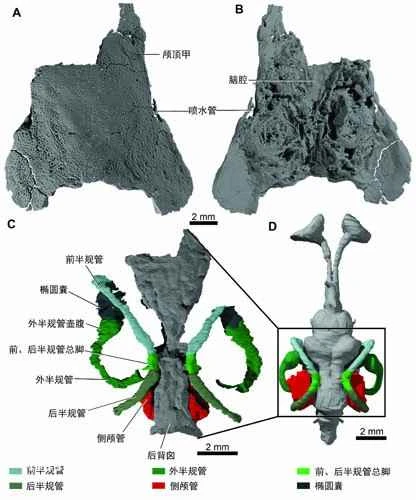
Figure 1. CT reconstruction model of the brain and skull structure of *Mimipiscs*. A, Top of the skull of *Mimipiscs* (dorsal view); B, Internal skull of *Mimipiscs* (ventral view); C, Dorsal view of the brain cavity of *Mimipiscs*; D, Dorsal view of the brain cavity of the Late Devonian ray-finned fish *Mimipiscs* (Image provided by Lu Jing).
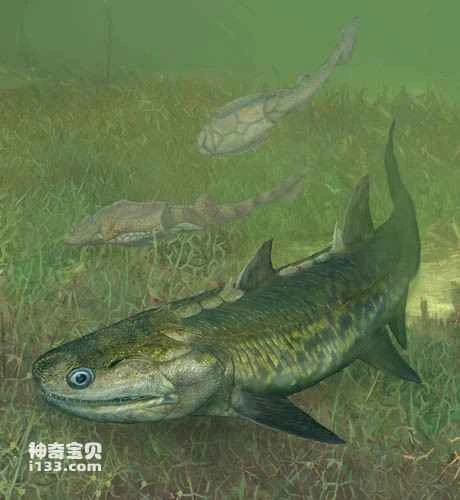
Figure 2. Ecological reconstruction of the morning mimanichthys (drawn by Brian Choo of Flinders University, Australia).
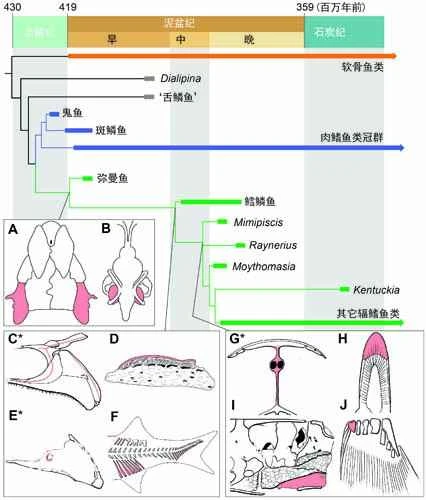
Figure 3. Branch system diagram of the Morning Dawn Mimanichthys. Green indicates ray-finned fishes, and blue indicates lobe-finned fishes (Image provided by Lu Jing).