The May 24, 2016 issue of *Scientific Reports* reported a new genus and species of mammal, *Anebodon luoi*, discovered in the Early Cretaceous Jehol Biota, a collaborative study by a research team from the Institute of Vertebrate Paleontology and Paleoanthropology, Chinese Academy of Sciences, and Linyi University. The fossil is a basal species of pistodonts, with fewer molars than previously discovered pistodonts such as *Zhanghethornis* and *Maothornis*, but the same number as in extant mammals. This indicates that the dental formula of extant mammals had already formed in the Early Cretaceous, providing crucial evidence for studying the evolutionary relationships and dental homology of modern mammals.
The new specimen, discovered in the Early Cretaceous Yixian Formation of Lujiatun, Liaoning Province, dating back 125 million years, is a three-dimensionally preserved skull fossil with a mandible. Previously discovered fossils of *Zhanghe* and *Mao* in western Liaoning were flattened, plate-like fossils lacking crucial skull features. *Luo's Late-Emeraldosaurodon* provides the first description of the skull morphology of a *Psittacodon*. *Psittacodon* basal species are considered ancestral types of the Mesozoic mammal groups *Triconodon*, *Multituberculates*, and extant mammals. The new skull features are significant for studying the phylogenetic relationships and trait polarities between Mesozoic mammals and extant mammals.
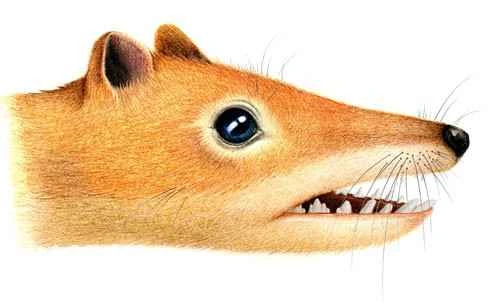
Reconstruction of the skull of the Late-Emerging Toothbeast Luo (illustrated by Shi Aijuan)