On June 3, 2016, the journal *Science Advances* published online the latest research findings of Lu Jing and other researchers from the Zhu Min research group at the Institute of Vertebrate Paleontology and Paleoanthropology, Chinese Academy of Sciences. Using high-precision CT scanning technology, they conducted a detailed study of the fine brain cavity structure of the predatory fish *Qingmenodon*, dating back 410 million years. This revealed that *Qingmenodon* possessed mosaic characteristics of both the stem and crown groups of lobe-finned fish, beginning to unravel the mysteries of the early evolutionary stages of lobe-finned fishes.
Bony fishes form the backbone of vertebrate evolution, branching into two major lineages: lobe-finned fishes and ray-finned fishes, which vied for dominance in Earth's waters. Today, only lungfish and coelacanths remain as lobe-finned fishes, barely surviving in the shadow of the flourishing diversity of ray-finned fishes. However, during the "Age of Fishes" of the Silurian-Devonian period, lobe-finned fishes held overwhelming dominance. They diversified in many directions into various forms and, around 380 million years ago in the Late Devonian, ventured onto land, evolving into tetrapods, including humans.
Lobe-finned fishes experienced explosive growth during the Early Devonian period, approximately 400 million years ago. This era divides the evolutionary history of lobe-finned fishes into two distinct phases. Prior to this, lobe-finned fish were classified as the stem group, represented by species like the *Gyrodactylus* and *Pteranodon*, exhibiting very primitive morphology and lacking even typical lobe-fins; their fins were not significantly different from those of ray-finned fishes. Following this, larger groups of lobe-finned fish, such as lungfish, coelacanths, and tetrapods (the direct ancestors of terrestrial vertebrates), evolved, and they are generally referred to collectively as the crown group of lobe-finned fishes or modern lobe-finned fishes.
During the great development of modern lobe-finned fishes in the Early Devonian period, a group emerged that, although it could not compare with the other major groups in terms of survival time, abundance, or even fame, evolved into the most ferocious predators of that era: Onychodonts.
This is a group of mysterious fish whose entire evolutionary history is confined to the Devonian period, spanning 60 million years. Currently, only six genera of clawed fish are known, and their fossils are mostly fragmented. In most cases, only long, curved, and menacing teeth scattered in rock strata, resembling the claws of raptors, mark the existence of these predators. It wasn't until the latter half of the 20th century, with the discovery of relatively complete clawed fish fossils in Australia, that we gained a comprehensive understanding of this type of fish.
Fossils show that clawed fish possessed strong shoulders and expandable skulls, facilitating the subjugation and swallowing of large animals. Their signature massive fangs, arranged in two whorls at the front of the lower jaw, known as "tooth whorls," retracted into deep, sheath-like depressions at the top of the mouth when closed. These terrifying teeth could pierce the prey's body like a harpoon, leaving no escape. Inside a clawed fish approximately 60cm long, the remains of a 30cm-long placoderm were discovered. All evidence points to a ferocious, efficient, and aquatic "killer" adapted to ambush and prey on large prey.
Besides their formidable predatory structure, researchers have other compelling reasons to remain highly attentive to these mysterious "killers." Clawed fishes exhibit a mixture of characteristics from the lobe-finned fish group, typical features of modern lobe-finned fishes, and unique evolutionary traits. Unraveling this tangled web of features is crucial for determining the taxonomic position of clawed fishes and tracing the early evolutionary history of modern lobe-finned fishes.
Normally, the complex and intricate structure of a fish's brain and skull provides the most abundant morphological information, helping to unravel this tangled mess. However, although the clawed fish discovered in Australia is quite complete, the important brain and skull portion was not preserved. Due to the lack of this information, research on clawed fish has been hampered by a lack of available information.
Fossil discoveries in Yunnan, my country, have provided a new opportunity to solve the above problems. The eastern Yunnan region during the Early Devonian period is the "cradle" of the evolution of lobe-finned fishes and even the entire bony fish population. Here, the earliest known representatives of almost all major groups of primitive bony fishes have been discovered, including the oldest known clawed fish, Qingmenodus yui.
So far, only the skull of the *Qingmenodon* has been discovered. When it was alive 410 million years ago, it was approximately 15 cm in length. Its distinctive clawed-tooth features, such as whorls, indicate that although small in size, it was a ferocious predator. Even more excitingly, it preserves a complete set of important brain and cranial morphological information missing from clawed-tooth fossils in Australia, including the brain cavity, inner ear, nerves, and vascular pathways. This provides crucial evidence for studying the early evolutionary history of clawed-tooth fishes and even the entire lobe-finned fish species.
High-precision CT scans and digital 3D reconstruction techniques have made it possible to study the brain and skull structure of the *Clawed C ...
An even more surprising result was that the inner ear and brain cavity structure of the *Clawfish* bore many similarities to those of the coelacanths. This new evidence suggests a close kinship between *Clawfish* and *Coelacanths*. It could be said that shortly after the emergence of *Coelacanths*, a branch diverged, evolving towards a more predatory lifestyle, thus becoming *Clawfish*.
The study also showed that the brain and skull structure of the Qingmen toothfish retained many primitive features, especially some features that were previously thought to be unique to clawed toothfish, which are actually ancient features of primitive lobe-finned fish. This makes clawed toothfish a key link between the stem group and the crown group of lobe-finned fish, and more clearly shows how modern lobe-finned fish, the fish-like ancestors that once dominated the waters of the earth during the "Age of Fish", evolved.
This research was supported by the National Natural Science Foundation of China and the Ministry of Science and Technology's 973 Program.
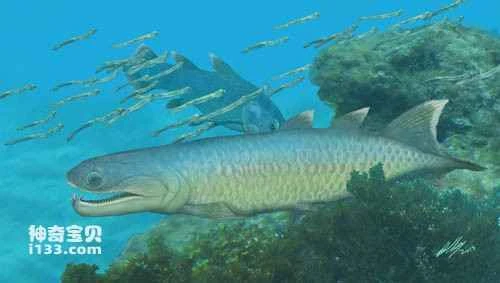
Figure 1. Ecological reconstruction of the Qingmen toothfish (drawn by Brian Choo).
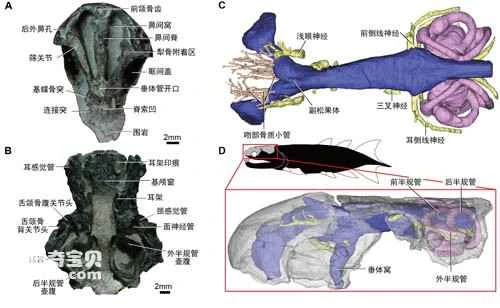
Figure 2. Photographs and reconstruction of the brain cavity of the Qing incisorfish. A, ventral surface of the brain cavity in the ethmoidal region; B, ventral surface of the brain cavity in the auricular-occipital region; C, reconstruction of the ventral surface of the brain cavity; D, reconstruction of the left side of the brain cavity, with the translucent shell indicating the brain cavity. II-X indicate the 2nd to 10th cranial nerve canals (provided by Lu Jing).
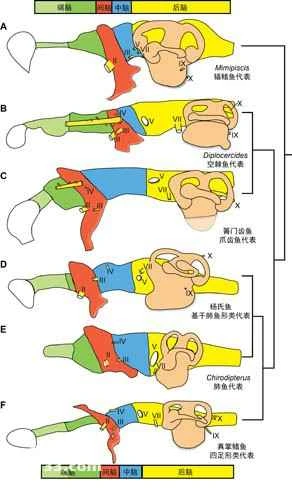
Figure 3. Schematic diagram comparing the brain cavities of major groups of Devonian bony fishes (Image provided by Lu Jing)