Modern argali sheep (Ovis) are widely distributed across a range of mountainous regions, including the Caucasus, Himalayas, Tibetan Plateau, Tian Shan-Altai Mountains, East Siberia, and the Rocky Mountains of North America. In Eurasia, only a few dental specimens of argali sheep have been found at several Pleistocene sites in North China, East Siberia, and Western Europe, with no prior records from the Tibetan Plateau.
In a recent issue of the international journal *Journal of Vertebrate Paleontology*, a joint team led by Wang Xiaoming from the Institute of Vertebrate Paleontology and Paleoanthropology of the Chinese Academy of Sciences and the Natural History Museum of Los Angeles County reported the discovery of a new genus and species of fossil sheep, *Protovis himalayensis*, in the Zanda Basin of Tibet. This discovery not only extends the fossil record of sheep to the Pliocene of the Tibetan Plateau but also suggests that the Tibetan Plateau, possibly including the Tian Shan-Altai Mountains, represents the ancestral habitat of argali sheep. This basal group is the most recent common ancestor of all extant argali sheep species, and is consistent with the team's previous theory of Ice Age animal origins "leaving Tibet".
The new fossil material was collected during field expeditions in 2006 and 2007 from the Guandeng site (Field Site ZD0712 of the Institute of Vertebrate Paleontology and Paleoanthropology) in Zanda County, Tibet Autonomous Region, in the western Himalayas. The holotype specimen (IVPP V18928) is a pair of almost complete male left and right horn centers, which form the main basis for establishing this new genus and species. The outer arc of the horn center is 443 mm in total length, similar to the size of some extant species of argali sheep.
This newly discovered extinct sheep species has a combination of characteristics that differ from other genera and species such as the argali, blue sheep (Pseudois), and Tossunnoria. It was smaller than the extant Asian argali, but like the argali, it had posteriorly curved horns and partially developed frontal sinuses, as well as some transitional traits tending towards those of the argali.
The Zanda Basin, nestled between the Himalayas and the Ayirajü Mountains, was formed in a tectonically active region. Throughout its development, the residual basement rock layers and surrounding mountains along the shores of the ancient Zanda Lake provided a rich tapestry of rugged terrain and gentle hills. The fossil site of the aurochs (Gastropoda) is not far from an ancient island formed by metamorphic rock basement; these cliffs may have provided protection for the aurochs when threatened by predators.
Carbon isotope analysis of fossils of herbivorous mammals in the Zanda Basin indicates that C3 plants dominated the vegetation during the Pliocene. This fact suggests that, like modern bovines on the Tibetan Plateau, the Amur goat also fed on C3 plants.
The ancestors of the argali sheep on the Tibetan Plateau shared the same distribution range as modern argali sheep. During the Pliocene, they had adapted to the cold, high-altitude environment, while other regions, including the high-latitude Arctic Circle, experienced warmer climates. This ancestral group rapidly evolved to resemble modern argali sheep, gaining a competitive advantage in the frozen environment during the Quaternary Ice Age approximately 2.6 million years ago, and thus quickly spread to the areas surrounding the Tibetan Plateau and beyond. Most argali sheep species survived along their Pleistocene dispersal routes, resulting in a highly consistent zoogeographical pattern.
“This discovery of primitive sheep in the Himalayas provides another example for our previously proposed ‘out of Tibet’ hypothesis: the ancestors of the argali sheep adapted to the cold environment of high altitudes during the Pliocene and began to spread outward from their original habitat on the Qinghai-Tibet Plateau to North China, northern Siberia and western Asia during the Pleistocene,” said researcher Wang Xiaoming. “The argali sheep thus joined several other mammals, such as big cats, Arctic foxes, carnivorous dholes and woolly rhinoceroses, spreading beyond the Qinghai-Tibet Plateau during the Ice Age and becoming members of the Pleistocene glacial fauna.”
“New fossil material and existing molecular biological lineages both prove that the Tibetan Plateau, and possibly the Tianshan-Altai Mountains, represent the origin region of the argali sheep,” said Dr. Li Qiang, a co-author of the article. “Fortunately, the argali sheep were protected by the mountainous environment, which may be an important factor in their ability to escape being hunted by early humans and survive the extinction event at the end of the Pleistocene, while many of their Ice Age companions did not survive.”
This research was supported by the Strategic Priority Research Program of the Chinese Academy of Sciences, the 973 Program, and the National Natural Science Foundation of China.

Figure 1. Homotype of the Himalayan goat, showing the front-lateral view (A), rear view (B), and four cross-sections of the left horn center (Photo provided by Wang Xiaoming).
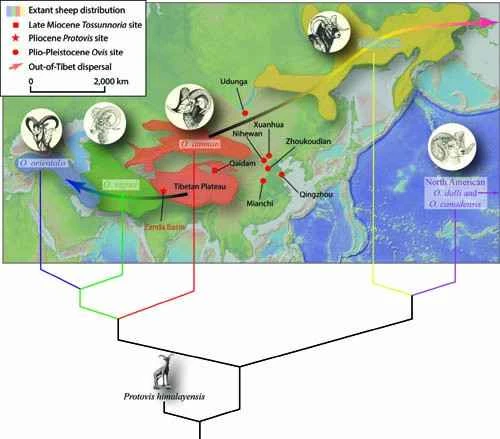
Figure 2. Distribution areas of extinct and extant species of the genus *Arganus* in Eurasia and their phylogenetic relationship with the Himalayan argali sheep (Image provided by Wang Xiaoming).
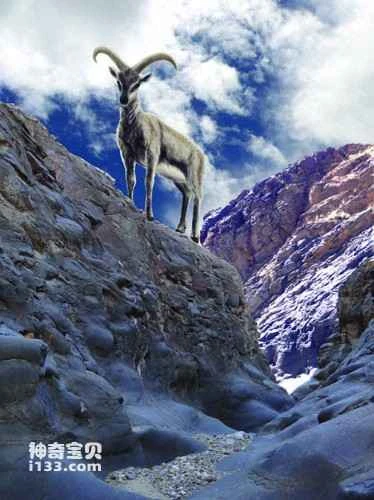
Figure 3. Reconstruction of a male Himalayan goat (drawn by Julie Selan), with the background being the widely exposed basement rock strata of the modern Zanda Basin (photograph by Wang Xiaoming).