Associate Researcher Wang Yuan from the Institute of Vertebrate Paleontology and Paleoanthropology, Chinese Academy of Sciences, in collaboration with doctoral student Zhang Hanwen from the University of Bristol and Professor Mark Purnell's research team from the University of Leicester, UK, used the dental microwear texture analysis (DMTA) technique developed in recent years to conduct a comprehensive analysis and preliminary exploration of the diet of fossil proboscis from different Pleistocene periods in South China. The research results, with Associate Researcher Wang Yuan as the corresponding author, were recently published online in the international SCI journal Quaternary International.
Elephant fossils, due to their rapid evolutionary rate, wide spatial and temporal distribution, and rich environmental indicators, have become important indicator fossils for reconstructing the paleoecological environment of Late Cenozoic terrestrial ecosystems. Since 2004, a research team led by Professor Jin Changzhu of the Institute of Vertebrate Paleontology and Paleoanthropology, Chinese Academy of Sciences, has successively discovered more than ten mammalian assemblages representing different periods of the Pleistocene with good inheritance and continuity in Quaternary cave and fissure deposits in Chongzuo, Guangxi and surrounding areas. Systematic studies of elephant fossils in these mammalian assemblages show that the evolution and replacement of proboscis in southern my country during the Quaternary period were regular: the Early Pleistocene was characterized by the combination of *Sinosaurus* and *Stegodon*; by the end of the Early Pleistocene, *Sinosaurus* and *Stegodon* may have become extinct in South China and were replaced by *Stegodon*; the genus *Asian elephant* began to flourish in the Late Middle Pleistocene, playing a dominant role in the fauna along with *Stegodon*. The evolution and replacement of the proboscis species mentioned above has driven the further division of the Quaternary biostratigraphic sequence in South China: the Gigantopithecus-Sinoma mammoth fauna of the Early Pleistocene, the Giant Panda-Stegodon fauna of the Middle Pleistocene (in a narrow sense), and the Asian elephant fauna of the Late Pleistocene.
Using the DMTA method to explore the diets of ancient mammals and humans has become a popular research direction in paleontology in recent years. Compared with traditional methods that use ordinary optical microscopes or scanning electron microscopes to study micro-traces in animal tooth fossils, DMTA has significant advantages in terms of the rigor and reproducibility of the data collection process. By comparing the complexity and anisotropy of molar micro-traces from the Chinese mastodons, saber-toothed elephants, and Asian elephants, researchers found that the Chinese mastodons of the Early Pleistocene in South China and the saber-toothed elephants spanning the entire Pleistocene mainly preferred tender leaves, which is a significant statistical difference from the Asian elephants, which have a broader diet, eating both grass and leaves.
The Chinese mastodon and the saber-toothed elephant coexisted in East Asia during the Pliocene and Early Pleistocene. However, over the long course of evolution, the Chinese mastodon retained its primitive ridged molars, while the saber-toothed elephant evolved ridged teeth more effectively for chewing plants. Around one million years ago, in the late Early Pleistocene, a significant biological event occurred in the Chongzuo region, primarily characterized by the disappearance of tropical rainforests and the extinction of Tertiary relict mammals (including the Chinese mastodon). As a fellow browser, the saber-toothed elephant, with its teeth better suited for chewing plants, squeezed out the Chinese mastodon in the survival competition under these environmental changes, leading to the latter's extinction in China. Conversely, the dietary differences between the saber-toothed elephant and the Asian elephant created a situation of ecological resource allocation, allowing them to coexist from the late Middle Pleistocene until the very end of the Pleistocene. The saber-toothed elephant went extinct at the end of the Pleistocene along with many other large mammal species globally, while the Asian elephant still inhabits areas such as Xishuangbanna in Yunnan, my country, today.
This research was supported by the National Natural Science Foundation of China, the Open Project of the State Key Laboratory of Modern Paleontology and Stratigraphy of the Chinese Academy of Sciences, and the Natural Environment Research Council (NERC) of the United Kingdom.
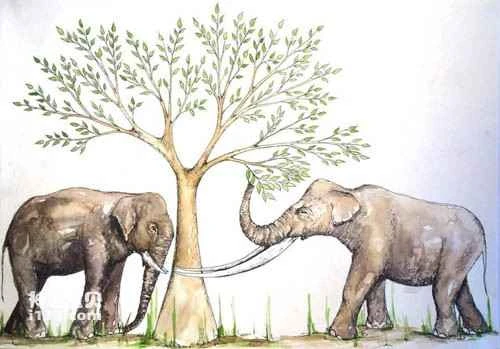
Figure 1. Ecological reconstruction of elephants in South China during the Late Pleistocene. The Asian elephant (left) had a predominantly herbivorous diet, while the saber-toothed elephant (right) mainly ate tender leaves (illustrated by Nicola Heath).
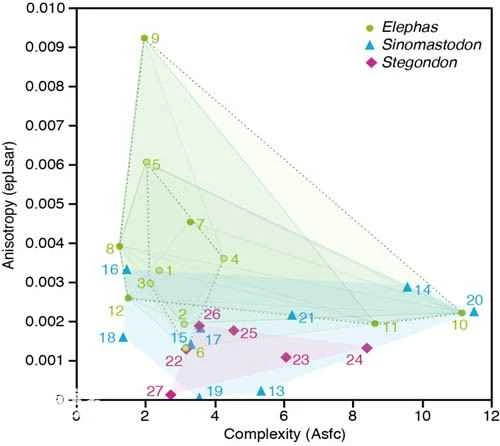
Figure 2. Complexity and anisotropy distribution of enamel micro-traces in molars of Quaternary long-nosed dinosaurs from South China (provided by Wang Yuanhe and Zhang Hanwen)